



Distribution in Logistics
Table of contents
- What is distribution? (Definition and Core Process)
- The role of warehouse logistics in the distribution chain
- How Contract Logistics Professionalizes Distribution
- The logistics property: The foundation of distribution
- Requirements for the "hall" from the point of view of contract logistics
- Key figures: How is the success of the distribution measured?
- The Future of Distribution: Automation and Urbanization
What is distribution? (Definition and Core Process)
What exactly do subject matter experts mean by distribution? In business administration and logistics, distribution (or distribution logistics) refers to the totality of all processes that are necessary to bring goods or services from the manufacturer (end of production) to the end customer or customer.
It is a common misconception to reduce distribution to pure transport. Rather, it encompasses a complex chain of activities, including:
- Order processing: Acceptance, verification and systemic recording of customer orders.
- Warehousing: Strategic stockpiling, buffering, and management of inventory.
- Picking & packing: Compilation of partial quantities (picks) and their preparation ready for dispatch.
- Transport (physical distribution): The choice of mode of transport (road, rail, air, sea) and the execution of transport.
- Information flow: The control and monitoring of these processes by means of IT systems (e.g. WMS, TMS).
The core goal of distribution is to maximize the level of delivery service (availability) while minimizing distribution costs, often summarized in the "6 Rs of logistics" (right goods, quantity, place, time, quality, costs).
What are the strategic levels of distribution? The distribution is planned on three levels:
- Strategic distribution: Long-term decisions (3-5+ years). This includes the choice of location of distribution centers (e.g. proximity to customer markets or production sites) and the definition of the distribution channel (direct vs. indirect).
- Tactical distribution: Medium-term planning (1-3 years), e.g. the dimensioning of the vehicle fleet, the choice of logistics service providers or the definition of warehouse strategies.
- Operational distribution: Daily control, such as route planning, picking control or loading management.
The role of warehouse logistics in the distribution chain
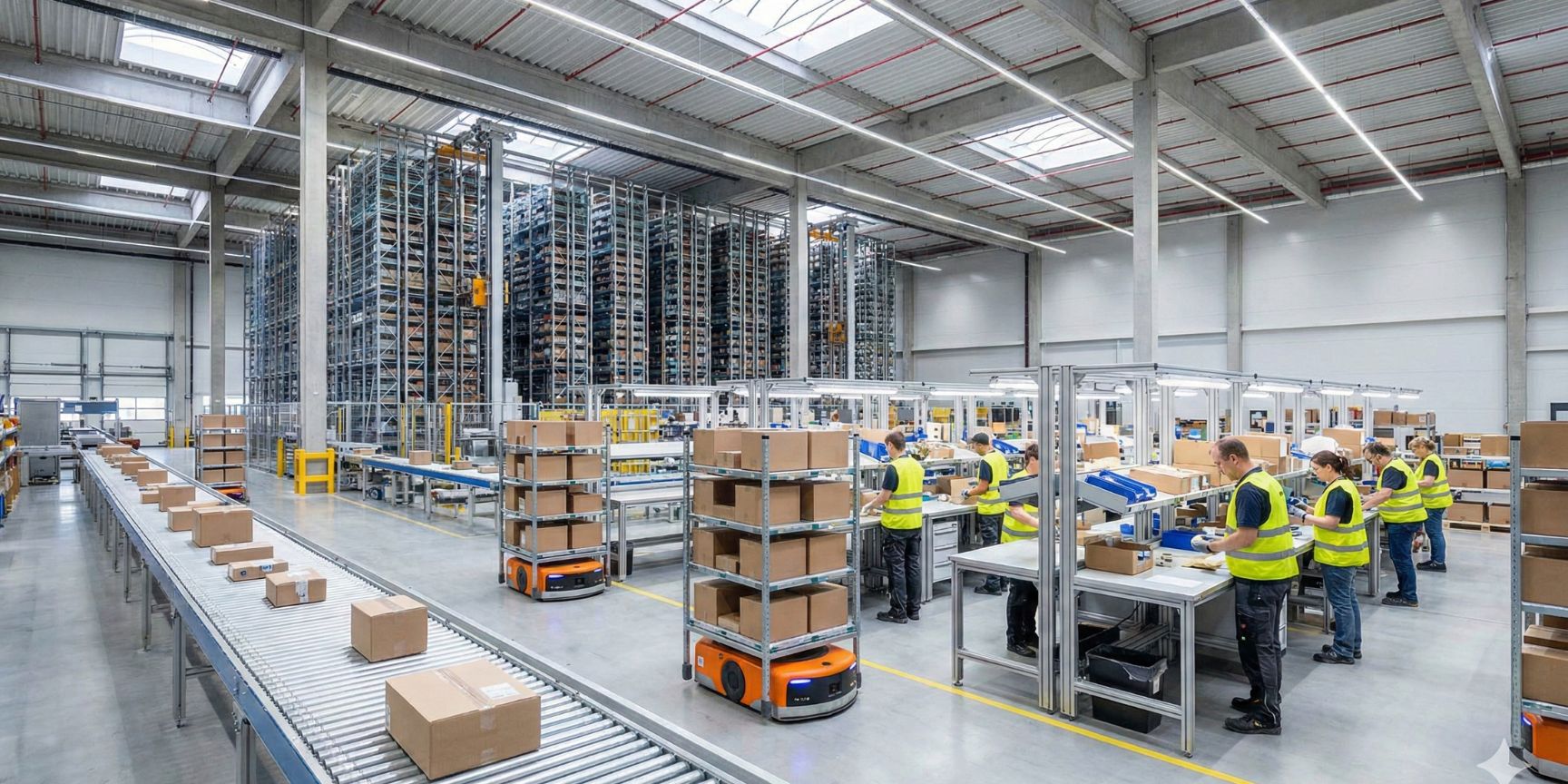
Why is warehouse logistics more than just "shelf storage" for distribution? The warehouse is the central physical hub in almost every distribution chain. Modern warehouse logistics (intralogistics) is highly dynamic and no longer serves as a buffer for inventories. In e-commerce, the warehouse (often referred to as a "fulfillment center") is the place that determines the speed and quality of delivery.
Which core warehouse logistics processes are crucial for distribution?
- Goods receipt: Not only unloading, but also qualitative and quantitative inspection, identification (labeling/scanning) and booking into the warehouse management system (WMS/WMS).
- Storage: The choice of the right storage technology (e.g. high rack, block warehouse, automatic small parts warehouse/AS/RS) and storage strategy (e.g. chaotic storage vs. fixed location) is crucial for space efficiency and access speed.
- Picking: The most expensive process in warehouse logistics. The type (e.g. pick-by-voice, pick-by-light, pick-by-scan) determines the speed and error rate of the distribution.
- Consolidation & Packaging: Bringing together picks from different storage zones, choosing the optimal packaging (cost and volume efficiency) and attaching documents (delivery note, return label).
- Outgoing goods: Provision for transport, loading security and systematic derecognition of the goods.
How Contract Logistics Professionalizes Distribution
What distinguishes contract logistics from a normal freight forwarder? While a freight forwarder often provides standardized transport or storage services (so-called "commodities") on demand, contract logistics (often provided by 3PL - Third-Party Logistics Provider) goes a decisive step further.
Contract logistics is the long-term, contractually fixed assumption of complex, often integrated logistics and additional services by a specialized service provider. These contracts typically run for 3-5 years and are based on a high degree of individualization and system integration (IT coupling) between the customer (shipper) and the service provider.
What added value (value-added services) does contract logistics offer in distribution? The 3PL not only handles A-to-B transports, but is also deeply integrated into the customer's value chain. Examples of such value-added services (VAS) in a distribution center are:
- Production-related services: Simple assembly (e.g. enclosing power supplies), set formation (bundling), quality controls.
- Retail-related services: labelling (pricing), display construction for the point-of-sale, packaging.
- Returns management: A critical factor in e-commerce. The 3PL checks, cleans, repairs and stores returns ("reverse logistics").
- Customs clearance: Essential for global distribution.
For the customer (e.g. an online retailer or producer), this means focusing on the core business, while 3PL controls distribution processes more efficiently through know-how, economies of scale and IT systems.
The logistics property: The foundation of distribution
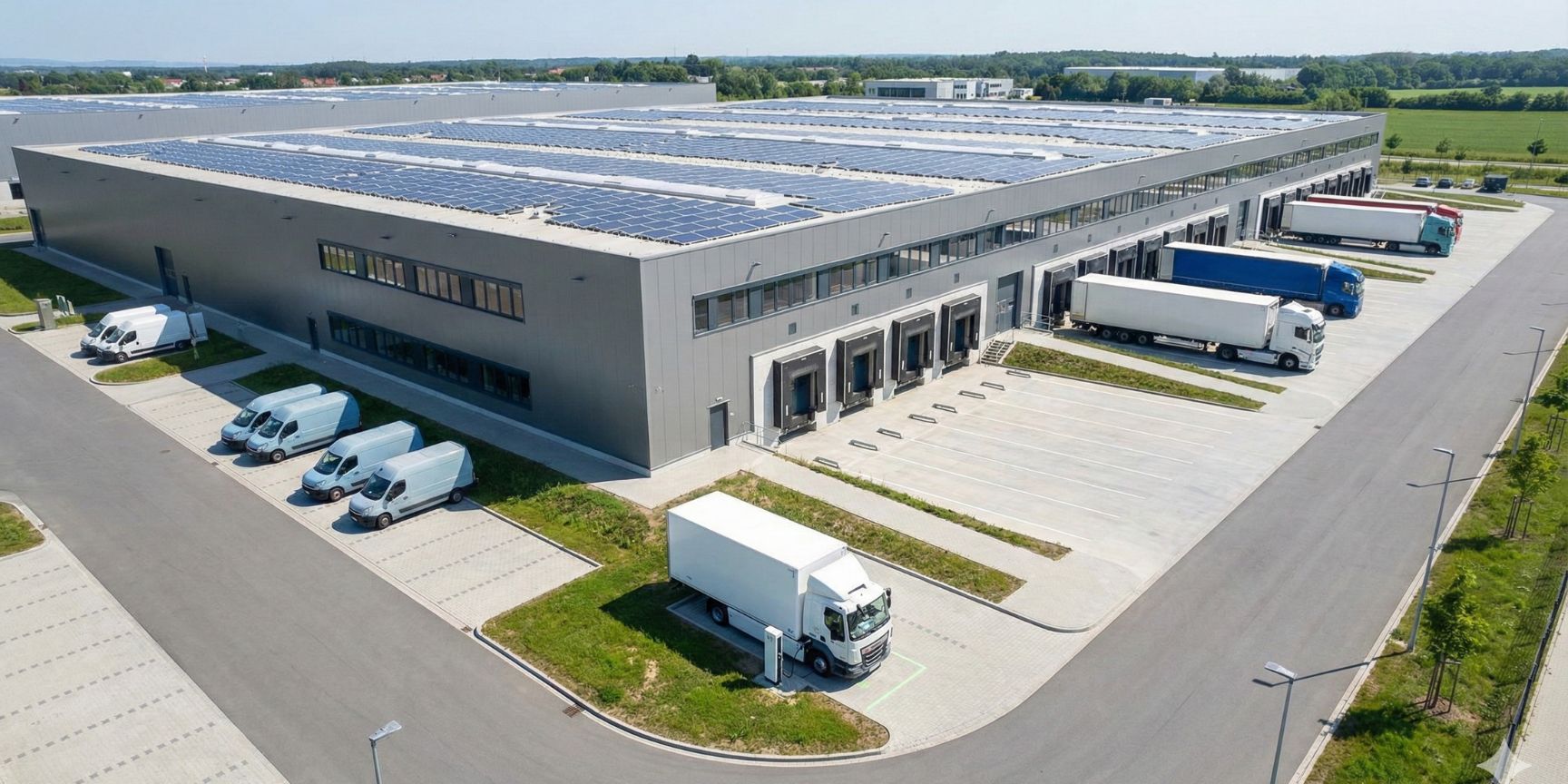
Isn't every large hall automatically a logistics property? No. A logistics property is a highly specialised commercial property that is precisely tailored to the requirements of modern distribution and warehousing processes. It is the "hardware" in which the "software" (warehouse and contract logistics) runs. The market for logistics real estate has grown strongly in recent years due to the e-commerce boom and the reorganization of supply chains (nearshoring).
What are the "hard facts" of a modern distribution property? Investors, developers, and users (such as 3PLs) pay attention to specific metrics that make a property "logistics-ready":
- Location (macro location): Direct connection to motorways (motorway hub), ideally proximity to intermodal terminals (combined transport) or cargo airports (e.g. Leipzig, Frankfurt).
- Property (micro-location): Sufficient space for truck manoeuvring and waiting areas (yard management) as well as car parking spaces (often a bottleneck).
- Hall height: Decisive for the storage volume. Modern standard is at least 10 meters, often 12 meters UKB (lower edge truss).
- Floor load capacity: At least 5 tons per square meter (t/sqm) to allow for heavy racking or block storage.
- Gates: Sufficient number of gates (ramp gates with dock levellers). The guideline is often 1 door per 800–1,000 sqm of hall space.
- Sustainability: ESG criteria are crucial today. These include DGNB or BREEAM certifications, rooftop PV systems, heat pumps and e-charging infrastructure.
Requirements for the "hall" from the point of view of contract logistics
Why does a contract logistics company need different halls than an owner-occupier? A producer (owner-occupier) often builds a "tailor-made" hall that is precisely tailored to his products (e.g. a hazardous goods warehouse). A contract logistics service provider (3PL), on the other hand, often operates its distribution centers as multi-user centers.
In a multi-user hall, the 3PL serves several customers (clients) in parallel. One customer may need 5,000 square meters for automotive parts, another 8,000 square meters for e-commerce returns.
What does "third-party usability" mean for a logistics hall? For the 3PL (and its investor), the third-party usability (flexibility) of the property is the most valuable asset. The hall must be designed in such a way that it can be easily re-let to a new customer (also from another industry) after the expiry of a 3-year contract.
Features for high third-party usability:
- Divisible: The hall must be divisible into smaller, self-sufficient units (e.g. from 5,000 sqm) (fire protection sections, separate gates and offices).
- Mezzanine areas: Retracted mezzanine floors (often made of steel) are essential for contract logistics, as this is where the personnel-intensive value-added services (VAS) take place (picking, packing).
- Flexible use: The hall must be suitable for high-bay storage as well as block storage or automation.
Key figures: How is the success of the distribution measured?
What KPIs (Key Performance Indicators) are used to control the distribution? Success in distribution is measurable. The most important metrics vary depending on the focus (cost vs. service), but are often closely linked:
- Warehouse logistics KPIs:
- Pick accuracy (error rate): Measures the quality of picking. Target: > 99.9%.
- Inventory turnover frequency: How often is the average inventory sold/replaced in its entirety per year? A high frequency ties up less capital.
- Cost per pick / Cost per order: Shows efficiency in operational handling.
- Transport KPIs:
- On-Time-Delivery (OTD): Proportion of shipments that arrive in the agreed time window.
- Transport costs per km / per shipment: The "hard" freight costs.
- Overall KPI (service level):
- Ability to deliver (fill rate): What percentage of an order could be delivered immediately (on-time, in-full - OTIF)? This is often the most important KPI from the customer's point of view.
The Future of Distribution: Automation and Urbanization
What challenges is distribution currently facing? The industry is experiencing a "perfect storm" of several megatrends:
- E-commerce growth: Leads to smaller shipment sizes (B2C instead of B2B pallets), higher return rate and the desire for same-day delivery.
- Shortage of skilled workers and drivers: Personnel-intensive processes (order picking, transport) are a bottleneck.
- Sustainability pressure (ESG): Customers, investors and legislators are demanding CO2-neutral supply chains and reduced traffic congestion (city logistics).
Which technologies will shape the distribution centers of the future? The answer to these challenges lies in technology:
- Automation (intralogistics): The use of robotics (e.g. autonomous mobile robots - AMRs) for picking and transport within the hall is increasing rapidly.
- Digitalization: AI (artificial intelligence) optimizes route planning and inventory forecasting. The "digital twin" of the supply chain enables simulations and real-time tracking.
- Urbanization (last mile): Distribution is moving closer to cities. Smaller micro-hubs and city depots are being created to serve the "last mile" efficiently (e.g. with cargo bikes or e-vans). The classic "big box" logistics property on a greenfield site is complemented by a network of smaller, urban locations.