




Dual-use logistics real estate in warehouse logistics
Table of Contents
- Dual-use logistics real estate: The chameleon of the logistics asset class
- Definition and demarcation: What makes a property "dual-use"?
- Technical Specifications: The DNA of Flexibility
- Focus on warehouse logistics: efficiency on the shop floor
- Contract logistics: Added value through value-added services (VAS)
- Location factors: urbanity vs. long-distance transport
- Profitability and ESG: Why investors love dual-use
- FAQ: Frequently asked questions about dual-use logistics real estate
- Facts and Figures (ZDF)
- Conclusion for practice
Dual-use Logistics Real Estate: The Chameleon of the Logistics Asset Class
The logistics real estate industry has become massively specialised in recent years. But while high-bay warehouses are often monolithic, purpose-built giants, the trend towards dual-use logistics real estate is focusing on the exact opposite: maximum versatility. But what is technically and economically behind this term, and why is third-party usability the measure of all things here?
Definition and Demarcation: What makes a Property "Dual-use"?
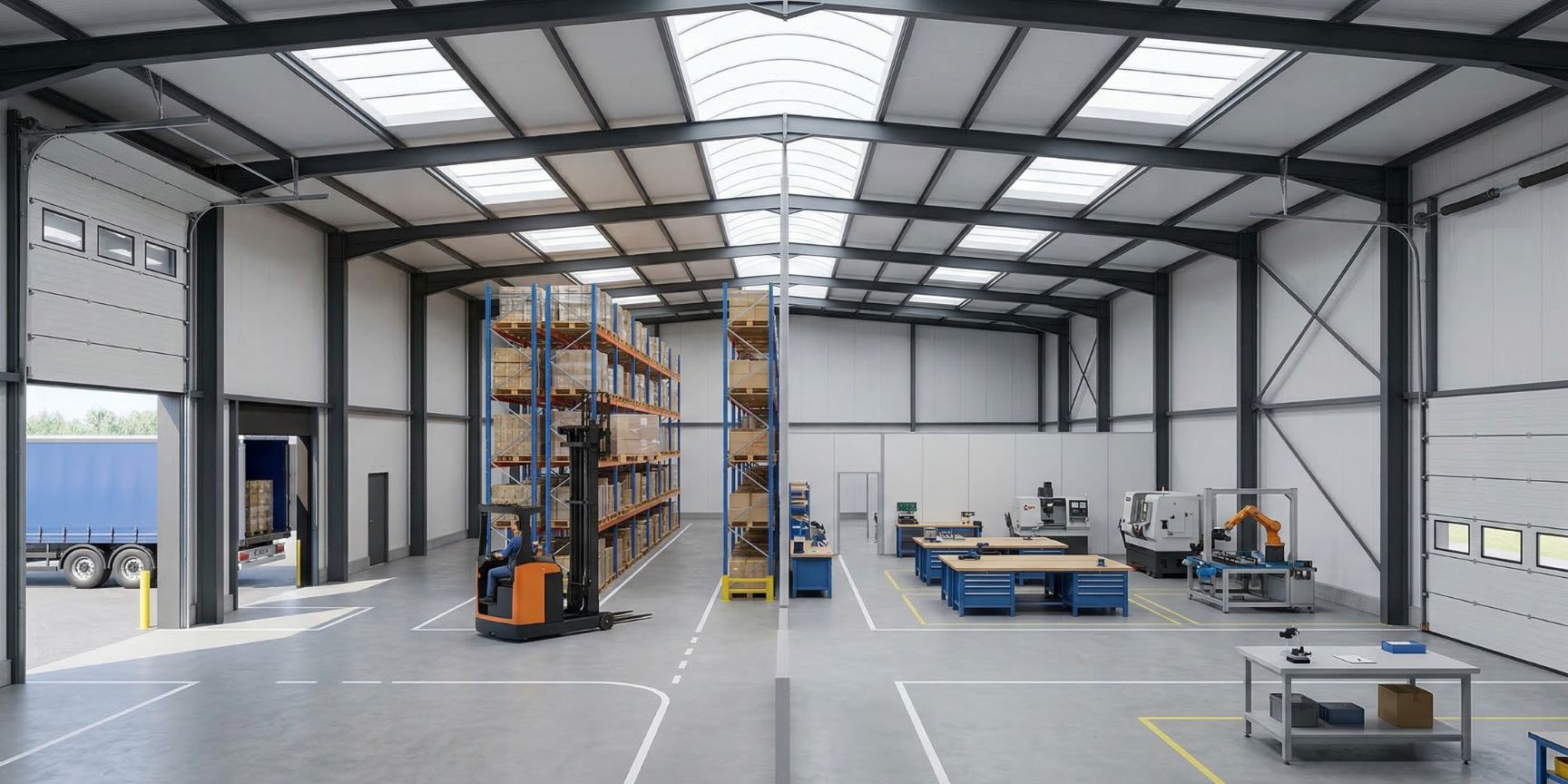
In essence, dual-use refers to a property that is structurally and legally designed in such a way that it is equally attractive to at least two different user groups. In most cases, it is a combination of classic warehouse logistics and light industrial (light production, assembly, repair).
In contrast to a pure "big box" (large-scale distribution centre), the dual-use hall is characterised by greater flexibility in terms of space distribution and higher-quality technical equipment. This enables companies to store goods as well as carry out value-added services directly on site.
Technical Specifications: The DNA of Flexibility
In order for a hall to be considered dual-use, certain structural parameters must be met that go beyond the standard of a pure barn:
- Floor load capacity: While 5 tons per square meter is standard, dual-use objects often target 6.0 to 7.5 tons/m² to support heavy machinery or dense shelving systems.
- Hall height: A clear height of 10 to 12 meters is ideal. It offers enough volume for high racks, but at the same time still allows efficient heating and lighting for workplaces in assembly.
- Office and social space share: In pure logistics, this is often 2–5%. Dual-use properties plan at 10-20% because production-related processes require more staff and administration.
- Delivery: A mixture of ramp feeding (for trucks) and ground-level gates (for Sprinters or material feeding into production) is essential.
Focus on Warehouse Logistics: Efficiency on the Shop Floor
In warehouse logistics, the turnover speed counts. Dual-use real estate supports this through modular space layouts. Fire walls and flexible sectional doors can be used to divide halls into units of often 2,500 to 5,000 m². This is particularly attractive for small and medium-sized enterprises (SMEs) that do not need 20,000 m² but are still looking for first-class connections.
Contract Logistics: Added Value through Value-added Services (VAS)
For contract logistics companies, the dual-use feature is a strategic competitive advantage. Since contracts with customers (shippers) often only have terms of 3 to 5 years, the property must be quickly adaptable to new requirements.
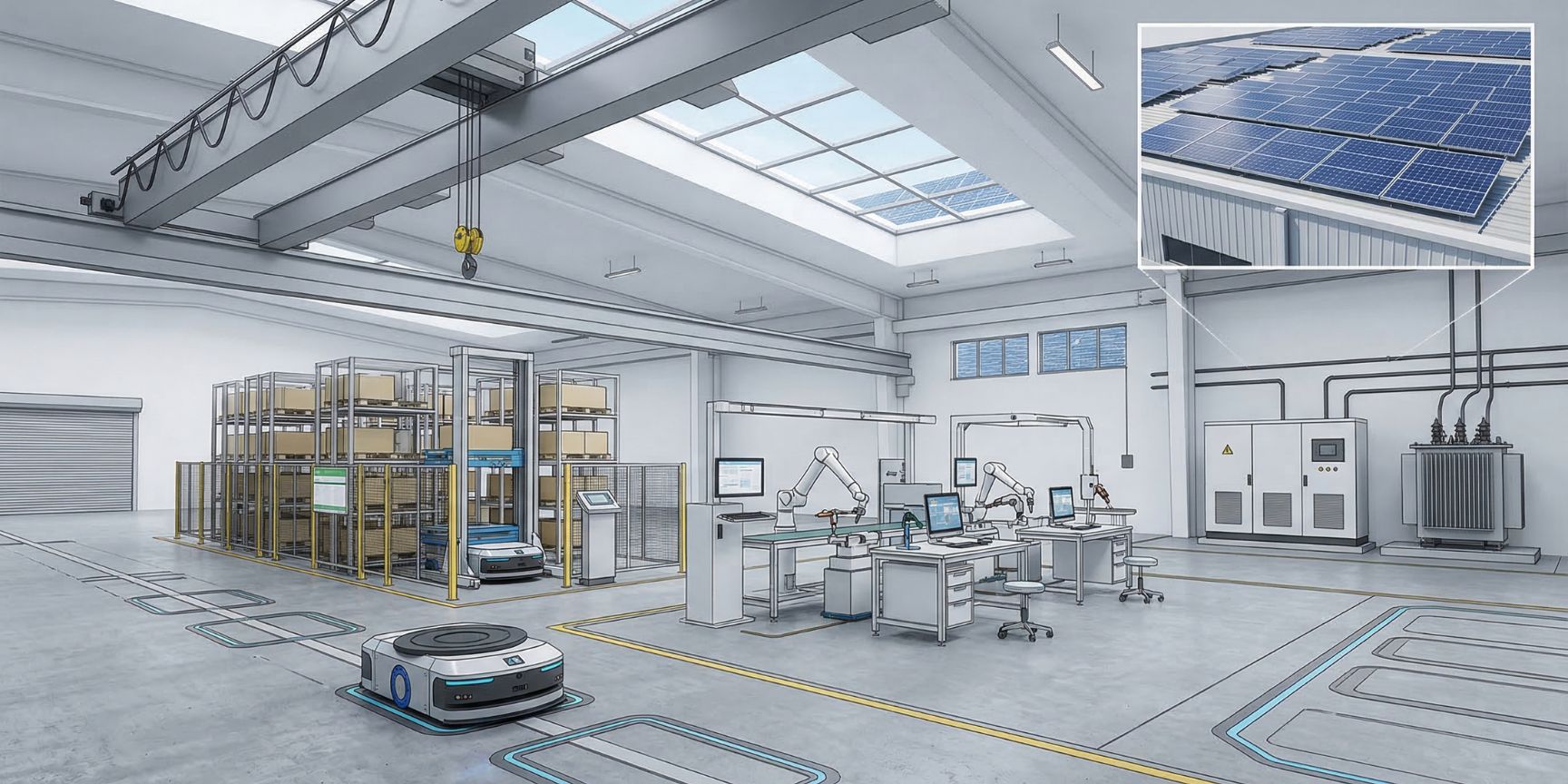
- Example: Today returns processing for fashion (a lot of personnel, small parts warehouse), tomorrow display construction or pre-assembly for the automotive industry (machine use, heavy load). The property must not become a limiting factor here. Sufficient power capacity (transformer stations for machinery) is therefore an often underestimated technical criterion.
Location Factors: Urbanity vs. Long-distance Transport
Dual-use properties are often found in peripheral locations of conurbations (suburbs). Why?
- Workforce: Since production and VAS are more labor-intensive than automated warehouses, proximity to residential areas and public transport is critical.
- Last mile: The proximity to the end customer enables use as a city logistics hub.
- Zoning: In contrast to purely residential areas, commercial areas or industrial areas allow the 24/7 operation required for dual-use.
Profitability and ESG: Why Investors Love Dual-use
From an investor's point of view, dual-use reduces the risk of vacancy. If the property is "suitable for third-party use", a successor from another industry can be found more quickly after a tenant moves out. In addition, current ESG criteria (environmental, social, governance) can be implemented more easily. Large roof areas are ideal for photovoltaic systems, whose electricity can flow directly into the (electricity-intensive) production in the building – a win-win for ancillary costs and CO2 balance.
FAQ: Frequently asked Questions about Dual-use Logistics Real Estate
Question: Is a dual-use property more expensive to rent than a standard hall?
Answer: Yes, as a rule, the prime rent for dual-use/light industrial space is approx. 15-25% higher than that of pure logistics big boxes. This is justified by the higher construction quality, better location and technical equipment.
Question: What role does approval planning (BImSchG) play?
Answer: A decisive one. Dual-use often requires a usage permit that goes beyond the mere "storage of non-flammable substances". Anyone planning production must take noise protection and emission values into account much earlier in the planning.
Question: Are dual-use halls suitable for automation?
Answer: Absolutely. Due to the high floor loads and the clear height, they are predestined for AMR (Autonomous Mobile Robots) or AutoStore systems that require a flat and heavy-duty surface.
Facts and Figures
- Average hall depth: 40 to 70 meters (optimal for flexibility).
- Power output: 100 to 200 watts/m² are often kept available for dual-use (standard logistics often only 20–50 W/m²).
- Share of the new construction market: In Germany, it is now estimated that 25–30% of take-up in the logistics sector is now accounted for by properties with a light industrial or dual-use character.
Conclusion for Practice
Anyone who invests in logistics real estate or rents space today should rely on the "two-pillar model". The dual-use property is the answer to shorter product life cycles and re-industrialization in Europe (reshoring). It offers the logistics company the necessary agility and the owner long-term value stability through maximum third-party usability.