




Dovetail delivery, sawtooth ramp arrangement in warehouse logistics
Table of contents
- Was ist ein Gewerbemakler für Logistikimmobilien?
- Die Kernaufgaben in der Logistikimmobilien-Vermittlung
- Wandel des Berufsbilds: Vom Vermittler zum strategischen Berater
- Wer nutzt die Dienste eines spezialisierten Maklers?
- Der konkrete Mehrwert: Warum ein Gewerbemakler unverzichtbar ist
- Was kostet ein Gewerbemakler? Die Maklerprovision erklärt
- Zukunftsaussichten: Digitalisierung und Nachhaltigkeit als Treiber
- Sustainability and Energy Efficiency in the Modern Warehouse
- What are the security aspects of a warehouse?
- Key Success Factors for Entrepreneurs in Choosing the Optimal Warehouse
The dovetail delivery and sawtooth ramp assembly
In the planning of logistics real estate, the interface between the warehouse and the truck – the loading area – is the most critical point for the material flow. While the classic 90-degree delivery (ISO ramp) is considered the standard, site layouts and process requirements often force planners to use alternative geometries. This is where the Sawtooth Dock and the often synonymous dovetail delivery come into play. This article sheds light on the structural, operational and financial implications of these arrangements.
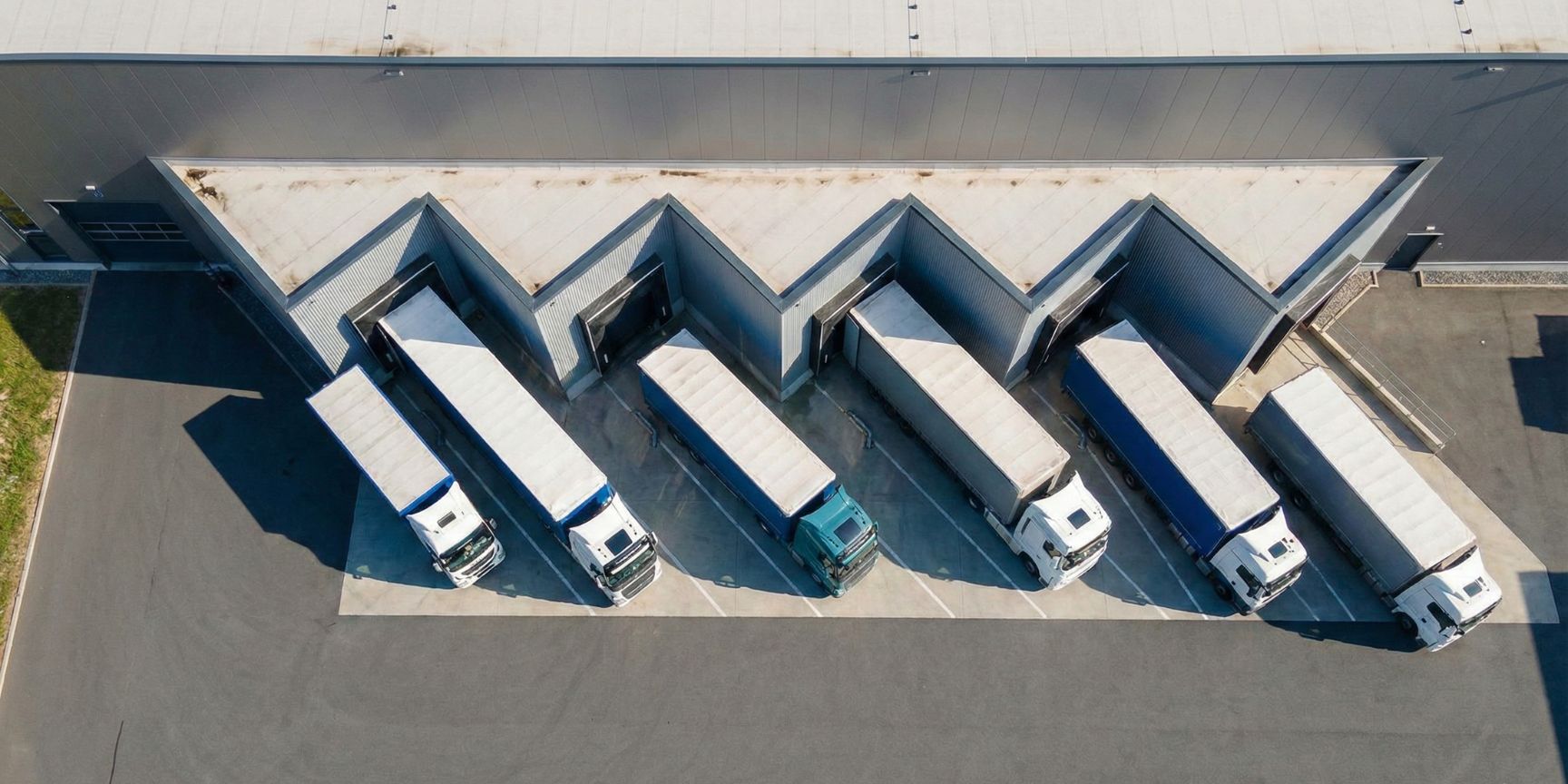
Definition and geometry: What is the sawtooth profile?
With a conventional ramp arrangement, the trucks are at a 90-degree angle to the outer wall of the hall. However, this requires a maximum apron (manoeuvring area) for parking in and out.
The sawtooth profile breaks up this linearity. The loading gates are arranged at an angle to the main façade line. The outer wall of the property zigzags – similar to the teeth of a saw or the feathers of a dovetail. Common angles for this arrangement are between 30° and 60°, with 45° being a common industry standard.
The primary driver: area efficiency and apron depth
The main reason for choosing a dovetail arrangement is almost always the lack of outdoor space. The geometry directly influences the required depth of the apron (apron).
- 90° delivery: A standard articulated truck (approx. 16.50 m) or articulated truck (approx. 18.75 m) requires a shunting depth of approx. 32 to 35 meters (including lane) to be able to dock safely in a train.
- Sawtooth delivery: The inclined position reduces the required manoeuvring distance to the opposite boundary (e.g. fence or opposite hall). At a 45° angle, the required apron depth can often be reduced to less than 20 to 25 meters.
Fact: This enables the construction of functional logistics properties on narrow plots ("towel plots") that would otherwise be unsuitable for a classic cross-docking facility.
Structural challenges and cost factors
From the point of view of logistics real estate development , the sawtooth ramp is a double-edged sword. It saves land area, but increases construction costs (capex).
- Facade surface: The zigzag guide extends the lfd. number of metres of the outer wall compared to a straight wall. This means more material expenditure for wall panels, plinths and parapets.
- Insulation and energy: A larger envelope area means potentially higher transmission heat losses. In addition, the complex geometry creates more geometric thermal bridges, which must be evaluated particularly critically when planning cold storage halls.
- Canopies and drainage: The roof construction over the sawteeth is more complex. The roof drainage must be planned more elaborately in order not to direct backwater into the depressions of the "teeth" in the event of heavy rainfall, which could endanger the gates.
Operational view: Contract logistics and turnover speed
For the contract logistics provider in daily operations, dovetail delivery offers specific advantages and disadvantages in handling:
- Visibility: Since trucks in Europe are predominantly left-hand drive, reversing over the left shoulder (driver's side) is easier and safer. An intelligently planned sawtooth ramp forces an approach angle at which the driver can see the gate better in the mirror than in a narrow 90° situation ("blind side backing" is avoided).
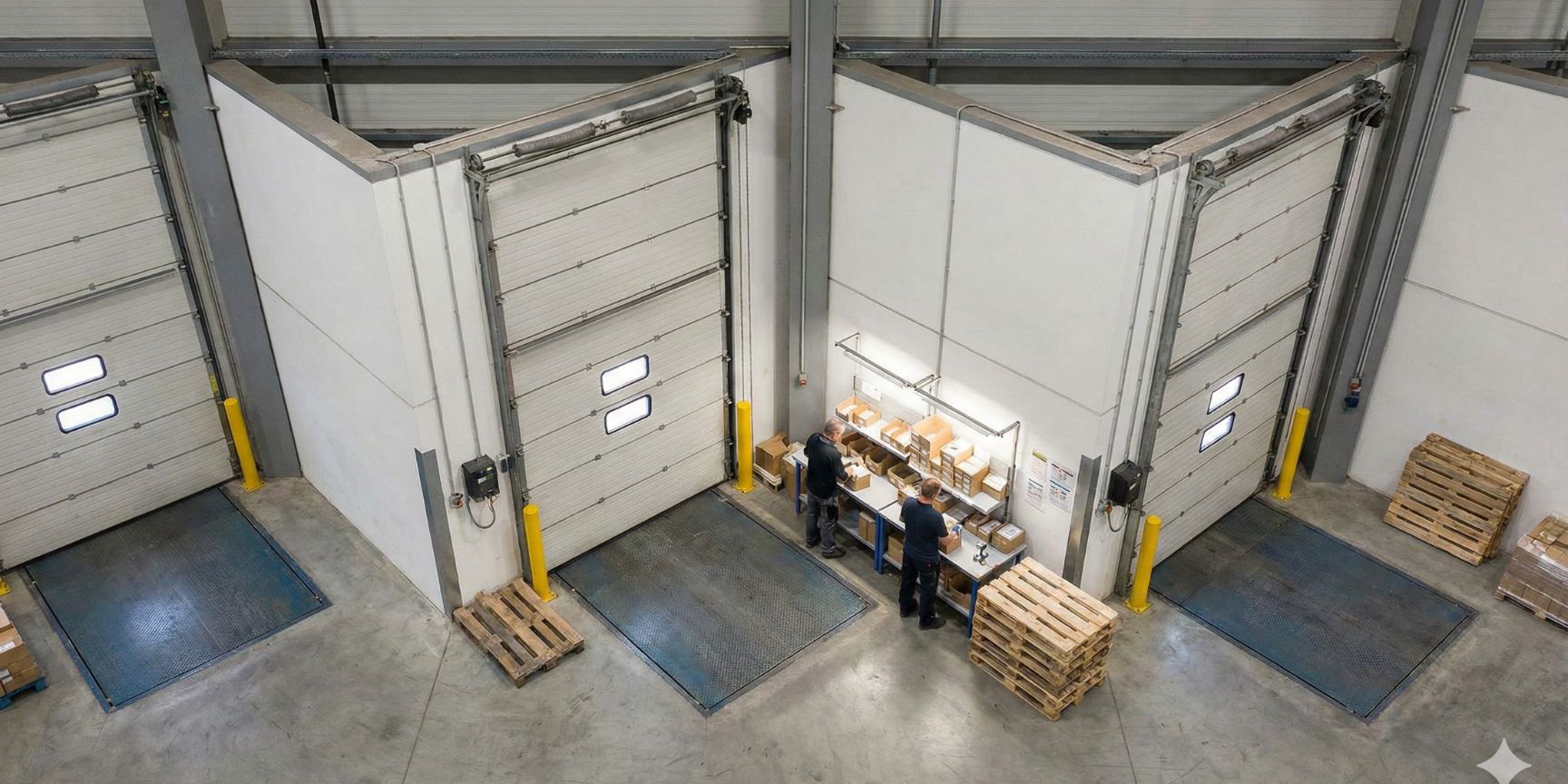
- Interior layout: The sloping gates create triangular "blind spots" between the gates inside the hall. These areas are difficult to use for pallet spaces. However, they are ideal for Value Added Services (VAS) workplaces, waste separation or load carrier depots.
- Gate spacing: At extreme angles, it can happen that the trucks are well positioned on the outside, but the center distance between the gates (center-to-center) on the inside becomes so small that it is difficult to load at two side gates at the same time. A minimum distance of 4.00 to 4.50 metres between the goal axes should also be maintained here.
Special case: The "real" swallowtail hall
While "sawtooth" usually only means the façade, in the history of rail and freight forwarding logistics there are also buildings that are shaped like a dovetail in their floor plan (wide front, narrower end or vice versa), often to combine rail sidings and truck traffic. In modern contract logistics , however, the term refers almost exclusively to the delivery situation of the truck gates.
Questions and answers (Q&A) on ramp planning
Question: Does a sawtooth ramp reduce the number of possible gates? Answer: Yes, tendentially. Since the sloping arrangement per door takes up more width of the overall front than a straight arrangement, fewer sawtooth gates fit on a 100-metre hall length than 90° gates. The space saved in the outdoor area is therefore "bought" with a lower door density.
Question: Are sawtooth ramps suitable for all types of trucks? Answer: In principle, yes. However, the angle must be calculated exactly. If the angle is too steep (e.g. > 60°), long vehicles (such as the long truck or Gigaliner, which is being discussed in Germany) can have problems if the train "buckles" too much when shunting.
Question: How does this affect real estate valuation? Answer: Neutral valuation: A property with sawtooth ramps is often a "special purpose" solution. It is functional, but investors often prefer the standard (90°) as it is more flexible for new tenants. However, on difficult properties, the sawtooth solution can only generate value by enabling logistics in the first place.
Conclusion: When is dovetail delivery worthwhile?
The sawtooth or dovetail delivery is not an aesthetic feature, but a problem solver for limited outdoor areas.
For logistics developers and users, the following rule of thumb applies: If the property is deep enough for a 35-metre apron, the 90° standard ramp (straight façade) should always be chosen – it is cheaper to build and more energy-efficient. However, if the layout of the property forces compromises, the sawtooth ramp is the means of choice to ensure high-frequency delivery despite the lack of space. For the logistics manager, this means better visibility for the drivers, but a little less flexibility on the staging area inside.