




Dark Warehouse in Warehouse Logistics
Table of contents
- The Dark Warehouse: When Logistics Becomes Autonomous
- The technological basis: More than just robots
- Requirements for the logistics property: Hardware for the software
- Contract Logistics: Business Case and Strategy
- Facts, figures, data: Profitability
- Challenges and risks
- FAQ – Questions and answers from practice
- Summary for decision-makers
The Dark Warehouse: When Logistics Becomes Autonomous
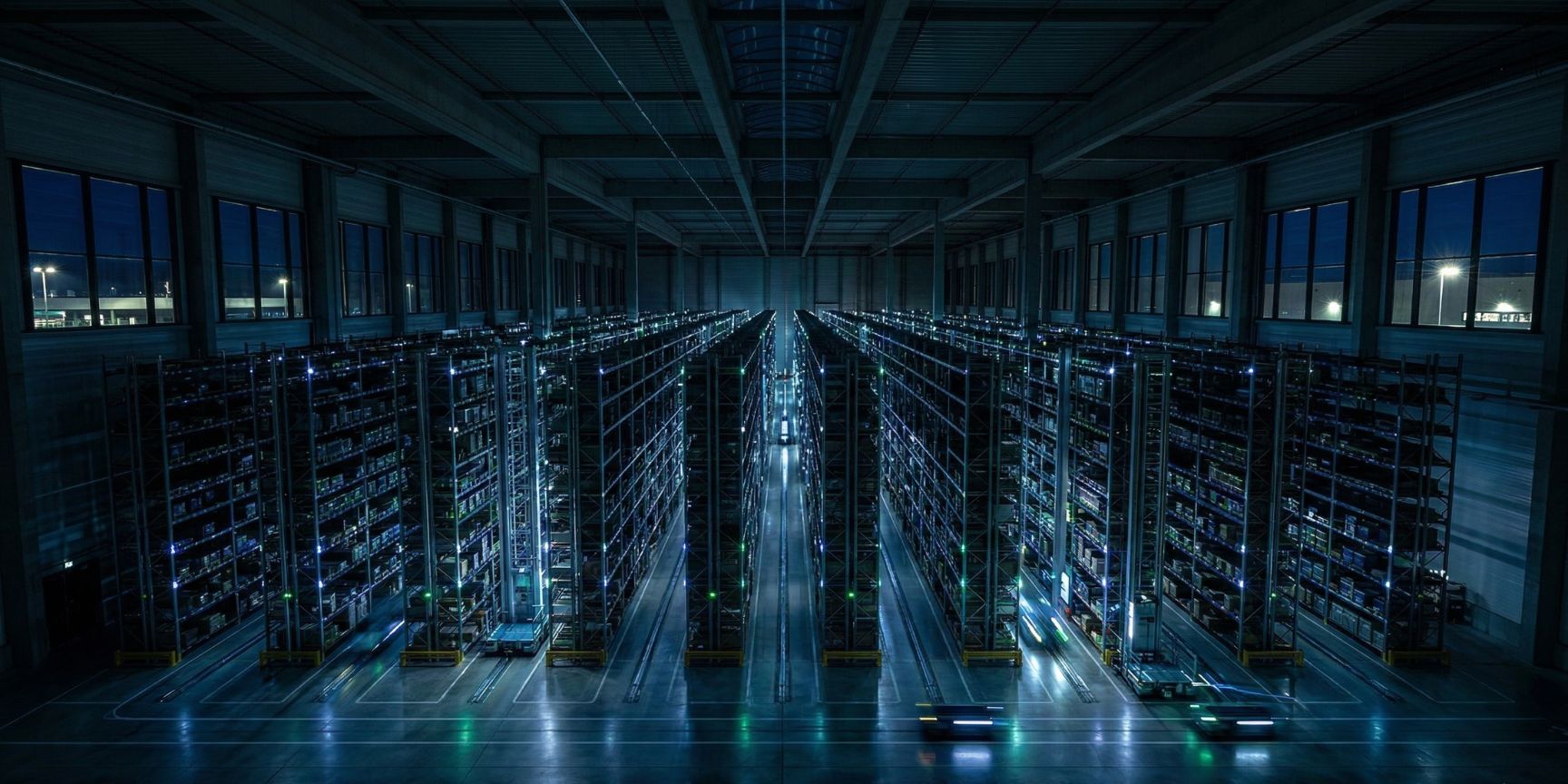
The term dark warehouse (also known as ghost logistics center) describes a warehouse whose core operational processes – from incoming goods to storage and picking to outgoing goods – are fully automated. The name comes from the fact that machines do not need lighting (and often no air conditioning for human comfort). We are moving away from man-to-goods logistics to a pure system-to-system environment.
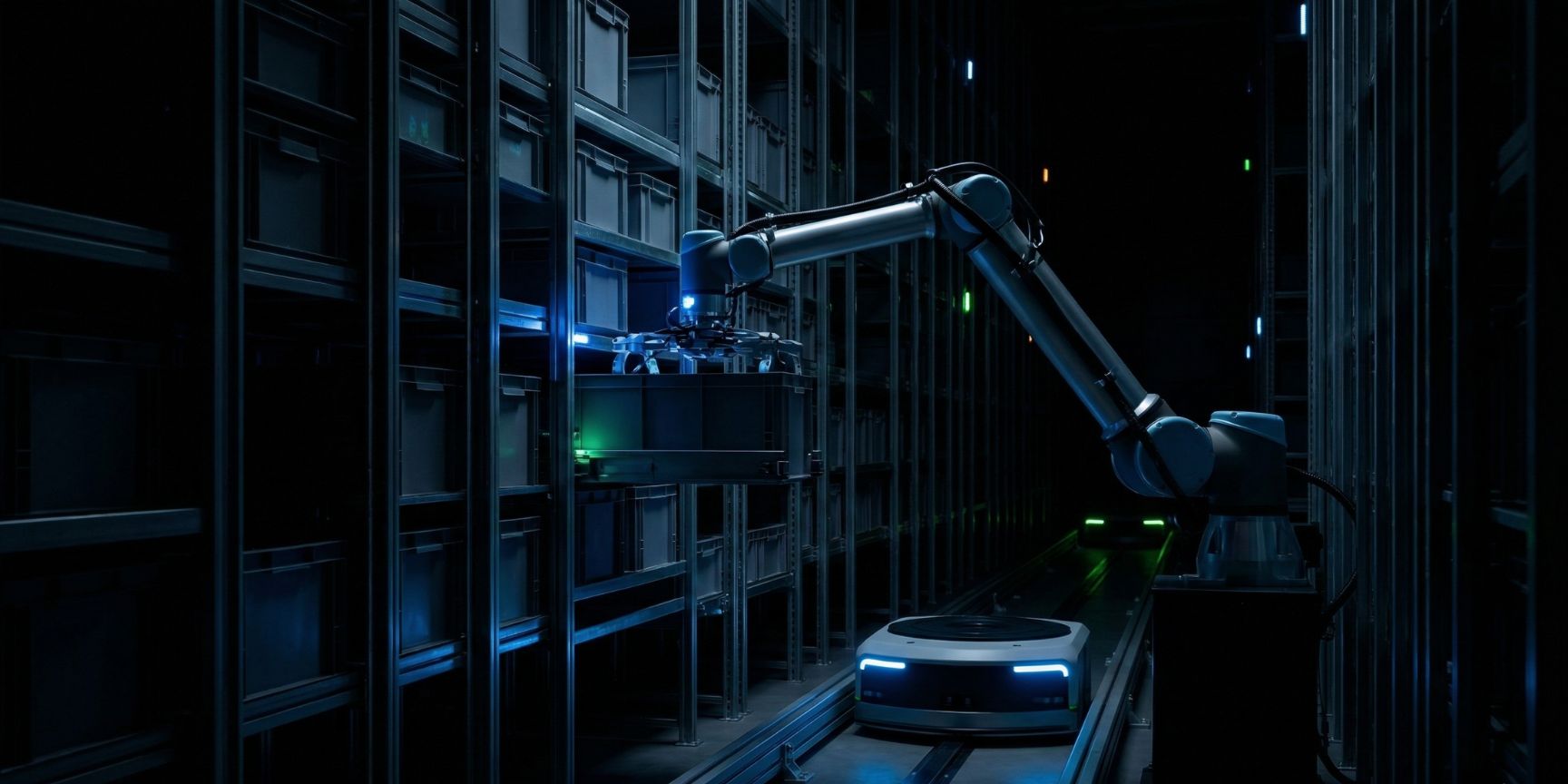
The technological basis: More than just robots
A dark warehouse is not a rigid structure, but a highly complex ecosystem. It is based on the interaction of four supporting pillars:
- AS/RS (Automated Storage and Retrieval Systems): High-bay systems in which storage and retrieval machines (SRMs) or shuttles operate at speeds of up to 6 m/s.
- Automated guided vehicles (AGVs) & AMR: Autonomous mobile robots (AMRs) take over horizontal transport and are highly flexible thanks to SLAM technology (Simultaneous Localization and Mapping).
- AI-powered WMS/WCS: The warehouse management system acts as a brain that prioritizes orders in real time and optimizes paths.
- Gripping technology & sensor technology: Modern 3D vision systems enable robots to reliably grasp heterogeneous items (pick-and-place), which was long considered the biggest hurdle.
Requirements for the Logistics Property: Hardware for the Software
For investors and project developers, a dark warehouse is fundamentally different from a standard logistics property. Anyone who builds "off the shelf" here risks bad investments.
- Floor conditions: The flatness tolerances (e.g. according to DIN 18202, Table 3, line 4) are extremely tight. Robots in high racks do not forgive millimeter deviations.
- Ceiling heights & statics: While standard halls often have a usable height of 12 meters (UKB), dark warehouses in contract logistics often aim for heights of 20 to 40 meters (silo construction) in order to make maximum use of the floor space.
- Energy infrastructure: The focus is shifting from heating to electricity capacity. A dark warehouse requires redundant power connections and often powerful photovoltaic systems with buffer storage systems to cushion load peaks from the robots.
- Air conditioning: Since there are no people in the work area, the temperature can be reduced to the minimum necessary for the goods. This saves up to 25% of the energy costs of a conventional hall.
Contract Logistics: Business Case and Strategy
For contract logistics companies, the dark warehouse is the answer to the "three big Ls": laboratory, location, liability . In regions with extremely high wage costs or de facto full employment, automation is often the only way to ensure the ability to deliver. A ghost logistics center offers scalability here that cannot be achieved with human personnel – especially during peak times (e.g. Black Friday), when the system simply runs 24/7 at full load without incurring shift bonuses or signs of fatigue.
Facts, figures, data: Profitability
Choosing a dark warehouse is primarily a CapEx (capital cost) decision in favor of lower OpEx (operating costs).
- Space efficiency: Extremely narrow aisles (VNA - Very Narrow Aisle) and enormous heights can increase storage density by up to 400% compared to manual warehouses .
- Lead times: Automated systems often reduce the time from order to goods issue by 50 to 70%.
- Error rate: While an error rate of 1-3% is considered acceptable in the manual warehouse, this drops to less than 0.01% in the dark warehouse.
- Amortization: The payback phase is between 5 and 9 years, depending on the degree of automation. As minimum wages rise, this period is steadily shortening.
Challenges and risks
Despite the euphoria, there are critical aspects that need to be highlighted in the expert consultation:
- Lack of flexibility: Once conveyor technology has been permanently installed, it is difficult to convert. Dark warehouses are often "special purpose properties".
- Cyber security: A total failure of IT means a complete standstill. Risk is shifting from physical security to digital resilience.
- Maintenance: Although you save on warehouse personnel, you still need highly qualified mechatronics engineers and IT specialists on site (or remotely).
FAQ – Questions and answers from practice
Question: Is a dark warehouse really completely deserted?
Answer: No. The term is idealized. People are still needed for maintenance, troubleshooting (exception handling) and strategic planning. However, the core operational process runs without manual intervention.
Question: From what number of items or what throughput is ghost logistics worthwhile?
Answer: There is no general number, but as a rule of thumb, the model becomes economically attractive with more than 1,000 picks per hour and an assortment that allows for a high level of standardization of packaging units (e.g. cartons or Euro pallets).
Question: How does automation affect fire protection?
Answer: This is a critical point. Oxygen reduction systems are often used in fully automated high-bay warehouses. Since there are no people in the camp, the oxygen content can be permanently lowered to such an extent that an open fire cannot physically occur.
Question: Can any existing logistics hall be converted into a dark warehouse?
Answer: Usually only with considerable effort (brownfield investment). It often fails due to the floor load capacity or the height of the hall. Greenfield projects that are specifically tailored to the technology usually make more economic sense.
Summary for decision-makers
The dark warehouse is not a futuristic gadget, but an economic necessity for high-volume, process-stable logistics markets. Contract logistics companies or real estate developers who miss the boat today will have long-term difficulties in meeting the required speed and cost efficiency of the market. However, the path to the Ghost Logistics Center requires a courageous willingness to invest and an excellent technological partnership.