




Soil Resilience in Logistics
Table of Contents
- What is soil resilience and why is it crucial?
- The most important key figures: surface load, point load and wheel load
- Legal basis and standards: A look at the Eurocode
- Significance for logistics practice: racks, forklifts and automation
- Risks of misjudgement: From hairline cracks to operational downtime
- Frequently Asked Questions (FAQ) about Floor Load Capacity
What is soil resilience and why is it crucial?
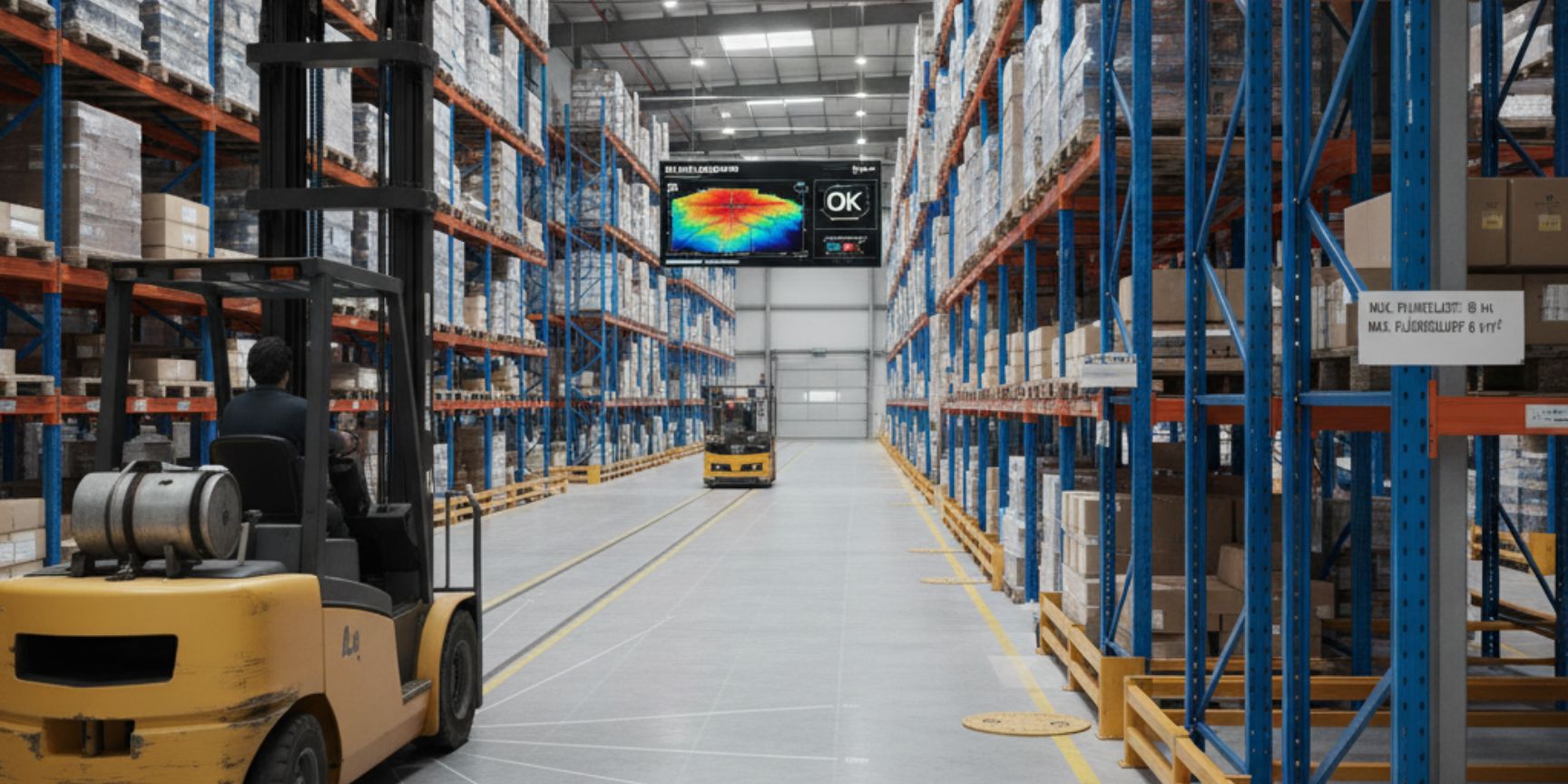
Floor load-bearing capacity, often referred to as the load-bearing capacity of the floor, defines the maximum load that a floor slab or floor slab can take without suffering damage or losing its static integrity. In the world of logistics real estate, this value is not a trivial matter, but one of the most critical key figures of all. He decides which racking systems can be installed, which industrial trucks can be used and which goods can be stored. A misjudgement can lead to everything from cracks in the ground to expensive operational failures and catastrophic collapses. A basic distinction is made between static load (e.g. by pallets stored in racks) and dynamic load (e.g. by moving, braking and lifting forklifts).
The most important key figures: surface load, point load and wheel load
In order to describe the load-bearing capacity precisely, various values are used, which must be recorded in the load plan of a property or in the structural analysis.
- Surface load (kN/m² or t/m²): This is the most well-known value. It indicates how much weight may be evenly distributed on one square metre of soil. In modern logistics properties, a standard value of at least 5 tonnes per square metre (5 t/m²), which corresponds to approx. 50 kilonewtons per square metre (50 kN/m²), is common. This value is crucial for block storage or for areas with low to medium shelf height.
- Point load (kN): Often the more critical quantity in practice. The point load describes the maximum force that may act on a very small area. The classic application is the support feet of heavy-duty racks. Depending on the height and load, a single rack leg can transfer a load of several tons to an area of only a few square centimeters. If the permissible point load is exceeded, the concrete floor can be literally punched through at this point.
- Wheel load (kN): This key figure is essential for the use of industrial trucks such as forklifts or reach trucks. It indicates the maximum load that may be applied to the ground per wheel. Especially with heavy forklifts with smaller, hard wheels (e.g. made of Vulkollan), enormous pressures are created, which stress the floor for wear and breakage. Dynamic forces during braking and acceleration further increase this load.
Legal basis and standards: A look at the Eurocode
The minimum requirements for payloads in building construction are regulated throughout Europe by the DIN EN 1991 (Eurocode 1) series of standards: Effects on structures . Part 1-1 (DIN EN 1991-1-1), which defines various categories of use, is particularly relevant for logistics properties. Warehouse and industrial areas usually fall under category E: storage areas. This is further subdivided:
- Category E1: Areas for general storage. Surface loads of approx. 7.5 kN/m² are used here.
- Category E2: Areas for the storage of heavy goods, e.g. in the paper or metal industry. However, the specific design of a hall must always be carried out by a qualified structural engineer and documented in the construction documents.
Significance for logistics practice: racks, forklifts and automation
The theoretical figures have a direct impact on operational planning:
- Rack planning: The permissible point load determines the maximum distance between the rack uprights and the possible shelf height. If the point load is too low, load distribution plates must be placed under the shelf feet, which means additional costs and effort.
- Vehicle fleet: The wheel load limits the choice of forklift trucks. A heavy counterbalance truck for unloading trucks requires a higher floor load capacity than a light picker for small parts.
- Automation & Mezzanine: Modern logistics relies on automation (AGVs, shuttles) and multi-storey storage solutions (mezzanine platforms). Both place extreme demands on the soil. Automated systems require not only a high load-bearing capacity, but also extreme flatness (in accordance with DIN 18202). Mezzanine platforms transfer the entire load of their surface into the hall floor as massive point loads via a few supports.
Risks of misjudgement: From hairline cracks to operational downtime
Soil overloading often happens gradually, but the consequences can be serious:
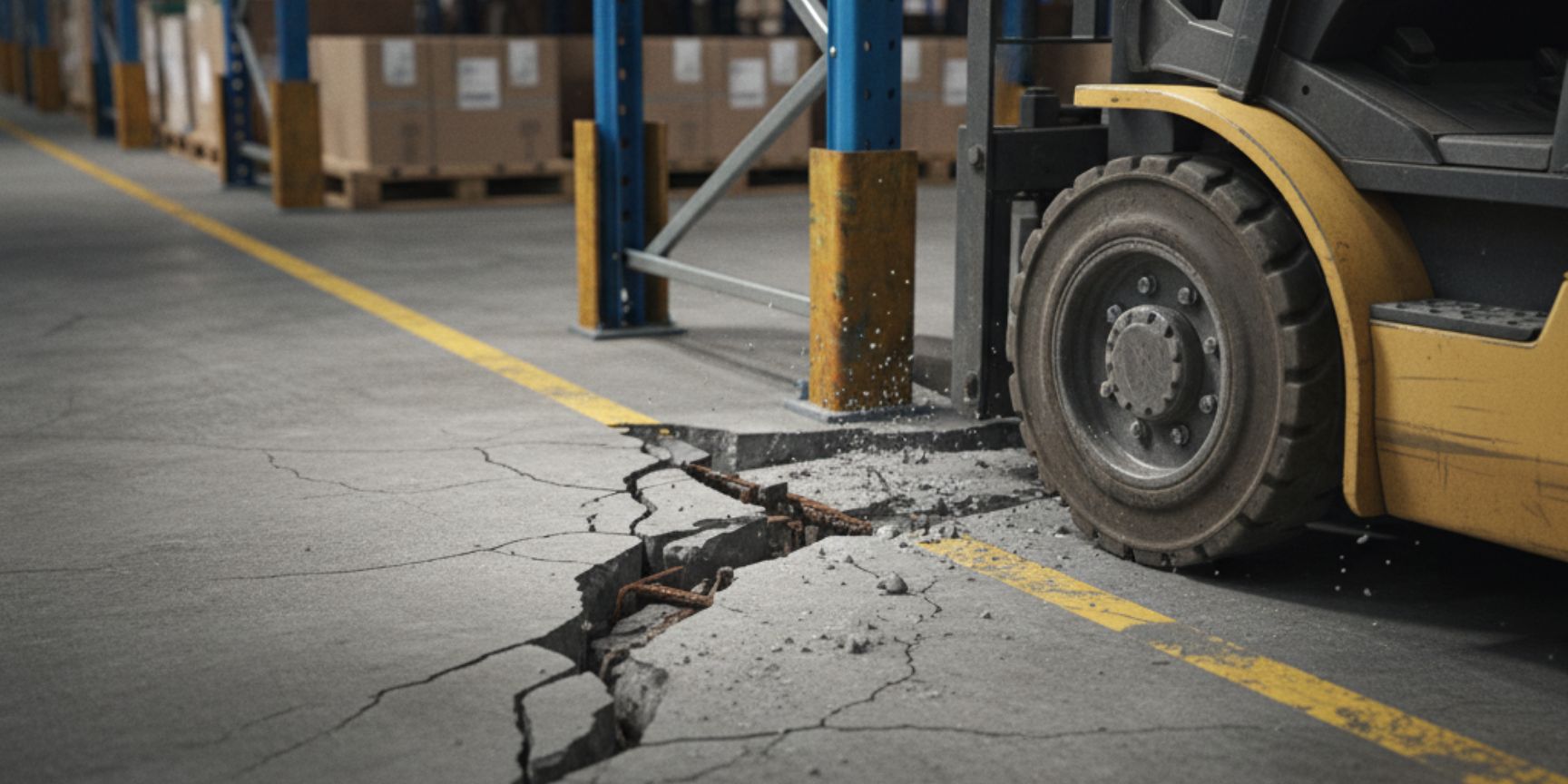
- Visible damage: It starts with fine hairline cracks that widen. Later, concrete parts can flake off (spalling) or the ground can sink at critical points.
- Safety risk: Cracks and unevenness pose a risk to forklift traffic. In the worst case, the instability of an overloaded floor can jeopardize the stability of racking systems.
- Economic damage: The renovation of an industrial floor is extremely expensive and almost always involves a complete or partial evacuation of the hall – a nightmare for every logistics manager.
Frequently Asked Questions (FAQ) about Floor Load Capacity
Question: Can I increase the floor load capacity of an existing hall at a later date?
Answer: A significant increase is only possible with massive structural effort. This can include the installation of a new, reinforced concrete layer or the reinforcement of the substructure. As a rule, this makes little economic sense and is extremely costly. Minor adjustments can be achieved by load distribution plates, but these do not solve the basic problem.
Question: What is the difference between t/m² and kN/m²?
Answer: t/m² is the specification in tons per square meter and is used colloquially. kN/m² (kilonewtons per square meter) is the physically correct unit of pressure and force used in static calculations. As a rule of thumb, 1 ton ≈ 10 kilonewtons. A floor with 5 t/m² therefore has a load capacity of approx. 50 kN/m².
Question: How do I recognize the resilience if there are no documents?
Answer: Without construction documents or a static report, a reliable statement is impossible. The only safe way is to hire a structural engineer. The latter can reassess the load-bearing capacity by means of test drilling (for the analysis of layer thickness and concrete quality) and load tests. Any other assumption is an incalculable risk.

Your Ideal Logistics Warehouse
Browse listings for warehouse space, logistics real estate, industrial land, and contract logistics solutions.
Browse Exposés
Maximize Exposure for Your Warehouse Space
Showcase your logistics properties and attract qualified inquiries.
Discover Products