




Storage equipment at a glance
Table of contents
- What is meant by storage equipment?
- Static storage systems: The backbone of the warehouse
- Dynamic storage equipment: conveyors and material flow technology
- (Q&A) What is the relationship between logistics real estate and warehouse equipment?
- (Q&A) What are the special features of contract logistics?
- Ancillary trades: Safety and control (WMS)
- (Q&A) When is it worth automating warehouse equipment?
- Sustainability and Energy Efficiency in the Modern Warehouse
- What are the security aspects of a warehouse?
- Key Success Factors for Entrepreneurs in Choosing the Optimal Warehouse
What is meant by storage equipment?
The term storage equipment (or storage technology) includes all stationary (static) and mobile (dynamic) technical components that are required within a warehouse or distribution center for the storage, buffering, picking and transport of goods. It is the "furniture" of the logistics property and the central tool of warehouse logistics.
In the narrower sense, storage equipment includes:
- Shelving systems (static, e.g. pallet racks, shelving racks)
- Mezzanines (to maximise space)
- Industrial trucks (dynamic, e.g. forklifts, pallet trucks)
- Conveying equipment (dynamic, e.g. conveyor belts, sorters)
- Picking systems (e.g. pick-by-light systems)
In a broader sense, IT hardware (scanners, terminals, printers) and safety equipment (collision protection, fire protection systems) are also included. The warehouse facility defines how a logistics property is used and how efficiently the intralogistics processes can be mapped.
Static storage systems: The backbone of the warehouse
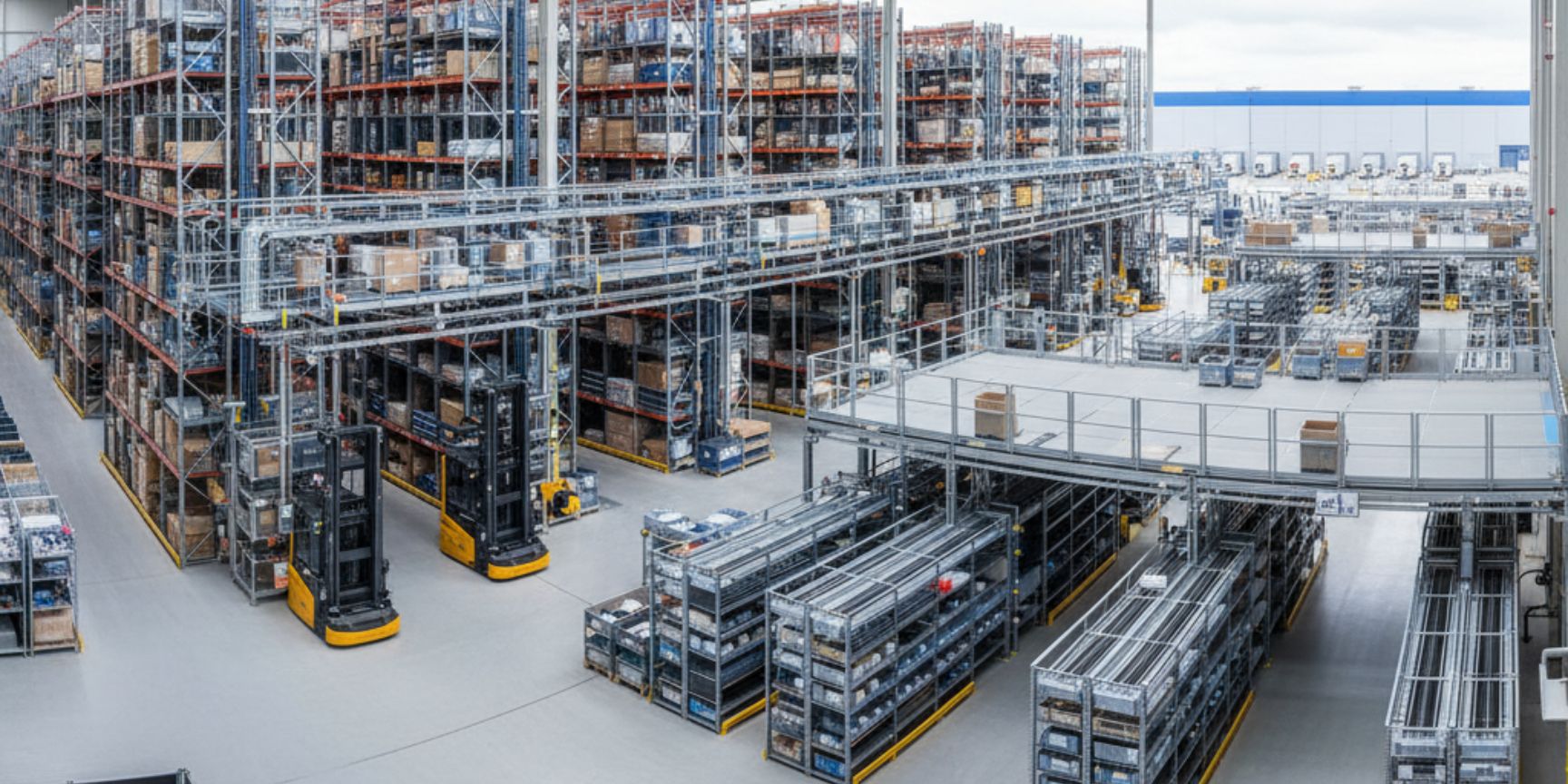
Static systems are the basis of storage capacity. Your choice depends primarily on the stored goods (weight, dimensions, turnover frequency).
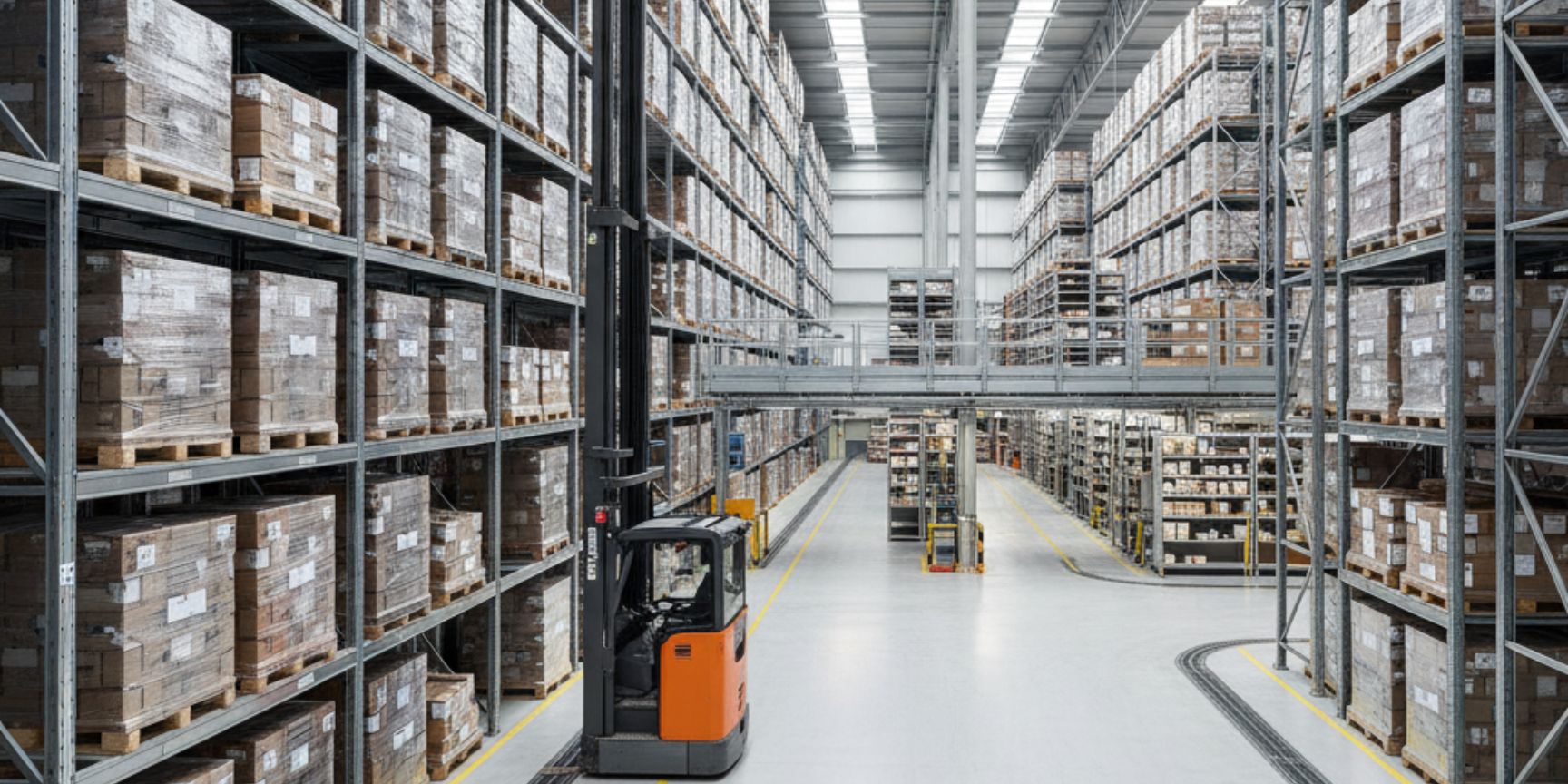
- Pallet racking (high-bay warehouse, high-bay warehouse): The most common system in warehouse logistics for the storage of Euro pallets or industrial pallets. They enable a high use of space, especially with hall heights of 10-12 meters (modern logistics properties). They are often operated with reach trucks.
- Shelving racks: The classic "basement shelf" in an industrial design. Used for the manual storage of small parts, cardboard boxes or storage boxes (KLT). Typical for e-commerce picking zones or spare parts warehouses.
- Cantilever racks: Special racks for the storage of long goods (e.g. pipes, wooden slats, steel profiles). The load rests on horizontal "arms".
- Flow and slide-in racks (FIFO/LIFO): These systems offer a very high storage density.
- Flow racks (FIFO - First-In, First-Out): The goods are stored on one side and roll on inclined paths to the removal side. Ideal for batch tracking or buffer storage in production.
- Slide-in racks (LIFO - Last-In, First-Out): Pallets are "pushed in" one after the other on rails. Lower selectivity but high density.
- Mezzanine: A cost-effective method of doubling or tripling the storage space without changing the floor area of the hall. Often used to locate light picking activities (e.g. shelving racks) or value-added services (VAS) above the main logistics areas (e.g. pallet warehouses).
Dynamic storage equipment: conveyors and material flow technology
Where static systems are stored, dynamic systems ensure the material flow. A distinction is made between continuous conveyors (constant flow) and discontinuous conveyors (flexible transport).
Discontinuous conveyors (industrial trucks, FFZ): These are the "workhorses" in the warehouse. The selection of the FFZ type largely determines the required aisle width and thus the bearing density.
- Hand pallet truck/ant: For horizontal transport over short distances (loading and unloading trucks).
- Counterbalance forklift (front loader): Universal device, but requires wide aisles (approx. 3.5 - 4.0 m).
- Reach truck: standard in pallet racking. Can lift loads up to 12 m and requires smaller aisle widths (approx. 2.7 - 3.0 m).
- Very Narrow Aisle (VNA): Enables maximum storage density, as the aisles are only slightly wider than the pallet (approx. 1.6 - 1.8 m). The devices are often rail- or inductive-guided.
Continuous conveyors: These systems (e.g. roller conveyors, belt conveyors, chain conveyors) connect fixed points in the warehouse (incoming goods, order picking, outgoing goods). They are at the heart of automated equipment and sorters that can distribute thousands of packages per hour.
(Q&A) What is the relationship between logistics real estate and warehouse equipment?
This is one of the most critical interfaces when planning a warehouse. The property (the "shell") sets the physical boundaries for the furnishings (the "content").
Question: I am planning a new logistics hall. Should I build the property first or plan the storage facility?
Answer: The ideal case in logistics planning follows the principle of "inside before outside". This means:
- The logistical process (What is moved and how often?) defines...
- ... the storage equipment (Which shelves? Which forklifts? Automation?), and this defines...
- ... the requirements for the logistics property (height, floor, column grid).
In practice, especially in the case of rental properties, it is often the other way around: an existing property (brownfield) is rented and the storage equipment has to adapt to the circumstances.
Critical factors of the property for furnishing:
- Floor load and flatness: The standard floor load of 5 t/m² in modern halls is usually sufficient for pallet racks. More critical is the point load of the shelf uprights. In the case of narrow-aisle warehouses or automatic warehouses (AS/RS), the floor flatness (according to DIN 18202 or DIN 15185) is the decisive factor.
- Hall height (UKB): The "lower edge of the truss" (UKB) defines the maximum possible shelf height. Modern logistics properties offer 10 m or 12 m UKB to be able to stack 4-6 pallets on top of each other.
- Column grid: The distance between the hall girders influences the planning of the rack aisles. An unfavorable grid "wastes" valuable space.
- Fire protection: The type of sprinkler system (ESFR sprinkler vs. in-rack sprinkler) must be precisely matched to the rack layout and the stored goods.
(Q&A) What are the special features of contract logistics?
Question: As a contract logistics specialist (3PL), I often have changing customers and goods. How does my storage facility have to react to this?
Answer: The core requirement for warehouse facilities in contract logistics is flexibility. A 3PL that stores auto parts today and pharmaceutical supplies tomorrow can rarely afford a highly specialized, rigid facility (exception: dedicated locations for long-term customers).
- Modularity instead of specialization: Standard pallet racks are more flexible than a permanently installed flow rack. Mezzanines are often bolted (modular) rather than welded to keep them movable.
- Universal industrial trucks: Manual or semi-automated systems (e.g. reach trucks) are often more flexible than automated guided vehicles (AGVs) or rigid conveyor systems that are designed for a specific loading aid (e.g. KLT size X).
- Multi-user capability: The facility (and the WMS) must be able to handle different customers (tenants) physically and systemically separated from each other in the same hall.
Ancillary trades: Safety and control (WMS)
A storage facility only works in conjunction with two other elements: safety and control.
Safety devices: They are not a "nice-to-have", but a legal requirement and essential for operation.
- Collision protection (impact protection): Protects rack stands at corners and passages from collisions with forklifts.
- Rack inspection: Storage equipment must be inspected regularly (usually annually) by a qualified person (in accordance with DIN EN 15635).
- Lighting: Correct illumination of the aisles is crucial for pick quality and occupational safety.
- Guidance systems: Floor markings for driveways, footpaths and parking spaces.
Control (WMS/WMS): The physical storage facility is the "hardware". The Warehouse Management System (WMS) is the "brain". It decides which forklift goes to which shelf compartment and when. A WMS optimizes routes, controls picking (e.g. pick-by-voice, pick-by-scan) and manages inventories in real time. Without a WMS, modern warehouse logistics is inconceivable.
(Q&A) When is it worth automating warehouse equipment?
Question: My warehouse runs manually with forklifts and MDA scanners. Should I switch to an automated small parts warehouse (AS/RS) or robot?
Answer: The decision between "manual", "semi-automated" and "fully automated" is one of the most strategically important (and expensive) when it comes to warehouse setup.
Automation (e.g. AS/RS, Shuttles, AutoStore) is worthwhile if:
- High, constant turnover figures are available (high throughput).
- Standardized processes and loading aids (e.g. KLTs) are available.
- Multi-shift operation (24/7) (the system pays for itself faster).
- High accuracy is required (e.g. pharmaceuticals).
- There is an acute shortage of skilled workers (forklift drivers, order pickers).
Manual systems (e.g. forklifts, shelving racks) are superior if:
- The throughput is low or fluctuating strongly (e.g. seasonal business).
- A broad, heterogeneous range of articles is handled.
- High flexibility is required (e.g. contract logistics with short contract terms).
- The investment (CAPEX) should be kept low.
Automation has high investment costs (CAPEX), but in the long term it reduces operating costs (OPEX), especially personnel costs. Manual systems are cheap to purchase (low CAPEX), but have high ongoing operating costs (high OPEX).