




Pick-by-Light in the warehouse
Inhaltsverzeichnis
- Definition and functioning: The optical guidance system in detail
- Key figures: Picking performance and error rates in practice
- Pick-by-Light from the Perspective of Contract Logistics
- Effects on the logistics property and hall planning
- Questions and Answers (Q&A) on Technology
- System Limits and Alternatives
- Conclusion: When is it worth using it?
Definition and functioning: The optical guidance system in detail
Pick-by-Light (PbL) is a paperless picking process in which order pickers are guided by visual signals directly at the storage compartment (eye-catching lights). In contrast to static lists or mobile data acquisition devices (MDE), which bind the employee's gaze, the PbL system directs attention directly to the object to be grasped.
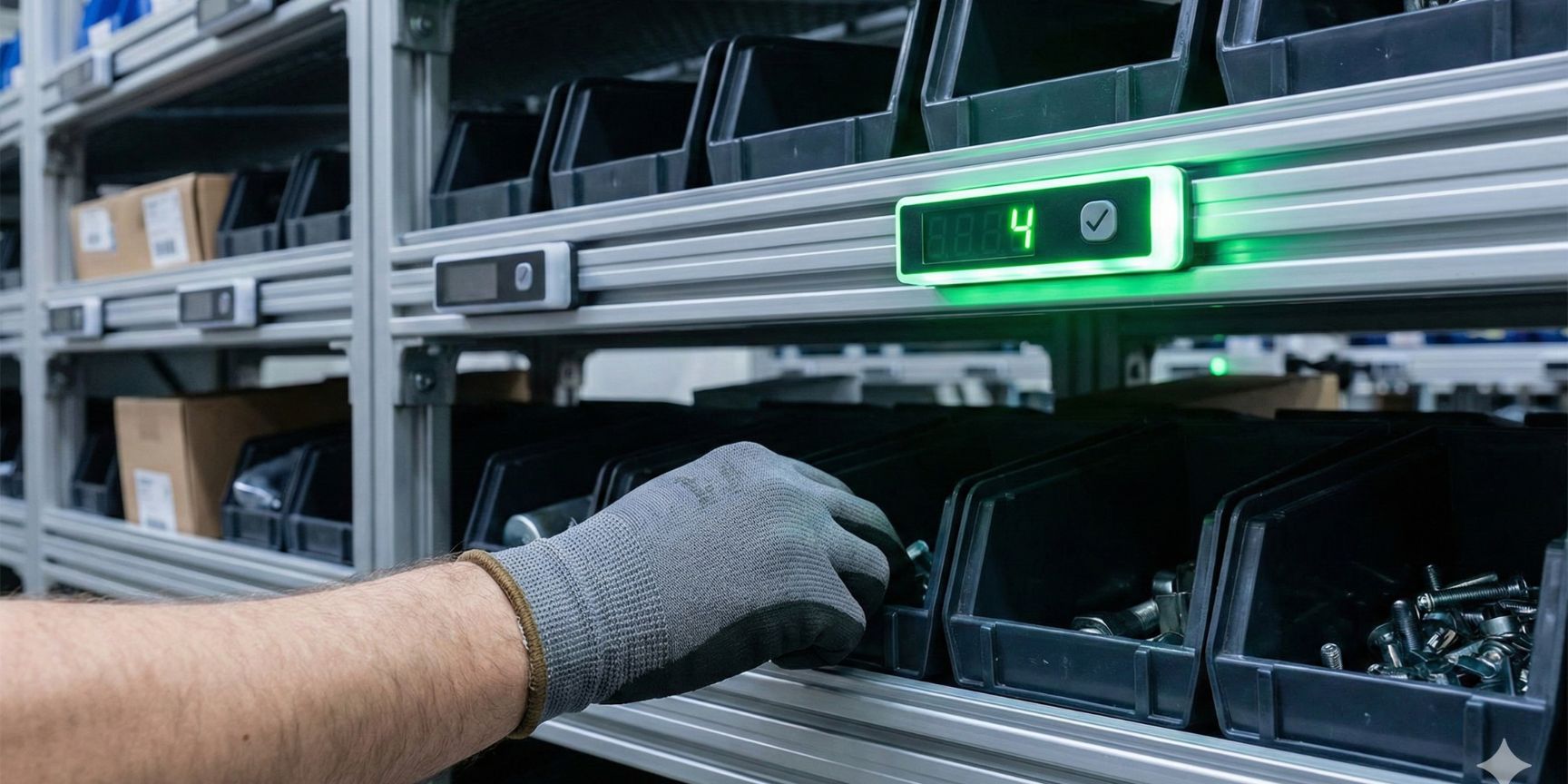
On the hardware side, the system consists of one compartment display per storage location, which has at least one significant luminaire, a numerical quantity display and a confirmation button. As soon as an order is started in the warehouse management system (WMS), the lamp on the corresponding picking compartment lights up. The display shows the quantity to be withdrawn. The employee removes the goods and confirms the operation by pressing the acknowledgement button, after which the light goes out and the inventory booking is reported to the WMS in real time.
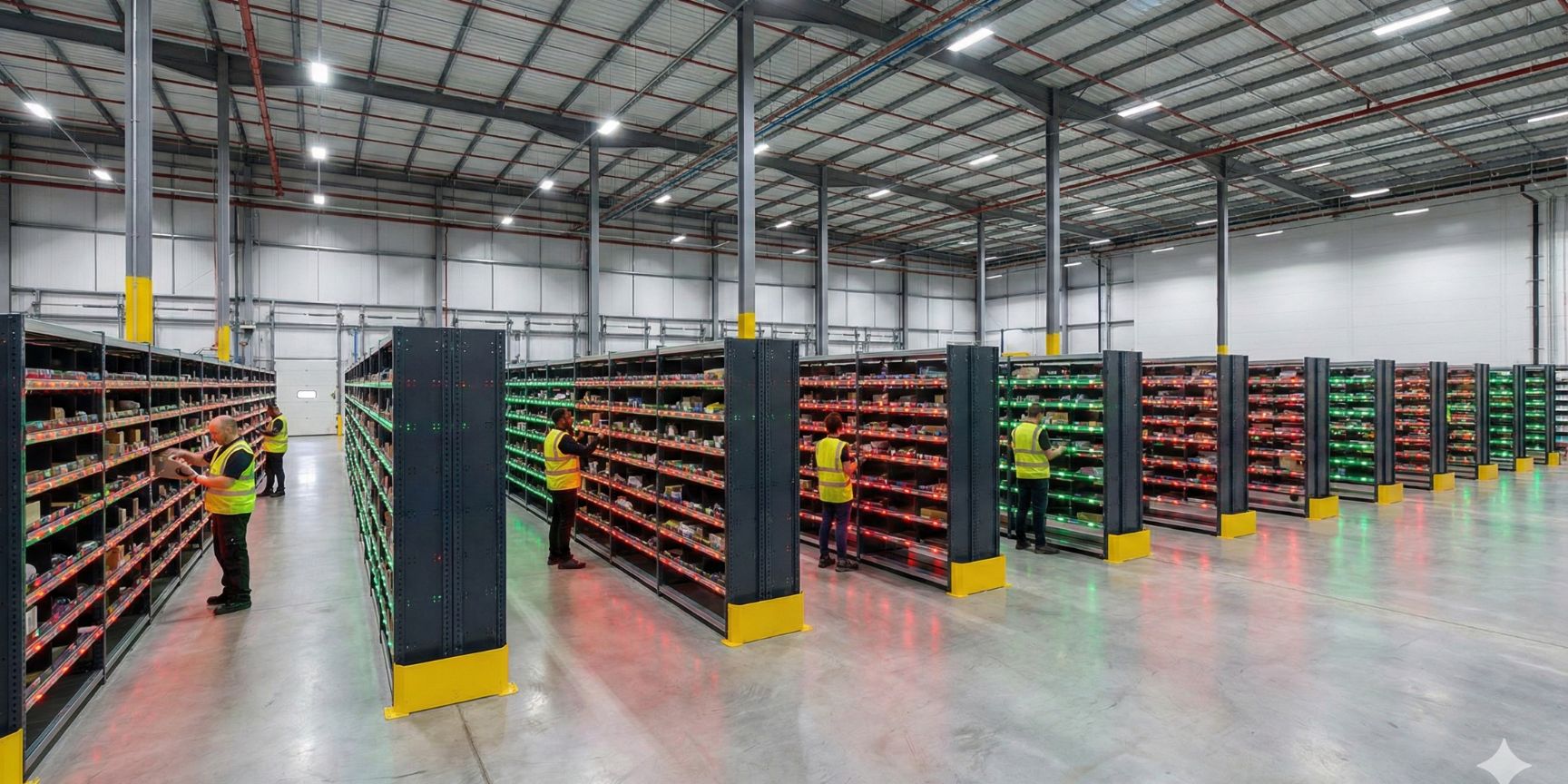
Communication usually takes place via a bus system installed on the shelves. Modern variants allow correction buttons (for inventory differences) or color codes to allow several pickers to work in one zone at the same time (multi-user picking).
Key figures: Picking performance and error rates in practice
For logistics planners, the hard facts are crucial. Pick-by-Light shows its strengths above all in fast-moving zones (A-articles) and with high pick density.
- Picking performance: In optimized environments, 350 to 550 picks per hour are realistic values. In high-performance systems (e.g. pharmaceutical wholesale), peak values of up to 800 picks can be achieved, depending on the travel time between the compartments.
- Error rate: The error rate is drastically reduced by visual guidance and the obligation to acknowledge at the compartment. Values of less than 0.1% (less than 1 error per 1000 picks) are the standard.
- Training time: A decisive factor for contract logistics. The training time for new employees is often only 15 to 30 minutes, as the system works independently of language and intuitively ("Follow the light").
Pick-by-Light from the Perspective of Contract Logistics
In contract logistics, which is characterized by short contract terms and fluctuating volumes, PbL is a double-edged sword.
Advantages: Coping with seasonal peaks (e.g. Black Friday, Christmas business) requires the use of temporary workers. This is where PbL is unbeatable, as there is no need for long training sessions and no language barriers (unlike pick-by-voice). In addition, the high picking speed enables efficient use of personnel resources.
Challenges: Contract logistics companies often shy away from high investment costs (CAPEX) when the contract term is only 3 to 5 years. A classic, wired PbL system is expensive to purchase (hardware per compartment, controller, software integration). If the contract ends or the range of goods changes drastically (e.g. from small parts to pallet goods), the system is difficult to adapt. This is where newer, wireless systems (based on WiFi or wireless technology) gain in importance, as they can be more easily dismantled and reused in new locations.
Effects on the logistics property and hall planning
The integration of a pick-by-light system has a direct impact on the technical building equipment (TGA) and the use of the warehouse.
- Cabling and power supply: Classic PbL systems require power and data cables on each shelf. This requires precise planning of the cable trays from the sub-distributions to the rack aisles. For the real estate developer, this means that sufficient connections must be provided in the ceiling or floor area.
- Rigidity of the system: A shelving system equipped with PbL becomes a "real estate within a property". The shelves cannot simply be moved without undoing the complete wiring. This reduces the third-party usability of the hall space if the tenant moves out.
- Lighting: Since PbL is based on light signals, hall lighting must be planned in such a way that it does not outshine the signal lights, but still ensures occupational safety. Glare-free LED lighting is the standard here.
Questions and Answers (Q&A) on Technology
Question: Is Pick-by-Light only suitable for small parts warehouses? Answer: Primarily, yes. It is mostly used in flow racks or shelving racks for cartons and small parts. For pallet warehouses, it is usually uneconomical due to the long distances and the low picking density, although it is technically possible (e.g. with large LED matrix displays).
Question: What happens in the event of a system failure? Answer: This is the sore point. If the bus controller fails, the zone stands still. Modern systems offer redundancy or allow quick switching to "emergency lists". However, the hardware itself is very robust and low-maintenance.
Question: Can PbL be retrofitted into existing warehouses? Answer: Yes, the so-called "retrofitting" is common. Particularly cordless systems can be easily attached to existing shelf rails by means of a click mechanism, without the need for time-consuming cable work in the hall structure.
System Limits and Alternatives
Despite the high speed, Pick-by-Light is not the answer to all questions. The investment costs per storage space are the biggest stumbling block. In the case of C-items (slow-moving items), the installation of one display per compartment is hardly economically worthwhile. Hybrid solutions are often used here: PbL for fast-moving devices, MDE or pick-by-voice for the rest of the warehouse.
In addition, the system is rigid: If the compartment size on the shelf changes, the strips have to be physically moved or remapped on the software side.
Conclusion: When is it worth using it?
Pick-by-Light is the "sports car" among manual picking systems: expensive to buy, but unbeatable in acceleration over short distances. For logistics real estate developers , this means planning flexible supply shafts. For contract logistics companies , it is the solution of choice for high-frequency small parts and high use of unskilled labor, provided that the ROI (return on investment) can be achieved within the contract period. The future increasingly belongs to wireless systems that resolve the conflict between rigid technology and flexible hall use.