




Pick-by-Piece in the warehouse
Table of Contents
- Pick-by-piece: The supreme discipline of fine distribution
- Process Logic in Warehouse Logistics: The Fight Against Travel Time
- The Contract Logistics Perspective: Flexibility vs. Automation
- Requirements for the logistics property and hall
- Facts and figures: Focus on key figures
- Frequently Asked Questions (Q&A)
- The role of IT: WMS as the brain
- Conclusion and outlook
Pick-by-piece: The supreme discipline of fine distribution
Pick-by-piece, to German single-piece picking, refers to the logistical process in which individual units are removed directly from a storage bin in order to assemble a customer order. In contrast to pallet or carton picking (pick-by-case), this process places the highest demands on the granularity of inventory management, the ergonomics of the workstations and IT control.
In the modern supply chain, pick-by-piece is no longer just an issue for the classic mail order business. This process is also standard in B2B spare parts logistics and the pharmaceutical industry. The challenge lies in the details: while a pallet is moved with a forklift, the individual piece requires "bin picking" – manually or automatically.
Process Logic in Warehouse Logistics: The Fight Against Travel Time
In operational warehouse logistics, pick-by-piece is the most cost-intensive area. Studies show that with conventional methods, up to 50-60% of an order picker's working time is spent on pure distances. Only about 10–20% is the actual withdrawal time.
To combat this inefficiency, logistics planners rely on various strategies:
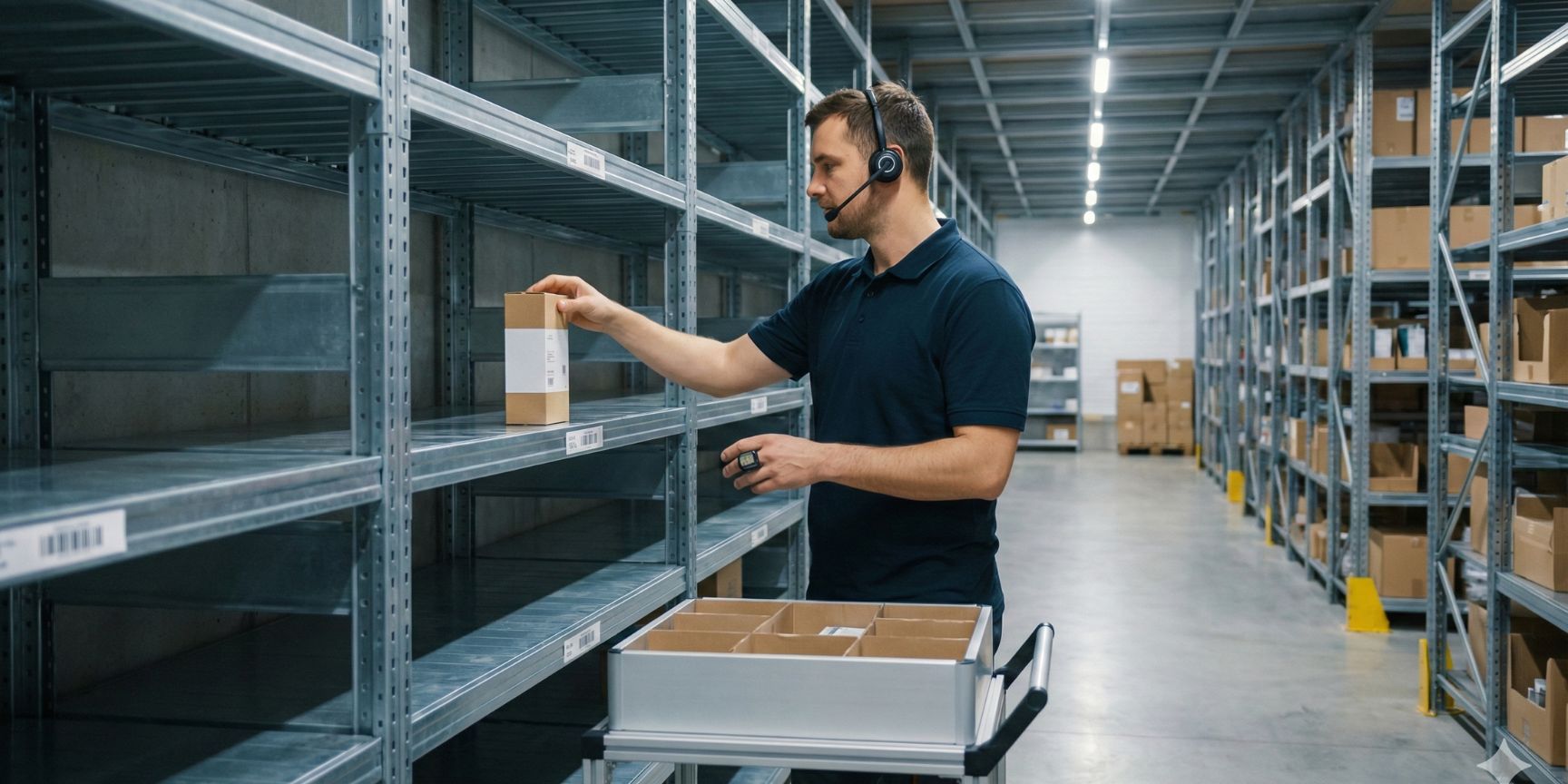
- Man-to-goods: The classic way. Optimization is carried out here by technologies such as pick-by-voice, pick-by-light or pick-by-vision (data glasses). These systems guide the employee in a route-optimized manner and allow two-handed work (hands-free).
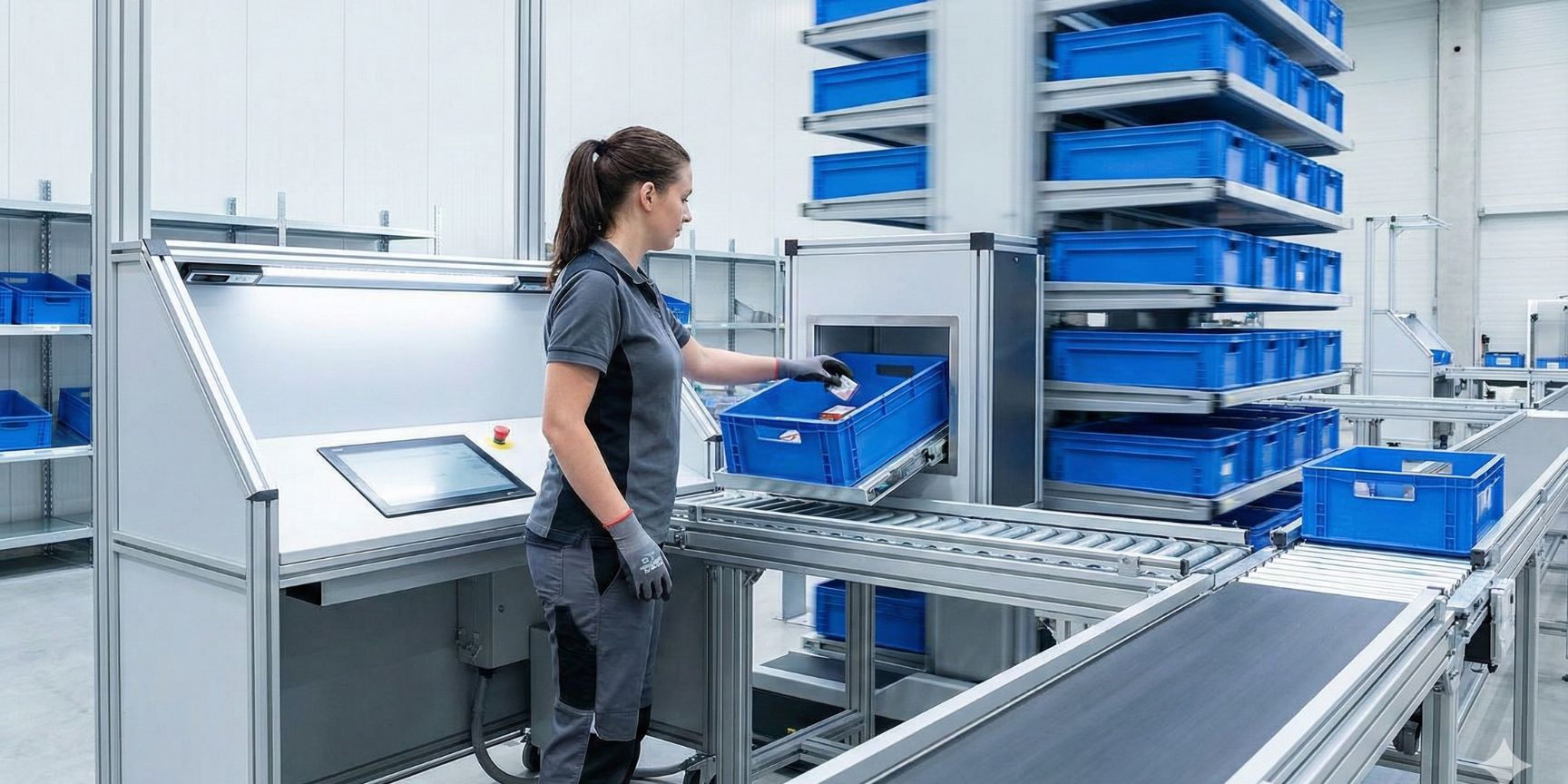
- Goods-to-person (GTP): This is where automated small parts warehouses (AS/RS) or shuttle systems are used. Containers move to an ergonomic workstation. The pick performance can increase from approx. 60–100 picks/hour (manual) to 400–600 picks/hour (GTP).
The Contract Logistics Perspective: Flexibility vs. Automation
For contract logistics companies, pick-by-piece is a double-edged sword. On the one hand, e-commerce fulfilment contracts offer high margins, but on the other hand, volumes are extremely volatile (e.g. Black Friday peaks).
- Scalability: A purely manual pick-by-piece system is easier to scale (use of temporary workers at peak times) than rigid full automation.
- Billing models: In contract logistics, billing is often done on a transactional basis (cost-per-pick). The service provider must therefore know the exact process costs. A pick error that triggers a return can destroy the profit of dozens of correct picks.
- Use of technology: Contract logistics companies are increasingly relying on AMR (Autonomous Mobile Robots). These robots support the pick-by-piece process without the need for expensive conveyor technology to be firmly anchored to the ground. This protects the investment risk in the event of short contract terms.
Requirements for the logistics property and hall
Real estate plays an often underestimated role in pick-by-piece. A standard logistics hall ("Big Box") is primarily designed for pallet racking. However, there are specific requirements for intensive single-piece picking:
- Lighting and working atmosphere: Since pick-by-piece is very personnel-intensive, workplace guidelines must be observed more strictly. While 150-200 lux is sufficient in a high-bay warehouse, 300 to 500 lux and efficient heating/ventilation are often required in picking zones.
- Floor conditions: For the use of picking robots or AGVs (Automated Guided Vehicles), the industrial floor must be extremely flat (DIN 15185 or VDMA guidelines). Joints and unevenness lead to interference with sensitive robots.
- Mezzanine levels: In order to increase space productivity for small parts, multi-storey shelving systems (pick towers) are often installed. For this purpose, the logistics hall requires a sufficient point load capacity of the floor slab (often > 50 kN/m² with point loads of the supports) and a clear height of at least 10 to 12 metres.
Facts and figures: Focus on key figures
To evaluate the efficiency of pick-by-piece, the following KPIs (Key Performance Indicators) are essential:
| Key figure | Description | Target value (benchmark) |
| Pick performance | Number of units withdrawn per hour. | Manual: 60-150 / Auto: 300-600+ |
| Pick error rate | Proportion of erroneous picks in total picks. | < 0.1 % (best-in-class: < 0.01 %) |
| Lead time | Time from order receipt to goods issue. | Same-Day (often < 2 hours) |
| Fill level | Volume usage of the shipping box. | Target: > 70% (avoidance of "air transport") |
Frequently Asked Questions (Q&A)
Question: Is automation always worthwhile for pick-by-piece?
Answer: No. For very wide assortments with many C-parts (slow-moving items), the manual shelving pick is often more economical. Automation (e.g. AutoStore or Shuttle) usually pays off with high pick density in a limited space and in multi-shift operation.
Question: How does pick-by-piece change the requirements for fire protection in the hall?
Answer: Massively. Pick towers and narrow plastic container warehouses change the fire load. Shelf sprinklers (in-rack sprinklers) are often necessary because ceiling sprinklers cannot bring water through the dense levels of the mezzanine or container stacks.
Question: What is multi-order picking?
Answer: In order to save travel time, an employee often picks several orders at the same time on one trolley (batch picking). The separation of customer orders takes place either directly on the trolley or later on a sorter.
The role of IT: WMS as the brain
Without a powerful warehouse management system (WMS), efficient pick-by-piece is impossible. The WMS takes care of the route optimization (Traveling Salesman Problem) and inventory reservation. Particularly critical is the "replenishment control". If the picker is faced with an empty compartment, the pick-by-piece process breaks down. Modern WMS therefore predictively calculate when a compartment will be empty and start driving forklifts before the defect occurs.
Conclusion and outlook
Pick-by-piece is changing from a manual activity to a high-tech process. The logistics property of the future must be equipped for this granularity – through high-quality floors, energy supply for automation and human-friendly working environments. For contract logistics companies and retailers, the balance between investment costs (automation) and flexible personnel costs remains the key to success. Whoever controls the "unit" dominates the market.