




Predictive Logistics in Warehouses
Table of Contents
- Predictive Logistics: When Algorithms Control the Future of the Hall
- Predictive Analytics in Warehouse Logistics: The End of the "Out-of-Stock"
- Contract logistics: added value through precise planning
- The logistics property as a smart building
- Figures, data, facts: The measurable benefits
- FAQ – Frequently asked questions about predictive logistics
- The role of the hall in the networked chain
- Conclusion for practice
Predictive Logistics: When Algorithms Control the Future of the Hall
For decades, the logistics industry operated according to the principle of "reacting to what happens". Predictive logistics breaks with this paradigm. Through the use of artificial intelligence (AI), machine learning and big data, historical data is linked to real-time influences (weather, traffic, market trends) to predict future events with a high degree of probability.
In a specialist portal for warehouse and contract logistics, this is not only about the transport route, but primarily about the intelligent control of the "four walls" and the processes that take place within them.
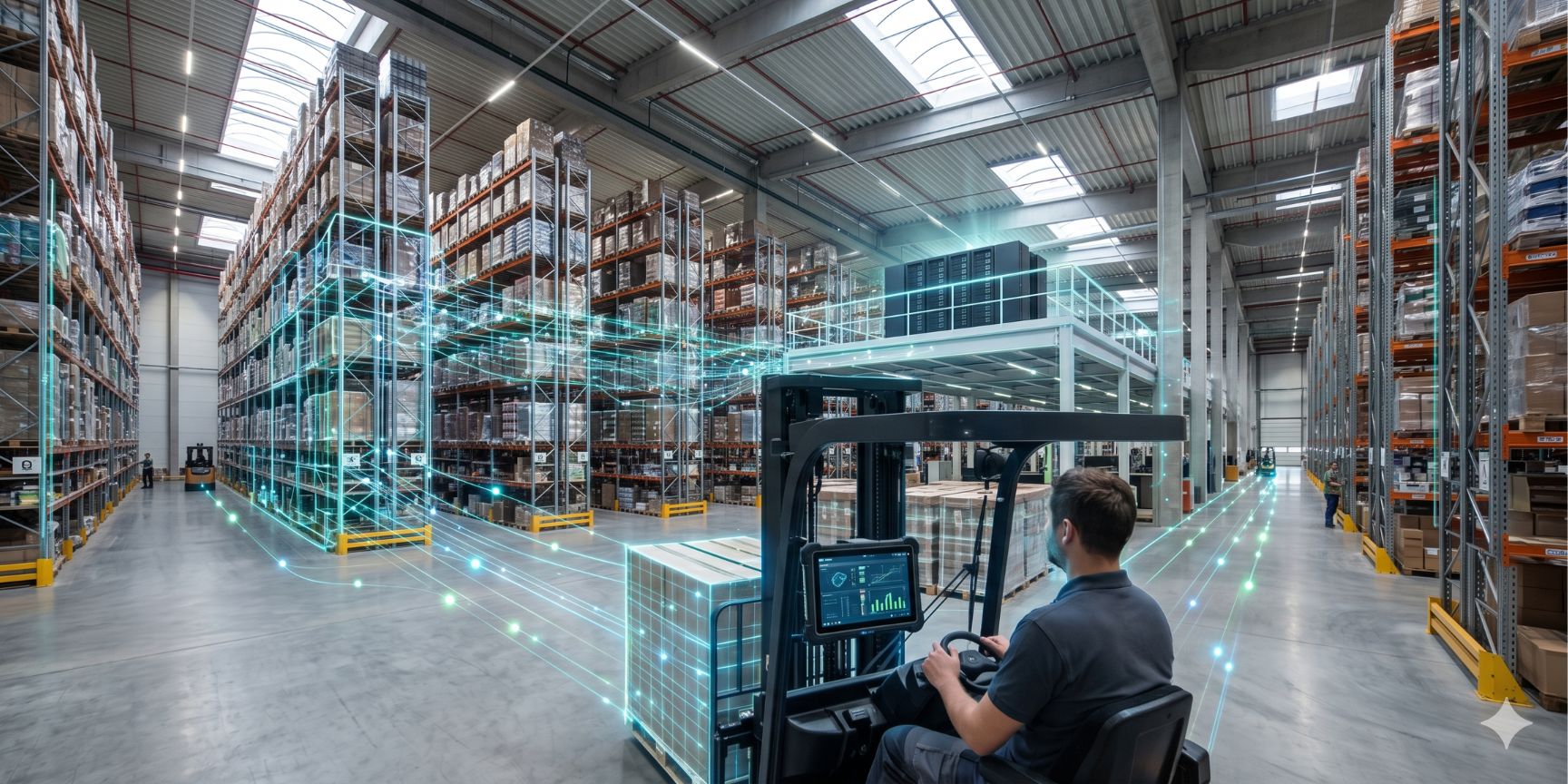
Predictive Analytics in Warehouse Logistics: The End of the "Out-of-Stock"
In classic warehouse logistics, the buffer is the most expensive commodity. This is where predictive logistics comes in to minimize safety stocks without jeopardizing the ability to deliver.
- Demand forecasting: Algorithms analyze not only past sales, but also external factors such as seasonal fluctuations or social media trends.
- Dynamic slotting: Tomorrow, the warehouse "knows" which items will be picked at high frequency the day after tomorrow. The AI proactively suggests replacements to minimize travel times.
- Resource planning: Staffing shortages are anticipated before the shift begins by accurately calculating the expected order volume against the available headcount.
Contract logistics: added value through precise planning
For contract logistics companies, predictive logistics is a crucial tool for securing margins. Because contracts are often long-term and complex, predictive quality helps meet service level agreements (SLAs).
By linking customer data with global logistics indicators, contract logistics companies can proactively propose solutions to their customers. For example, if the system predicts a delay in the delivery of raw materials for a production site, the logistics provider can already reserve storage capacity or plan alternative routes before the customer notices the bottleneck himself.
The logistics property as a smart building
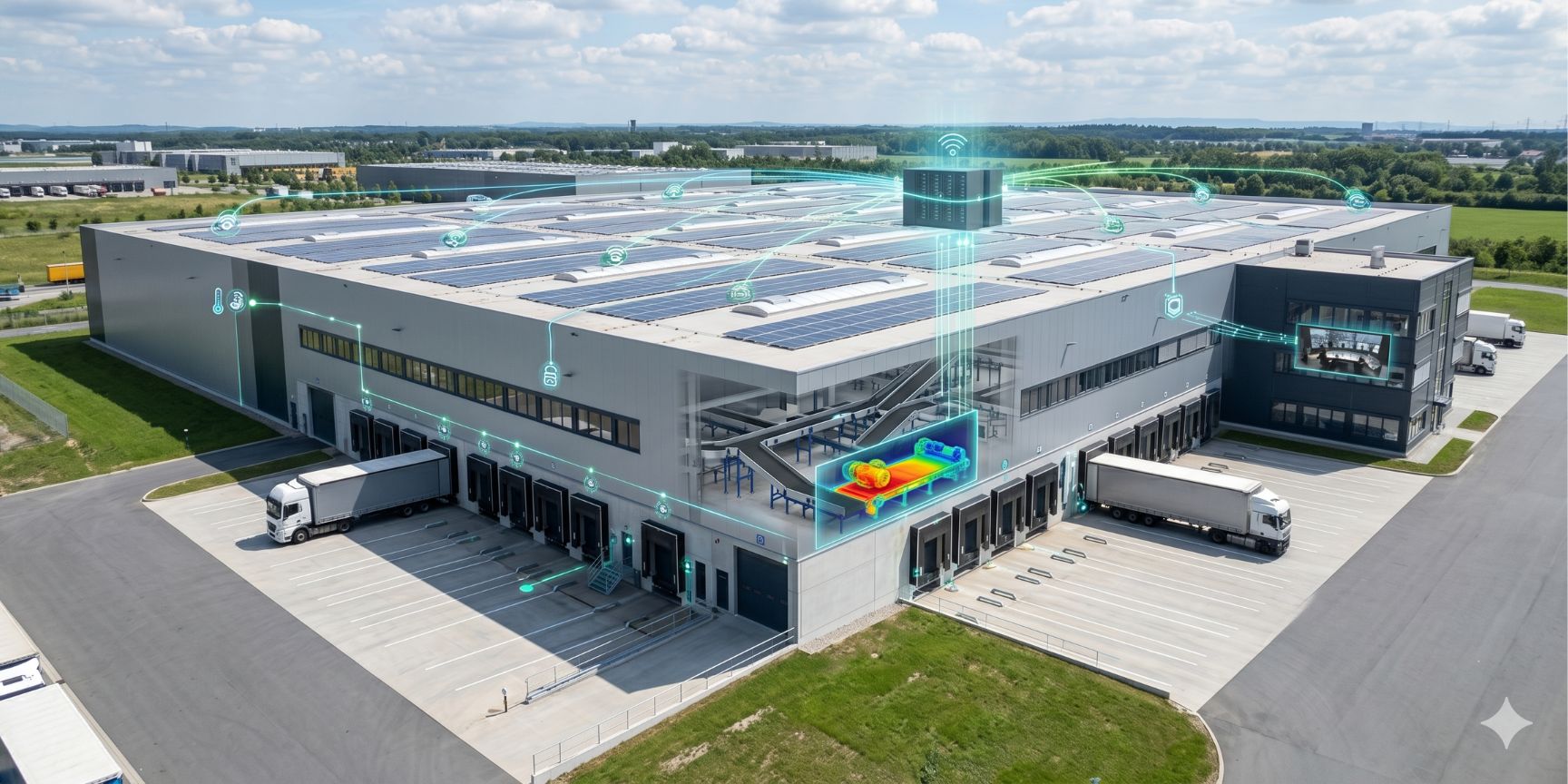
Often neglected, but essential: the property itself. Predictive logistics also extends to the technical infrastructure of the hall (predictive maintenance).
| Area | Classic (Reactive) | Predictive |
| Loading gates | Repair after defect | Sensor reports wear before failure |
| Industrial trucks | Rigid maintenance intervals | Use-oriented maintenance |
| Energy management | Heating according to schedule | Forecast-based heating/cooling (weather data) |
| Roof condition | Control in case of leakage | Sensors for early detection of waterlogging/load |
This leads to a significant reduction in the total cost of ownership (TCO) of a logistics property and increases the value of the asset for investors.
Figures, data, facts: The measurable benefits
Studies and practical values from industry show that the implementation of predictive systems is not a gimmick, but brings hard economic benefits:
- Reduction of storage costs: Between 10% and 25% through optimized inventories.
- Increase in pick efficiency: Up to 15% through improved slotting.
- Reduction of maintenance costs: Around 20% less unplanned downtime for technical systems (sorter systems, conveyor technology).
- CO2 savings: Optimised routes and intelligent energy management in the hall can reduce emissions by approx. 5-10%.
FAQ – Frequently asked questions about predictive logistics
Question: Does predictive logistics require a completely new IT infrastructure?
Answer: Not necessarily. Most modern warehouse management systems (WMS) or ERP solutions already offer interfaces for AI modules. The decisive factor is the data quality ("garbage in, garbage out"). A clean database is more important than an expensive new system.
Question: Is predictive maintenance also worthwhile for smaller halls?
Answer: Yes, especially in the case of critical bottlenecks such as automatic sorting systems or cooling technologies. The failure of a cooling system in a 5,000 sqm hall can be more expensive than the installation of predictive sensors.
Question: How does predictive logistics differ from classic statistics?
Answer: Statistics look back. Predictive logistics uses this hindsight, but links it to real-time variables and constantly learns through machine learning, so that forecasts become more and more precise over time.
The role of the hall in the networked chain
The modern logistics hall is no longer just a "storage box", but an active data hub. Through the use of IoT (Internet of Things) sensors, the physical shell becomes part of the digital supply chain.
For real estate developers, this means that pre-installation with fiber optics, nationwide 5G/WLAN and sensor platforms is just as important today as the floor load capacity or the number of gates. A property that cannot provide data quickly becomes a "stranded asset" in a world of predictive logistics.
Conclusion for practice
Predictive logistics is no longer a future scenario, but a necessity for competitiveness.
- Start small: Identify an area (e.g. inventory management) where the data situation is good.
- Check infrastructure: Is your logistics property ready for IoT?
- Choose partners: Contract logistics companies should proactively ask about the predictive capabilities of their service providers.
Those who are able to answer tomorrow's questions today before they are asked will secure a decisive advantage in the tough logistics market.