




Pick-by-Voice in the warehouse
Table of Contents
- Pick-by-Voice: The dialogue system in modern warehouse logistics
- Functionality and process integration
- Requirements for the logistics property and hall infrastructure
- Pick-by-Voice in Contract Logistics: Flexibility as a trump card
- Facts and figures: Focus on efficiency gains
- Technical Hardware Components
- Questions and answers (FAQ) about Pick-by-Voice
- Disadvantages and limitations of the system
- Conclusion: Standard of the future
Pick-by-Voice: The dialogue system in modern warehouse logistics
Pick-by-Voice (also known as Voice Picking) refers to a paperless picking process in which communication between the warehouse management system (WMS) and the warehouse employee takes place exclusively via voice. Unlike scanner-based systems (pick-by-scan) or visual aids (pick-by-light), this procedure leaves the employee's hands and eyes free ("hands-free" and "eyes-free"). This makes the system a standard in high-performance logistics, especially in food retailing, fresh food logistics and, increasingly, e-commerce.
Functionality and process integration
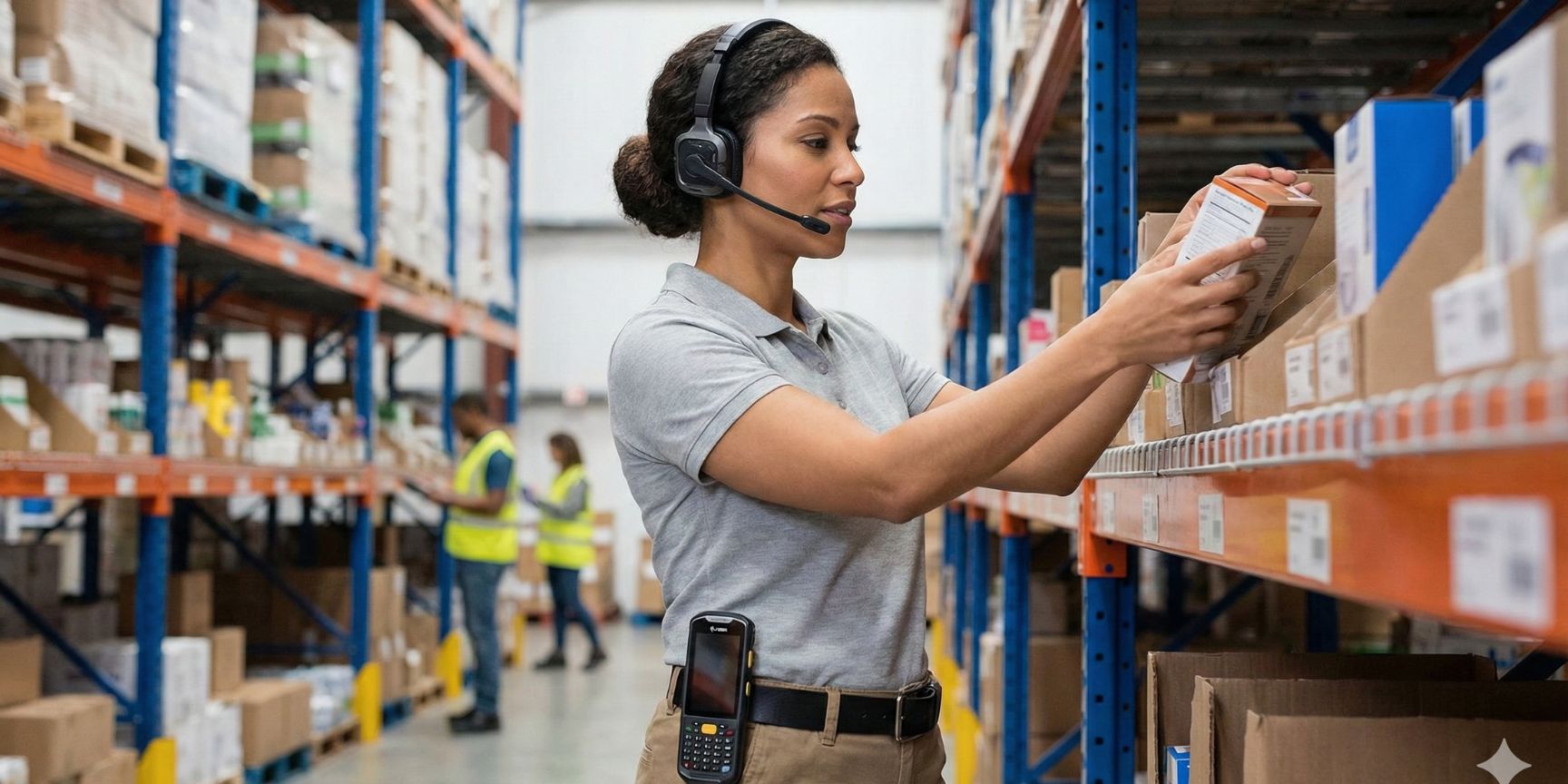
The employee wears a mobile data acquisition device (MDE) on his belt and a headset. The system converts digital pick orders from the WMS into voice commands using "text-to-speech".
- Instruction: The employee receives the instruction: "Aisle 4, Seat 12".
- Verification: When the employee arrives at the storage location, he reads out a check digit that is attached to the shelf.
- Withdrawal: The system confirms the location and calls the quantity: "Take 5".
- Confirmation: The employee confirms the withdrawal with a short command (e.g. "Okay" or "Five").
- Correction: If the stock deviates, this can be reported immediately verbally ("shortage"), which enables real-time inventory.
Requirements for the logistics property and hall infrastructure
For developers and operators of logistics properties, the use of pick-by-voice significantly changes the requirements for technical building equipment (TGA).
- Wi-Fi illumination (connectivity): Since voice systems constantly send and receive data packets, seamless Wi-Fi coverage (high-density Wi-Fi) to the last corner of the hall is essential. Roaming interruptions lead to direct disruptions in voice dialogue.
- Acoustics and noise levels: Although modern headsets have noise-cancelling, the hall should be designed to avoid extreme noise peaks. In areas with a high sound pressure level (e.g. due to conveyor technology), sound-absorbing measures on ceilings or walls may have to be tested.
- Lighting: An often underestimated advantage for the property: Since the employee does not have to read lists or scan displays, the requirements for the lux number (illuminance) in the aisles are often lower than with paper-based warehouses. This holds potential for energy savings (green logistics).
Pick-by-Voice in Contract Logistics: Flexibility as a trump card
In contract logistics, which is characterized by fluctuating volumes, seasonal peaks and frequently changing clients, pick-by-voice offers decisive competitive advantages.
- Fast onboarding: The training of new employees or seasonal workers is extremely fast. Studies show that the training time can be reduced from several days (for lists) to a few hours. The system guides the new employee intuitively ("teach-in" procedures are often no longer necessary with speaker-independent systems).
- Multi-language support: In a diverse workforce, the language barrier is often an obstacle. Modern voice systems speak dozens of languages. The system speaks German, Polish or Turkish, while the WMS works in the background in a standardized manner.
- Multi-client capability: A picker can theoretically process orders for different clients in parallel (multi-order picking), as the system manages the complexity of the assignment in the background and only instructs the employee where to place the goods (e.g. on which trolley location).
Facts and figures: Focus on efficiency gains
Why are companies investing in this technology? The numbers speak for themselves:
- Error rate: The pick error rate drops drastically, often to less than 0.1% to 0.08%. The compulsion to confirm the check digit almost eliminates gripping errors.
- Productivity: Pick performance (picks per hour) increases by an average of 15% to 35% compared to handheld scanners due to the need to constantly pick up and put the scanner away.
- ROI (Return on Investment): Due to the increase in efficiency, voice systems often pay for themselves within 9 to 15 months.
Technical Hardware Components
A professional pick-by-voice setup consists of three core components:
- The voice client (software): The interface to the WMS/ERP.
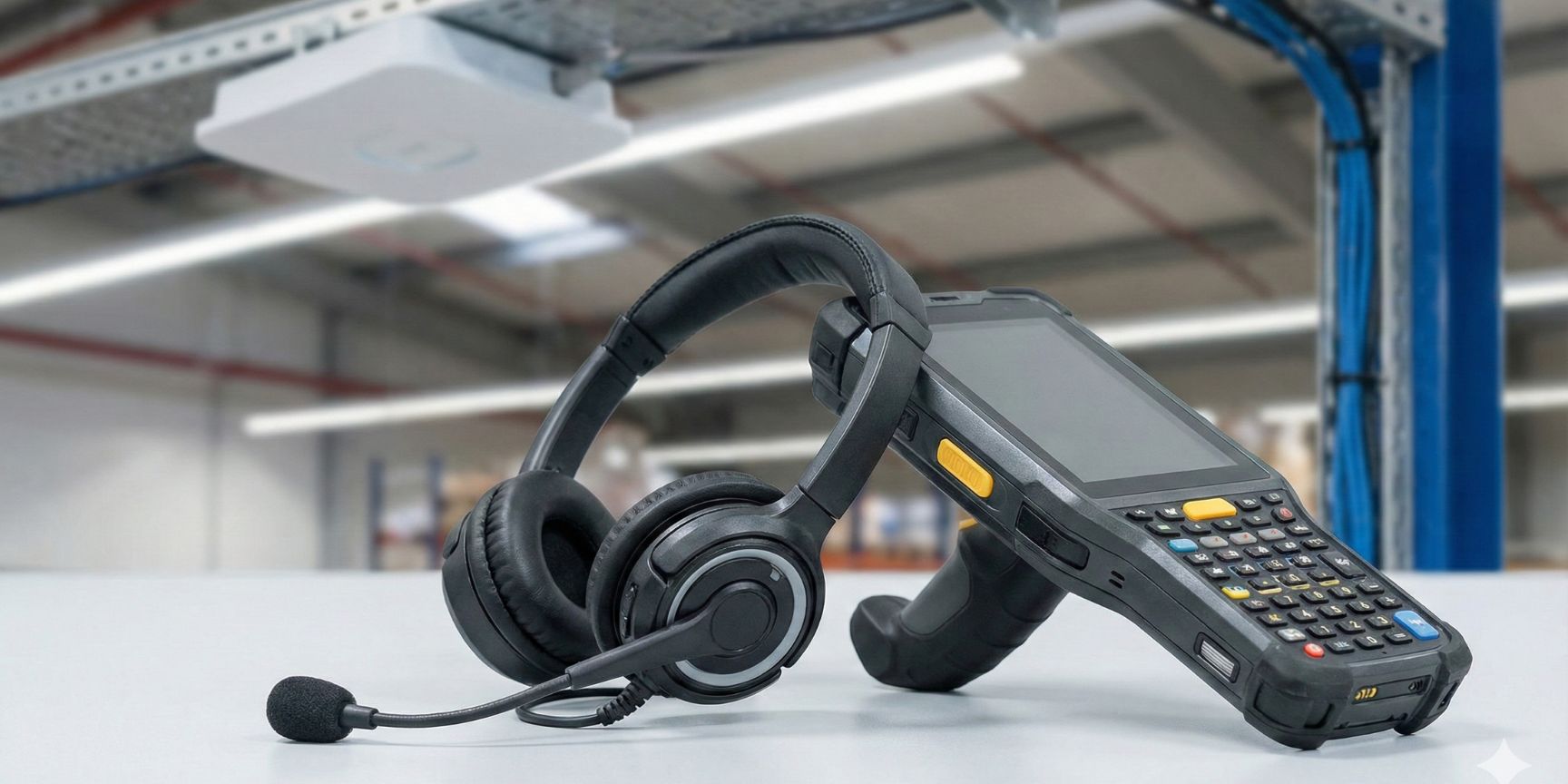
- The mobile computer: Often robust wearables without a display that are worn on the belt. Newer approaches also use Android smartphones or smartwatches.
- The headset: It must be extremely durable (rugged design), lightweight and suitable for shift operation (replaceable hygiene pads). There are wired and Bluetooth variants (although Bluetooth can present challenges in radio-dense environments).
Questions and answers (FAQ) about Pick-by-Voice
Question: Is Pick-by-Voice only suitable for large warehouses?
Answer: Originally yes, but due to falling hardware costs and cloud solutions, its use is now also worthwhile for medium-sized warehouses with about 3-5 order pickers per shift.
Question: How does the system deal with dialects or accents?
Answer: Modern systems use "speaker-independent recognition". They no longer need individual voice training and understand dialects and accents very reliably thanks to AI-supported algorithms.
Question: Can pick-by-voice be combined with other technologies?
Answer: Yes, hybrid approaches are common. For example, pick-by-voice can be combined with pick-by-vision (data glasses) to show the employee additional images of the article (useful for articles that are difficult to distinguish verbally). The combination with Screen (tablets on industrial trucks) for long list views is also common.
Disadvantages and limitations of the system
In order to ensure a complete view, the limits must also be mentioned. Pick-by-voice reaches its limits where visual information is absolutely necessary – for example, when checking best-before dates that are not stored in the system, or when checking complex packing patterns on a pallet (Tetris problem). Here, the employee lacks visual support. In addition, the constant "having in the ear" of the computer voice can lead to psychological fatigue or isolation for some employees, which is why break regulations and ergonomic headsets (e.g. one-sided earphones for environmental perception) are important.
Conclusion: Standard of the future
Pick-by-voice has evolved from a niche technology to a standard in modern warehouse logistics. For the logistics property, this means a shift in priorities from light to network stability. For contract logistics companies, it is the tool of choice for ensuring flexibility and quality in a volatile market environment.