




Pick-by-Case in the warehouse
Table of Contents
- Definition and functionality: What is pick-by-case?
- The central role of master data and "cubing"
- Effects on the logistics property and hall planning
- Pick-by-Case in Contract Logistics: Flexibility and Costs
- Questions and Answers (Q&A) on Practical Application
- Ecological aspects and sustainability
- Implementation Challenges
- Conclusion: When is the investment worthwhile?
Definition and functionality: What is pick-by-case?
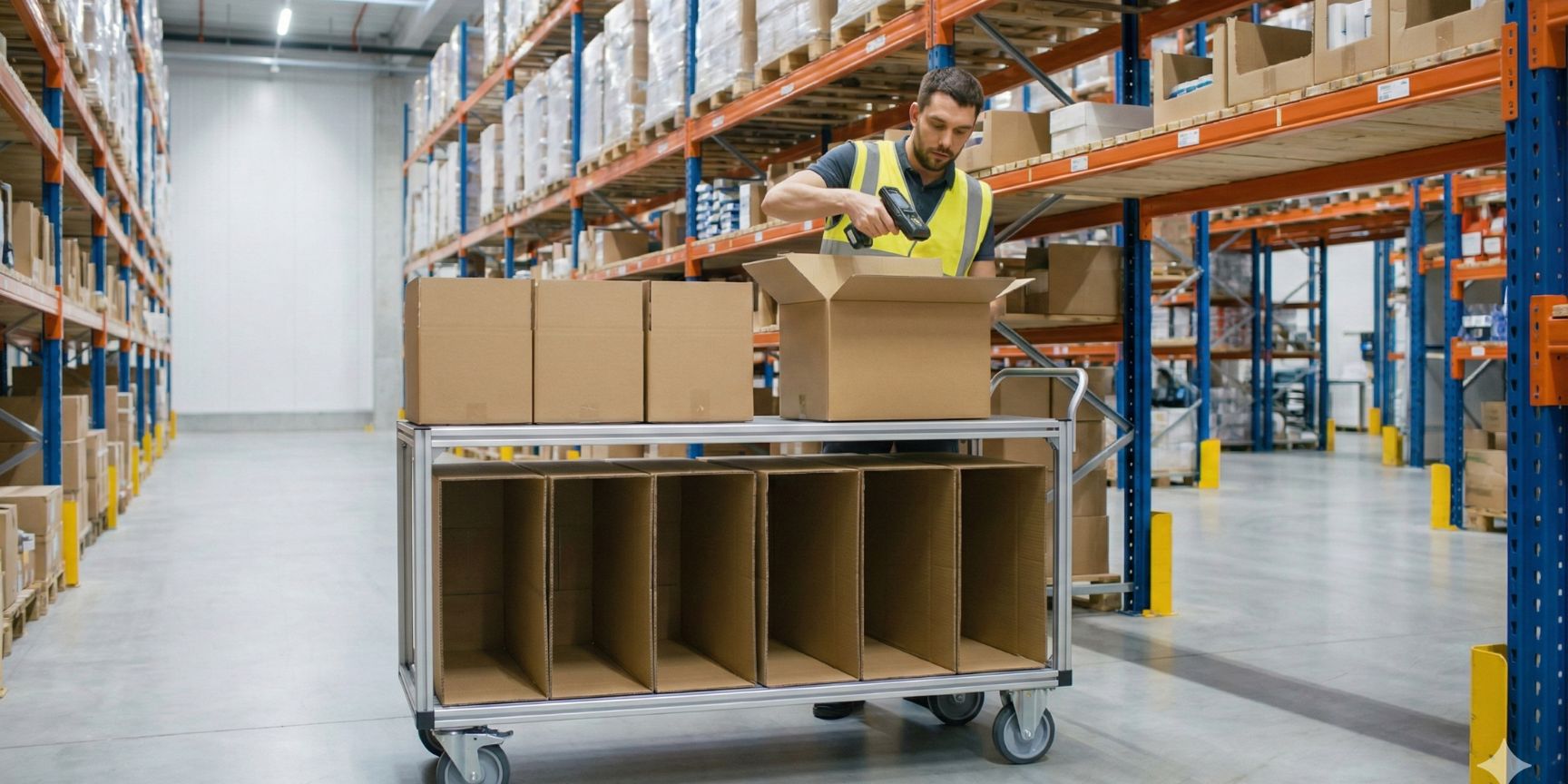
Pick-by-case (also pick-in-box or picking into the shipping container) is a picking method in which the goods are removed directly from the storage bin into the final shipping container. In contrast to two-stage picking (pick-and-pack), in which items are first collected in collection containers and repacked at a separate packing station, pick-by-case eliminates this consolidation and repacking step.
The process begins virtually: The Warehouse Management System (WMS) calculates the volume of the order in advance and determines the optimal shipping carton. The order picker receives this box, labels it (often initiated fully automatically) and fills it during his round. Once the order is complete, the box is immediately sealed and handed over to shipping.
The central role of master data and "cubing"
For pick-by-case to work in practice, excellent data quality is indispensable. This is often the sore point in implementation. The system must have the following parameters:
- Exact dimensions (length, width, height) of each item.
- Weight of each item.
- Volume and load capacity of the available shipping cartons.
On the basis of this data, the WMS carries out a so-called cubing . It calculates in milliseconds which article combination fits into which box without transporting too much "air" or overflowing the box. If this data is missing or inaccurate, the process fails because the employee realizes at the end of the pick route that the goods do not fit, resulting in time-consuming manual corrections.
Effects on the logistics property and hall planning
From the point of view of logistics real estate and hall planning, the decision in favor of pick-by-case has far-reaching consequences for the layout and the use of space.
- Elimination of packing zones: Since the separate packing process is no longer necessary, large areas that would otherwise be required for packing tables and buffer sections are freed up. These square meters can be used for additional storage capacity or value-added services (VAS).
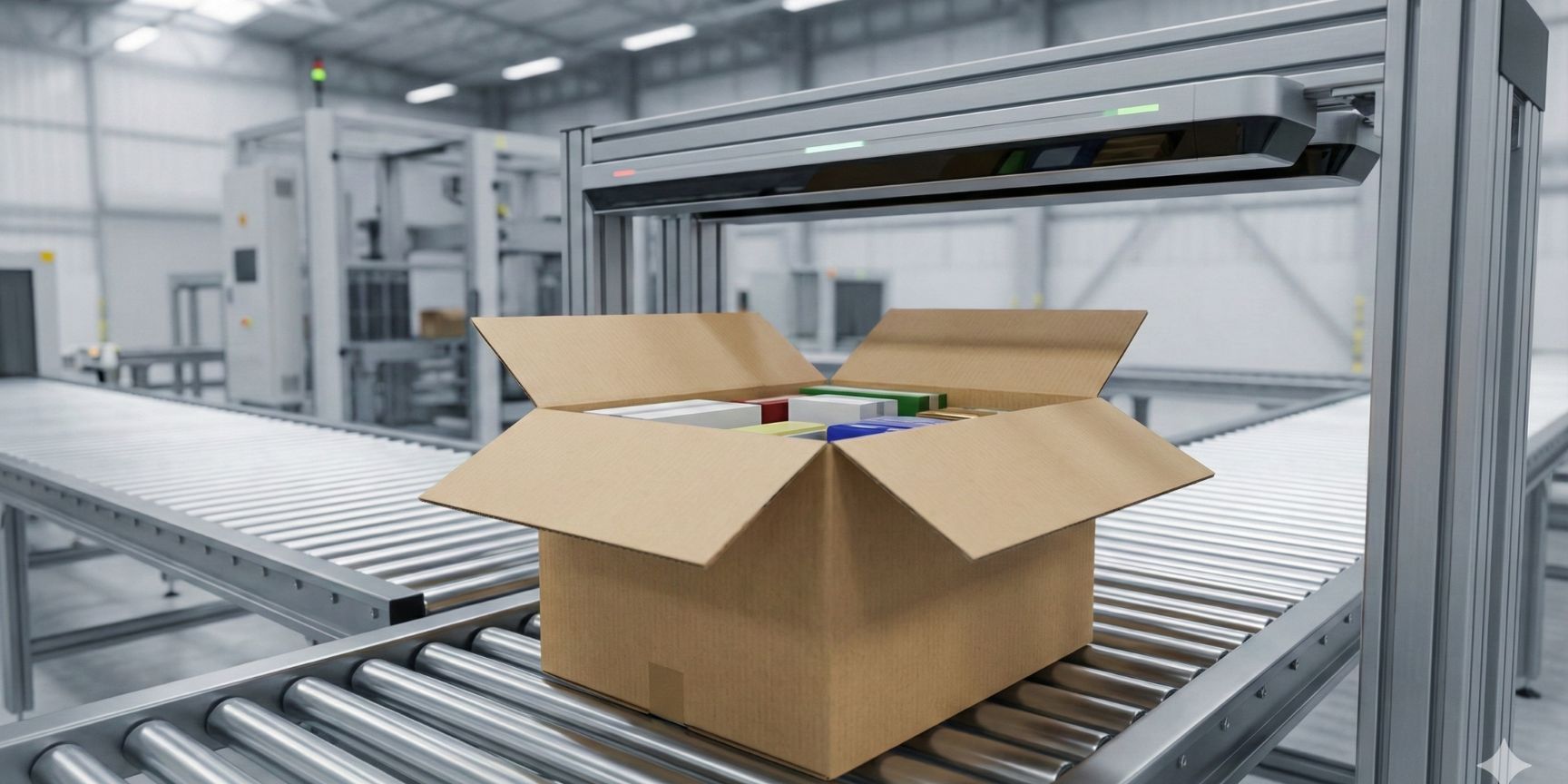
- Conveyor technology vs. manual trolleys: Pick-by-case is ideal for conveyor connections. Cartons can be erected automatically, guided through the aisles on container conveyor technology and capped at the end. This places demands on the floor conditions (anchoring of the conveyor technology) and the power supply in the hall.
- Fire protection: The direct use of cardboard in the aisles (instead of plastic containers) slightly increases the fire load in the picking zones, which must be taken into account when designing the sprinkler systems (ESFR).
Pick-by-Case in Contract Logistics: Flexibility and Costs
For contract logistics companies, pick-by-case is often the key to margins. Since personnel is one of the largest cost factors, the elimination of "double handling" (touching when picking + touching when packing) has a positive impact.
Fact-check efficiency: In classic pick-and-pack processes, the output is often 60–120 positions per hour (picks/h) including packing time. With an optimized pick-by-case, increases in overall productivity of 20 to 30% are possible, as the packing process is done "on the side". In addition, the material consumption (filling material) is reduced, as cubing often calculates better filling levels than a human being by eye.
Questions and Answers (Q&A) on Practical Application
Question: For which industries is pick-by-case best suited?
Answer: The process is predestined for e-commerce (B2C) and spare parts shipping, where orders often consist of several small-scale items that fit well into a standard box. It is less suitable for bulky goods or orders that require complex consolidation from different storage areas (e.g. pallet warehouses and small parts warehouses).
Question: How do you deal with quality control?
Answer: Since the packing station is no longer a "control instance", errors must be avoided during picking. Technologies such as pick-by-light, pick-by-voice or barcode scanning at each removal are imperative to minimize picking errors. In addition, integrated scales (checkweighing) are often used on the conveyor system to verify the contents of the carton by means of the target weight before it is sealed.
Question: What happens if the system has calculated the volume incorrectly?
Answer: This is the "worst case". The employee has to organize a new, larger box or split the order (split case). This massively disrupts the workflow. Therefore, many companies introduce tolerance values in the WMS that include a buffer for filling material to avoid physical bottlenecks in the carton.
Ecological aspects and sustainability
In times of ESG criteria (environmental, social, governance), pick-by-case offers ecological advantages. By algorithmically determining the carton size, the shipping volume is optimized ("Shipping Air" is reduced). Less air in the parcels means a higher utilization of the trucks in the outgoing goods area and thus a reduction in the CO2 footprint per unit shipped. In addition, there is no need to transport empty picking trays back, which saves internal distances and energy.
Implementation Challenges
The introduction is not just an IT project, but a change management process.
- Master data maintenance: Before the go-live, thousands of articles often have to be remeasured and weighed.
- Training: Employees have to pack more carefully (Tetris principle), as no downstream authority neatly sorts the goods into the box.
- Carton assortment: The selection of carton sizes must be statistically validated. Too many sizes increase the complexity in the warehouse, too few sizes lead to poor filling levels.
Conclusion: When is the investment worthwhile?
Pick-by-case is not a universal solution, but it is a powerful tool in modern distribution logistics. It is especially worthwhile for companies with:
- High shipment volume for small-scale goods.
- A modern, high-performance WMS.
- The desire to significantly reduce process costs and throughput times.
For the logistics real estate market, this means that halls must be flexible enough to accommodate both pure rack structures and complex conveyor system layouts, which are necessary for efficient pick-by-case processes.