




Pick-by-Vision in Warehouse Logistics
Table of Contents
- Pick-by-Vision: The Merging of Reality and the Data Plane
- Functionality and system architecture
- Increasing efficiency in warehouse logistics: Facts and figures
- The human factor: ergonomics and acceptance
- Importance for contract logistics: flexibility as a currency
- Requirements for the logistics property and hall infrastructure
- FAQ – Frequently asked questions from practice
- Summary and outlook
Pick-by-Vision: The Merging of Reality and the Data Plane
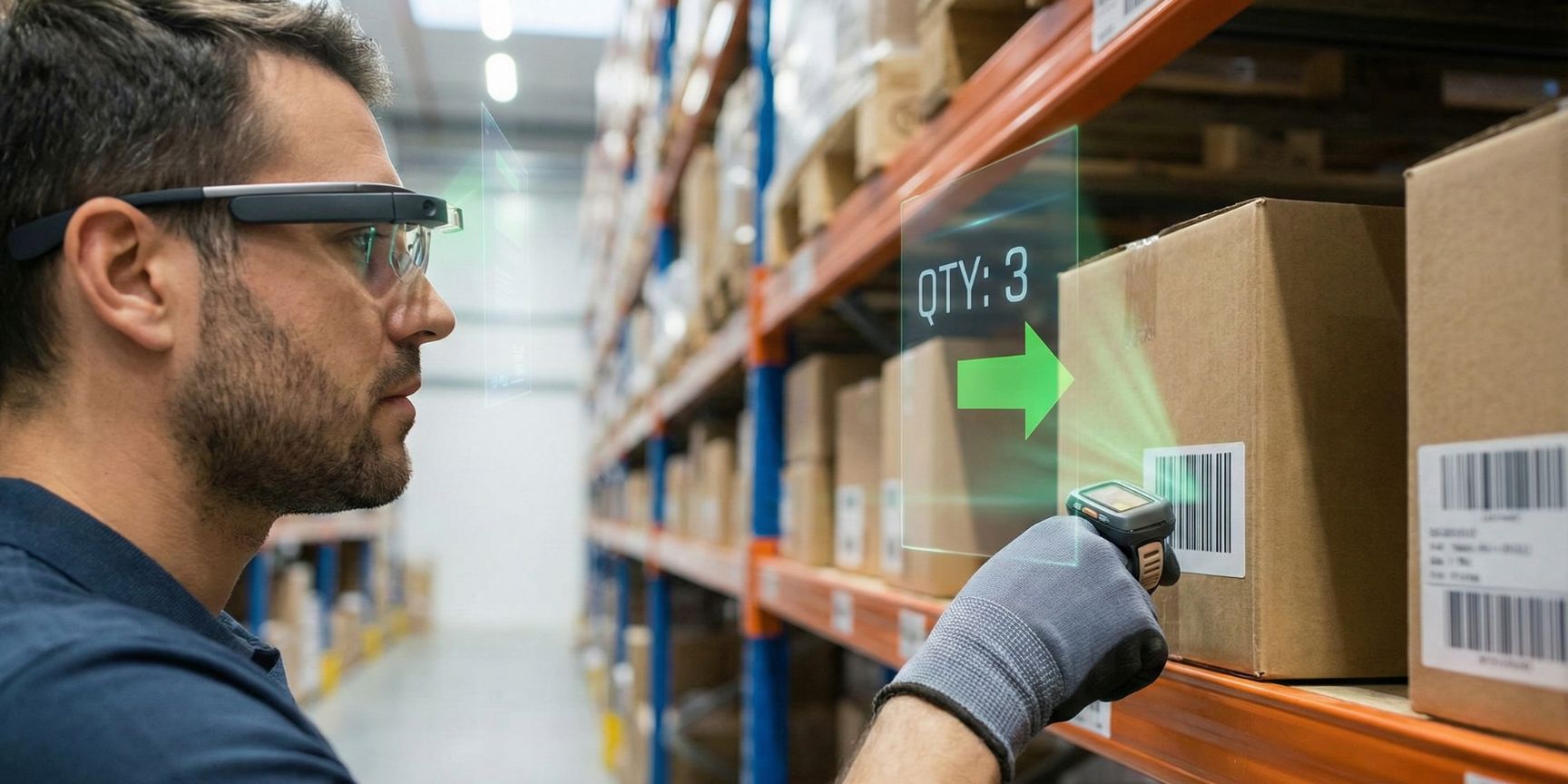
Pick-by-vision refers to a picking process in which warehouse employees are equipped with smart glasses. In contrast to static processes such as pick-by-light or acoustic methods such as pick-by-voice, all relevant information – storage location, article quantity, article description and navigation arrows – is displayed directly in the picker's field of vision.
Technologically, this is based on augmented reality (AR). The glasses enrich the real environment with additional virtual information. This enables "hands-free" work with simultaneous visual control, which makes the method particularly suitable for complex, multi-stage picking processes (multi-order picking).
Functionality and system architecture
At the heart of it all is bidirectional communication between the smart glasses and the Warehouse Management System (WMS) or ERP system.
- Order transmission: The WMS sends the pick order to the glasses via WLAN.
- Visual guidance: A graphical interface (UI) shows the employee the way and the destination.
- Verification: Confirmation is often done by integrated barcode scanners in the glasses, ring scanners on the finger or (more rarely) by gesture control.
- Real-time reconciliation: After the scan, the inventory is immediately updated in the WMS; Differences are reported in real time.
Increasing efficiency in warehouse logistics: Facts and figures
The primary driver for the adoption of pick-by-vision is process optimization. In practice, there are significant improvements compared to paper-based lists or handheld scanners:
- Error reduction: Due to the direct visual confirmation and the scan compulsion, the pick error rates often drop to less than 0.1%.
- Speed: Search times are eliminated by visual arrows and highlights. Studies and real-world applications report performance increases of between 15% and 30% compared to handheld scanners.
- Process reliability: Information is only visible when it is needed (context-sensitive), which reduces the cognitive load on the employee.
The human factor: ergonomics and acceptance
A frequently discussed aspect is hardware ergonomics. While early models were often heavy and had overheating problems, modern industrial data glasses (e.g. from Vuzix, Google or RealWear) today often weigh less than 50 grams.
Critical questions about "motion sickness" (nausea caused by AR) are justified, but mostly concern VR (Virtual Reality). Since pick-by-vision preserves the real field of vision and information is only displayed statically or accompanied, acceptance is very high if the glasses are adjusted correctly. The decisive factor here is an individually adaptable "monocular" (display in front of only one eye) or binocular systems that are less tiring.
Importance for contract logistics: flexibility as a currency
For contract logistics companies, which often struggle with seasonal fluctuations and high staff turnover, pick-by-vision offers a strategic advantage: the training period.
Traditional processes often require days of training to internalize item locations and terminal operation. With Pick-by-Vision, guidance is intuitive via colors and symbols.
- Onboarding effect: New employees or temporary workers often reach almost the performance level of the permanent workforce after just a few hours.
- Language independence: Visual icons (green arrow, red set) work across languages, which breaks down barriers in multicultural teams.
Requirements for the logistics property and hall infrastructure
Here, the topic is often underestimated. Pick-by-Vision places specific requirements on the property (hall) that facility managers and planners must take into account:
Wi-Fi illumination
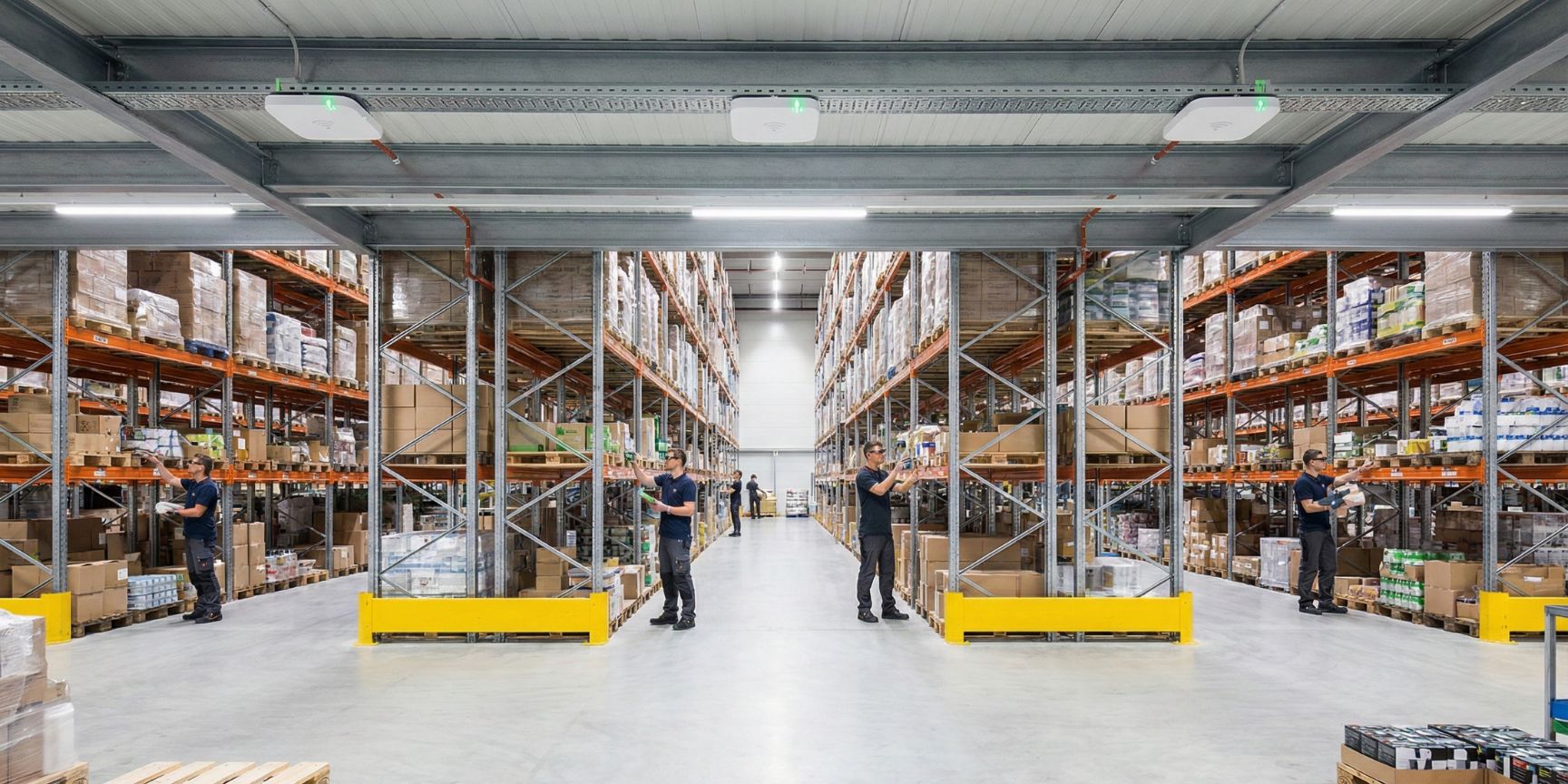
This is the most critical factor. Smart glasses require a permanent connection to the WMS.
- Problem: In high-bay warehouses with a lot of steel and liquids (damping), dead spots quickly arise.
- Solution: A professional "Site Survey" (WLAN illumination measurement) is mandatory. Access points must be placed in such a way that there is also a full signal in the aisles (not only above). Roaming (switching from one access point to the next) must take place in milliseconds and without interruption.
Lighting situation
Unlike pick-by-voice (where light is secondary) or pick-by-light (where displays light up), the hall lighting in Vision must harmonize with the glasses.
- Glare: Spotlights that are too bright can cause reflections on the prism of the glasses.
- Cameras: The integrated cameras of the glasses require sufficient lux (at least 300-500 lux at working height) to capture barcodes quickly and without delay ("pumping" the autofocus).
Aisle widths and warehouse layout
Pick-by-Vision does not require a fixed installation on the shelf (like Pick-by-Light). This makes it ideal for flexible hall layouts or block warehouses. It doesn't physically change aisle width requirements, but it allows for denser storage by eliminating the need to maintain fixed displays per compartment.
FAQ – Frequently asked questions from practice
Question: How long do the batteries of the glasses last in multi-shift operation?
Answer: Modern glasses have external battery packs or hot-swap functions (exchange during operation). A battery typically lasts 8-10 hours, sometimes less in intensive scanning mode, which is why exchangeable batteries are standard.
Question: Is Pick-by-Vision suitable for cold stores?
Answer: Yes, but with restrictions. The battery life drops drastically in the cold. Special, cold-resistant hardware versions are required. In addition, fogging of the display must be physically prevented during temperature changes (cold store to pre-zone).
Question: How high are the investment costs in comparison?
Answer: The initial costs are higher than for handheld scanners (hardware price approx. €1,000 - €2,000 per pair of glasses plus software licenses), but significantly lower than for pick-by-light (where each shelf compartment incurs costs). The ROI (return on investment) is usually achieved within 12 to 18 months through the increase in productivity.
Summary and outlook
Pick-by-Vision has long since left the status of an "experimental technology" and is an established solution in modern intralogistics. The system scores particularly well in contract logistics due to the rapid scalability of the workforce. For operators of logistics properties , the use means that the focus must shift away from physical installations on the shelf to a perfect digital infrastructure (high-performance WLAN).
In the future, the technology will continue to merge with artificial intelligence – for example, through automatic inventory recognition (image recognition instead of barcode scanning) or route optimization in real time based on traffic volume in the aisles.