




Peak Season in Logistics
Table of Contents
- Peak Season: Endurance Test and Sales Driver for Logistics
- Definition and seasonal cycles: More than just Christmas
- Warehouse logistics under high pressure: processes and inventory management
- The Role of Contract Logistics: Flexibility as a Currency
- Logistics real estate: requirements for the hall
- Reverse Logistics: The "Post-Peak" Wave
- Automation and IT as enablers
- Strategic checklist for logistics decision-makers
- Conclusion
Peak Season: Endurance Test and Sales Driver for Logistics
In logistics, the "peak season" refers to those periods in the financial year in which the volume of shipments and orders is significantly above the annual average. While the term is often used synonymously with the Christmas business in common parlance, the logistical reality is far more complex. For specialists in warehouse and contract logistics as well as for owners of logistics properties, this phase represents an extreme administrative and operational situation that must be planned months in advance.
Definition and seasonal cycles: More than just Christmas
Basically, the peak season is triggered by external market impulses. In the B2C (business-to-consumer) sector, the fourth quarter (Q4) is dominant. Driven by promotional days such as "Black Friday", "Cyber Monday" and the classic Christmas business, parcel volumes at courier, express and parcel services (CEP) often increase by up to 30 to 50 percent compared to normal months.
Question: Are there different peak seasons depending on the industry?
Answer: Yes. While e-commerce peaks in winter, other sectors are experiencing countercyclical spikes:
- Beverage logistics: High season in the summer months and before major events.
- Fashion logistics: Seasonal changes (spring/autumn) cause volume peaks in incoming and outgoing goods.
- Building materials logistics: Strong increase in spring, flattening out in winter.
A professional understanding of the peak season therefore requires the analysis of the specific volatility of the respective supply chain.
Warehouse logistics under high pressure: processes and inventory management
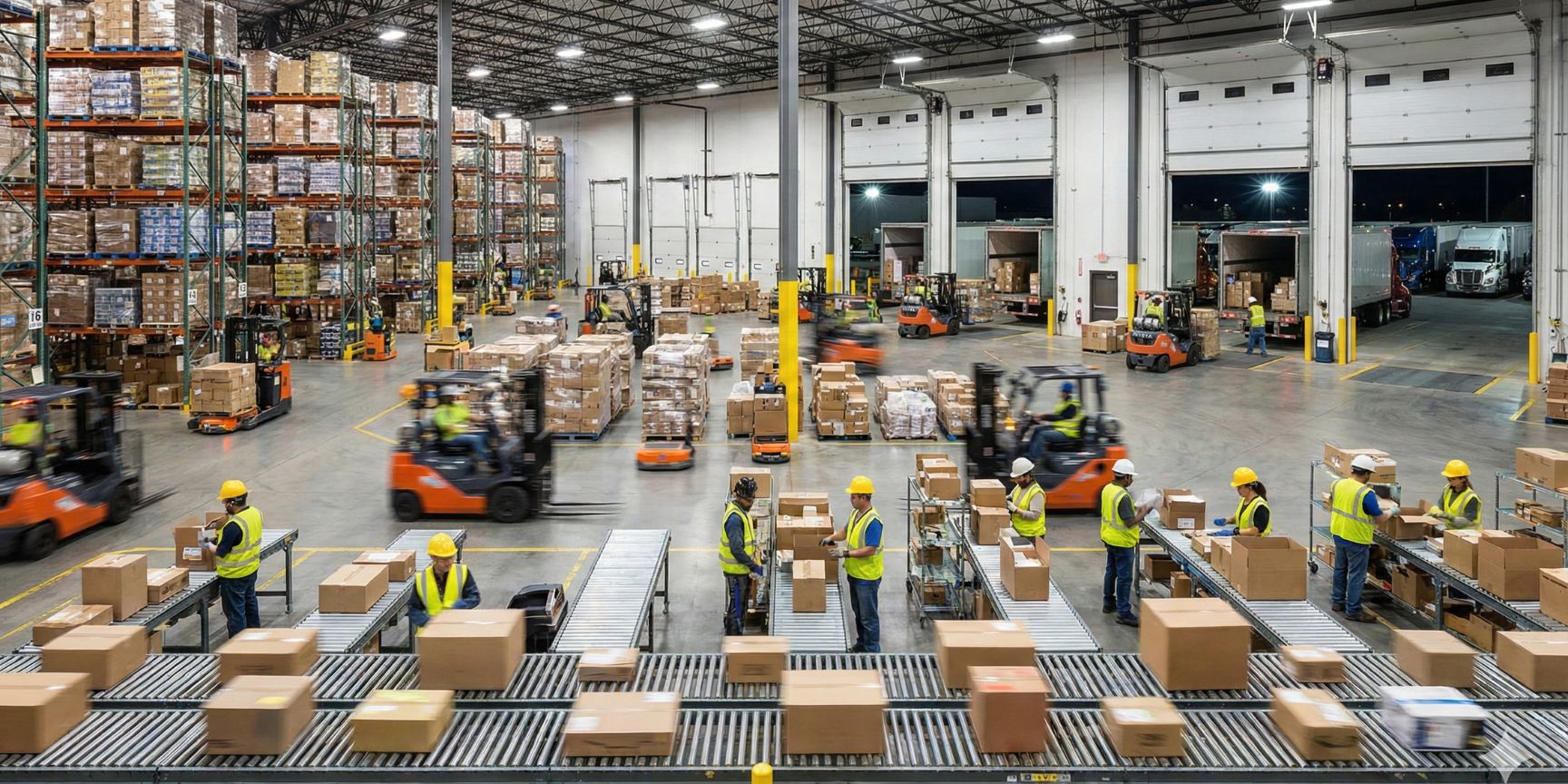
In operational warehouse logistics, the peak season leads to a consolidation of all processes. The main problem is often not only the number of orders, but the change in the order structure. The "pick density" is increasing, and throughput times must remain constant (same-day or next-day delivery) despite higher volumes.
Hierarchically, three core areas are affected:
- Inbound (goods receipt): Warehouses must be filled as early as Q3. This leads to an artificial shortage of parking spaces even before the actual sale.
- Intralogistics: Picking routes must be optimized. ABC analyses are often temporarily adjusted to place fast-movers closer to the shipping zones.
- Outbound (outbound goods): The cut-off times of CEP service providers are often stricter during peak season, which increases the pressure on delivery.
Technical note: In the peak season, the "just-in-time" principle often fails. Instead, many companies are switching to "just-in-case" strategies, which massively increases the inventory pressure due to safety stocks.
The Role of Contract Logistics: Flexibility as a Currency
For contract logistics companies that take over logistics services for third parties on a long-term basis, the peak season is the moment of truth regarding the agreed service level agreements (SLAs).
Question: How do contract logistics companies deal with volatility? The key word is breathing. Treaties must provide for "breathing" structures. This means:
- Personnel: Use of temporary workers (temporary work) to absorb peaks. In Germany, however, the labor market for qualified warehouse clerks is empty, which often causes personnel costs to rise disproportionately in the peak season due to bonuses and bonuses.
- Multi-user warehouses: Contract logistics companies are increasingly using warehouses in which several customers are served. If customer A (e.g. garden furniture) has little sales in winter, the space and staff can be used for customer B (e.g. toys). These synergy effects are essential for profitability.
Logistics real estate: requirements for the hall
From the point of view of the real estate industry, the peak season is changing the requirements for the "warehouse" asset. A property must be "peak-capable".
- Buffer areas: Modern logistics properties require flexible mezzanine levels or outdoor areas that can be temporarily used for the storage of empties or packaging material in order to keep the valuable hall space free for goods.
- Delivery: In the peak season, trucks are jammed. A ratio of at least one loading door per 800 to 1,000 m² of hall space is necessary to avoid bottlenecks in outgoing goods.
- Pop-up warehouses: There is a trend towards short-term leases of 3 to 6 months. Older existing properties (class B or C), which may not be suitable for modern automation, are experiencing a renaissance here as pure overflow warehouses.
Reverse Logistics: The "Post-Peak" Wave
An often underestimated aspect is returns logistics. Especially in e-commerce, the sales peak in December is followed by the returns peak in January.
Data shows that the return rate in categories such as fashion can rise to as high as 50% after Christmas . For warehouse logistics, this means that the processes must be converted from "dispatch" to "receipt, testing and reprocessing". Logistics areas must be planned in such a way that returns do not block the receipt of new goods.
Automation and IT as enablers
Manual processes reach their physiological limits during peak season. The use of technology is no longer a luxury, but a necessity.
- Forecasting: AI-powered forecasting tools analyze year-over-year data, weather trends, and marketing campaigns to predict volume on a weekly basis.
- Automation: Autonomous Mobile Robots (AMRs) can be rented temporarily (Robotics-as-a-Service) to increase picking performance without having to expand permanently installed conveyor technology.
Strategic checklist for logistics decision-makers
In order to successfully manage the peak season, the following points should be checked:
- IT stress test: Can the WMS (Warehouse Management System) withstand the tenfold increase in transaction load?
- Capacity balancing: Were CEP service providers informed about forecast quantities at an early stage? (Cap limits threaten!)
- Space management: Are overflow areas contractually secured?
- Personnel: Has onboarding been standardized for seasonal workers to minimize onboarding time?
Conclusion
The peak season is the pacesetter of modern logistics. It mercilessly reveals inefficiencies in the supply chain. For contract logistics companies and real estate operators, however, it also offers the greatest opportunity: those who deliver during the peak season retain customers in the long term. The trend is moving away from reactive "fire extinguishing" to data-driven, proactive seasonal planning, in which warehouse space and personnel resources are considered flexible variables.