



Goods receipt in the warehouse
Inhaltsverzeichnis
- What is the receiving of goods? Definition and delimitation
- The process of receiving goods in 7 steps
- Challenges and KPIs: Efficiency in Goods Receipt
- Q&A: Frequently Asked Questions on Goods Receipt
- Special case of contract logistics: Goods receipt for third parties
- The logistics property as a foundation: requirements for halls and gates
- Digitization and automation in incoming goods
What is the receiving of goods? Definition and delimitation
Goods receiving, often used synonymously with goods receiving , refers to the entire physical and administrative process associated with receiving goods at a warehouse, manufacturing facility, or distribution center.
This process forms the interface between external transport logistics (inflow) and internal intralogistics (storage, order picking). It formally begins with the arrival of the means of transport (e.g. truck, container) at the ramp or assigned unloading area and ends when the goods have been identified, checked, administratively recorded (booked) and handed over to the first storage location or buffer zone.
The core functions of goods receiving are:
- Physical acceptance: The unloading of the goods.
- Identification & verification: The comparison of the delivery with the order data (Avis).
- Quality & quantity assurance: Checking for completeness and integrity.
- Administrative entry: The posting of the goods in the warehouse management system (WMS/WMS) or ERP system, which makes the goods available "systemically".
In practice, the receipt of goods is the point of the transfer of risk. As soon as the goods are acknowledged as "in order", responsibility for the goods is transferred from the transport service provider to the recipient (the warehouse).
The process of receiving goods in 7 steps
Although the details vary greatly depending on the industry (e.g. pharmaceutical, automotive, e-commerce), the core process follows a standardized logic.
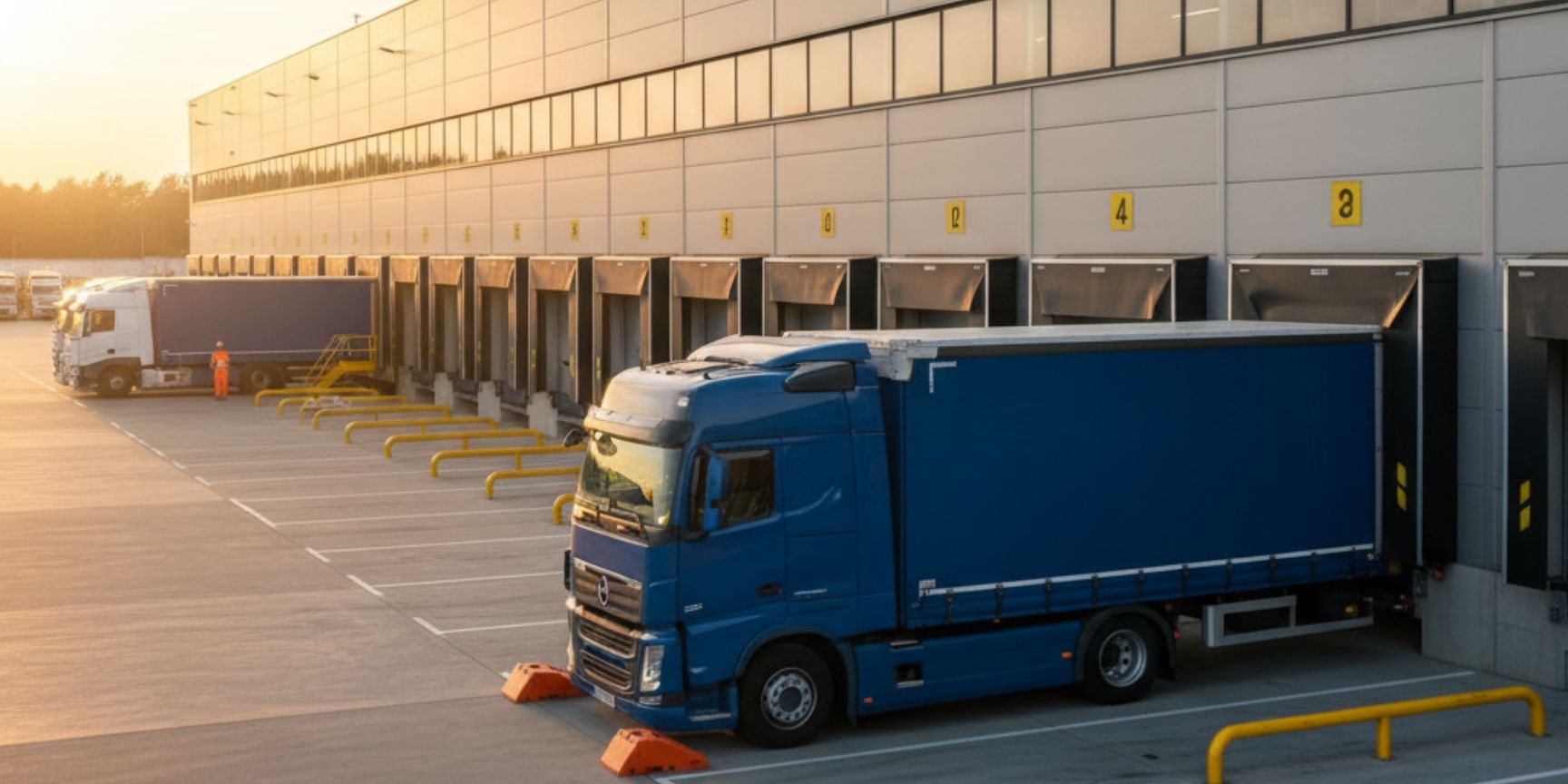
- Registration and Yard Management: The truck registers with the gatekeeper or a digital terminal. Modern yard management assigns a time slot and a specific gate (dock) to the vehicle to avoid traffic jams.
- Docking and securing: The vehicle drives up to the assigned dock leveller. Before the gates are opened, the truck is secured (e.g. by wheel chocks, traffic light systems).
- Unloading: The physical removal of goods (pallets, packages, lattice boxes) by means of industrial trucks (e.g. pallet trucks, forklifts). The goods are moved to the staging area directly in front of the gate.
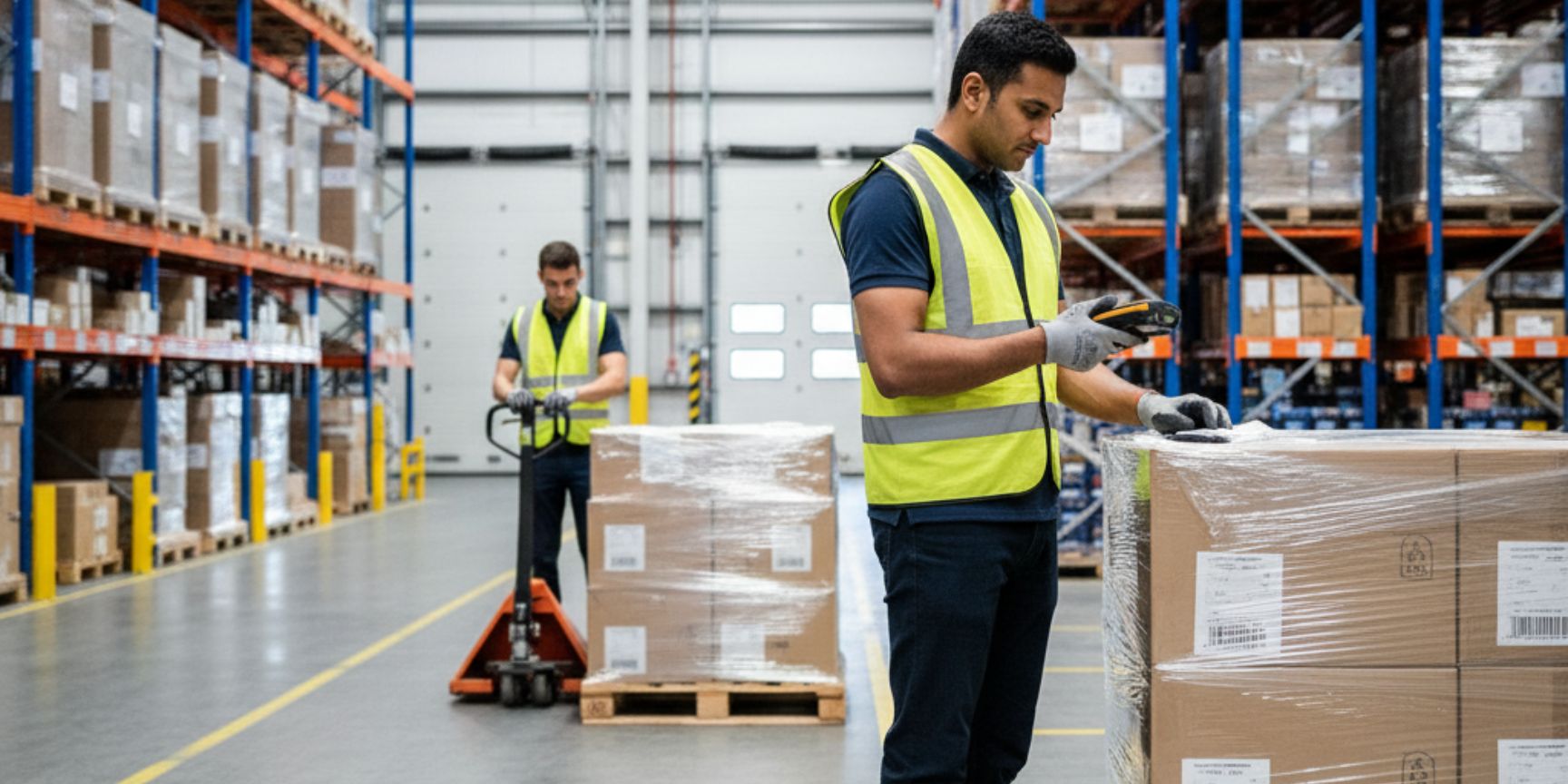
- Identification and quantity check (1st check): The warehouse worker compares the delivered packages with the freight documents (delivery note, consignment note). Is the number of pallets correct? Are the correct addressees noted? Modern systems use MDE (Mobile Data Capture) devices to scan NVE/SSCC codes, which are ideally transmitted in advance via ASN (Advanced Shipping Notice ).
- Quality inspection (2nd inspection): This is the actual incoming goods inspection.
- Visual inspection: Is packaging damaged, wet or dented?
- Random checking: If necessary (or predefined rules), individual boxes are opened to check items (SKUs), batch numbers or the best-before date (BBD).
- Booking and labelling: After successful inspection, the goods are "collected" or "booked" in the WMS (Warehouse Management System). The goods are now part of the inventory. Internal warehouse labels (with storage location suggestion) are often printed and applied here, if the goods have not already been labelled by the supplier in a standardised manner (e.g. according to VDA standards).
- Transfer to storage: The checked and booked goods are picked up from the staging zone and sent to the final storage location (e.g. high rack, block storage, shelving).
Challenges and KPIs: Efficiency in Goods Receipt
Incoming goods is often a bottleneck. The biggest challenge is to handle fluctuations in delivery volumes (peak times, e.g. in the morning) with limited resources (staff, gates, staging space).
Efficiency is measured by clear key performance indicators (KPIs ):
- Dock-to-Stock-Time (DTS): The time span from unloading (dock) to systemic availability at the storage location (stock). A high DTS (e.g. > 8 hours) means that goods are physically in the warehouse but are not yet available for picking, which can lead to out-of-stock. Benchmarks often target 2-4 hours.
- Error rate on delivery: The percentage of deliveries in which deviations (quantity, quality, incorrect items) were detected.
- Cost per goods receipt: The total costs (personnel, rent pro-rata, IT) divided by the number of items or delivery notes received.
- Dock Occupancy Rate: The average length of time a door is blocked for an unloading operation.
A lack of discipline in supplier notification (ASN) or insufficient staging area are the most common causes of inefficiencies.
Q&A: Frequently Asked Questions on Goods Receipt
Question: What happens in the event of deviations (shortages or damage)? Answer: The acceptance must not be acknowledged "purely". Any deviation must be noted in detail immediately on the freight documents (e.g. CMR consignment note) and countersigned by the driver (assumption "subject to change"). At the same time, the goods are physically separated (often in a "restricted warehouse" or a clarification zone) and blocked in the WMS. Photos and immediate notification to the purchasing / supplier are mandatory to secure liability and compensation claims.
Question: How detailed does the quality inspection have to be? Answer: That depends on the goods and the supplier relationship. In the case of A-suppliers with certified processes (e.g. "ship-to-stock"), often only the identity and external integrity are checked. For C-suppliers or sensitive goods (e.g. pharmaceuticals, food with a cold chain), intensive spot checks or even full tests (e.g. temperature control) are mandatory.
Question: Who is liable for damage that only becomes apparent after acceptance (hidden damage)? Answer: This is a legally complex field (regulated in the HGB/CMR). Concealed damage must be reported to the carrier (freight forwarder) immediately after discovery, usually within a period of 7 days. However, the burden of proof that the damage occurred during transport and not in the warehouse often lies with the recipient, which is difficult in practice.
Special case of contract logistics: Goods receipt for third parties
In contract logistics , a logistics service provider (3PL/4PL) does not receive goods for itself, but on behalf of a customer (client). This poses specific requirements:
- Multi-client capability: The WMS must be "multi-client capable", i.e. it must be able to manage the inventories, article masters and processes (e.g. audit rules) for each customer strictly separately.
- Service Level Agreements (SLAs): The processes are not optimized internally, but contractually fixed. An SLA could define that 98% of all deliveries must be booked "dock-to-stock" within X hours of arrival.
- Value Added Services (VAS): Very often, the VAS begins directly in the incoming goods department. This can include repacking into neutral cartons, applying customer-specific price labels (labeling), forming sets (kitting) or advanced quality controls.
- Reporting & Transparency: The client expects real-time transparency about the status of his goods, often via web portals or EDI interfaces.
The logistics property as a foundation: requirements for halls and gates
The efficiency of the goods receipt is largely dictated by the logistics property (the hall). Deficient structural conditions can hardly be compensated for by software.
- The gates (docks): It is not only the number of gates (depending on the turnover factor) that is decisive, but their type. For articulated trucks, ramp gates (approx. 1.20 m high) with dock levellers (hydraulic or manual) are standard to compensate for height differences to the truck. For smaller sprinters or side unloading, a ground-level ("jumbo") gate is required.
- The staging area: This is the most critical area. It is the buffer between the door and the rack warehouse. If this zone is too small, the unloaded goods block the traffic routes or even the next gate. In modern logistics halls (hall height often > 10 m UKB), a depth of the staging area of 15 to 25 meters is aimed at in order to be able to buffer at least one full truckload (approx. 33 pallets) without blocking the main traffic route.
- The yard: The outdoor area must offer sufficient manoeuvring space (recommended: approx. 35 m depth in front of the gate) and waiting areas for trucks waiting for their slot (yard management).
- Infrastructure: Very good illumination of the unloading zone (important for quality control), a stable IT infrastructure (WLAN for MDE scanners up to the gate) and flat floors (DIN 18202) for safe forklift traffic are essential.
Digitization and automation in incoming goods
Goods receipt is changing. While the MDE scanner with barcode (or RFID) for data capture is standard, the trend is towards higher automation to minimize dock-to-stock time.
- WMS/ERP integration: The WMS is the brain. It controls the processes, gives the employee instructions (e.g. "Check batch") and determines the optimal storage location (storage strategy).
- Automated data collection: "Gates" or tunnel systems that automatically scan, weigh and measure pallets as they pass (DWS - dimensioning, weighing, scanning). This eliminates manual input errors.
- Physical automation: This ranges from simple conveyor technology (roller conveyors) that transport packages from the gate to the inspection station to automatic truck loading/unloading systems (ATLS) that pull pallets out of the truck independently.
- AI and image recognition: Future systems will use cameras and AI (machine vision) to automatically detect damage to packaging or even incorrect items on a mixed pallet, supporting or replacing manual quality inspection.
Investing in these technologies pays off by reducing manual errors, speeding up processes and increasing transparency at the most valuable moment in the logistics chain: the receipt of the goods.