




Ground-level storage area in the warehouse
Table of Contents
- Ground-level storage area: definition and meaning in logistics
- Structural requirements for ground-level logistics properties
- Process advantages in contract logistics and intralogistics
- Suitability profile: For whom is ground-level delivery worthwhile?
- Questions and Answers (Q&A) on ground-level storage space
- Special feature: Storage of hazardous substances and WHG
- The "hybrid form": The gold standard of modern logistics real estate
- Conclusion and outlook
Ground-level storage area: definition and meaning in logistics
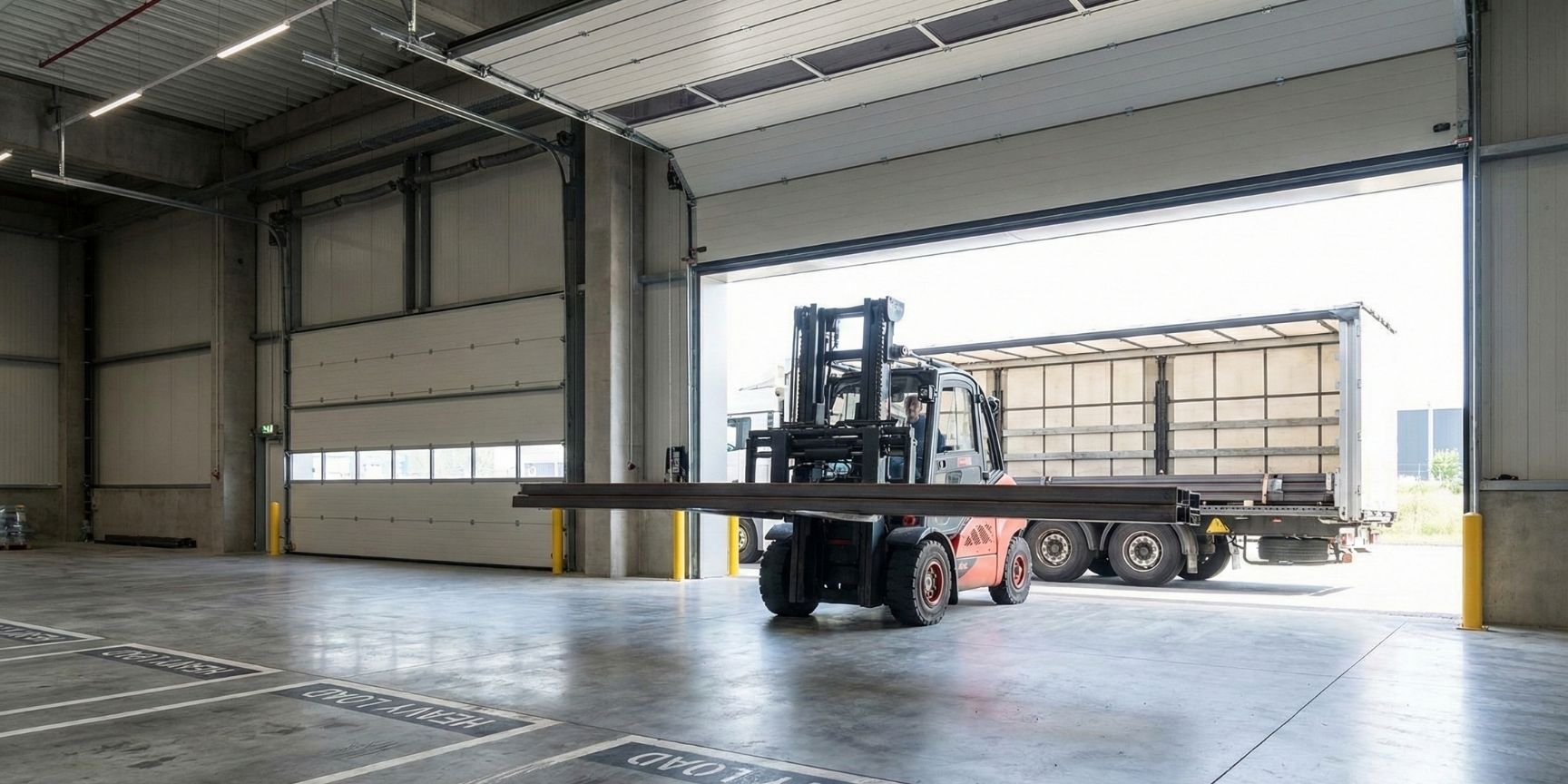
In the logistics real estate industry and warehouse logistics, a ground-level storage area refers to a hall area that does not have any loading ramps (docks), but whose hall floor is located at the same height level as the outdoor area (courtyard, access roads). Access is usually via large-sized sectional doors or roller shutters, which allow vehicles – from forklifts to trucks – to enter the hall directly.
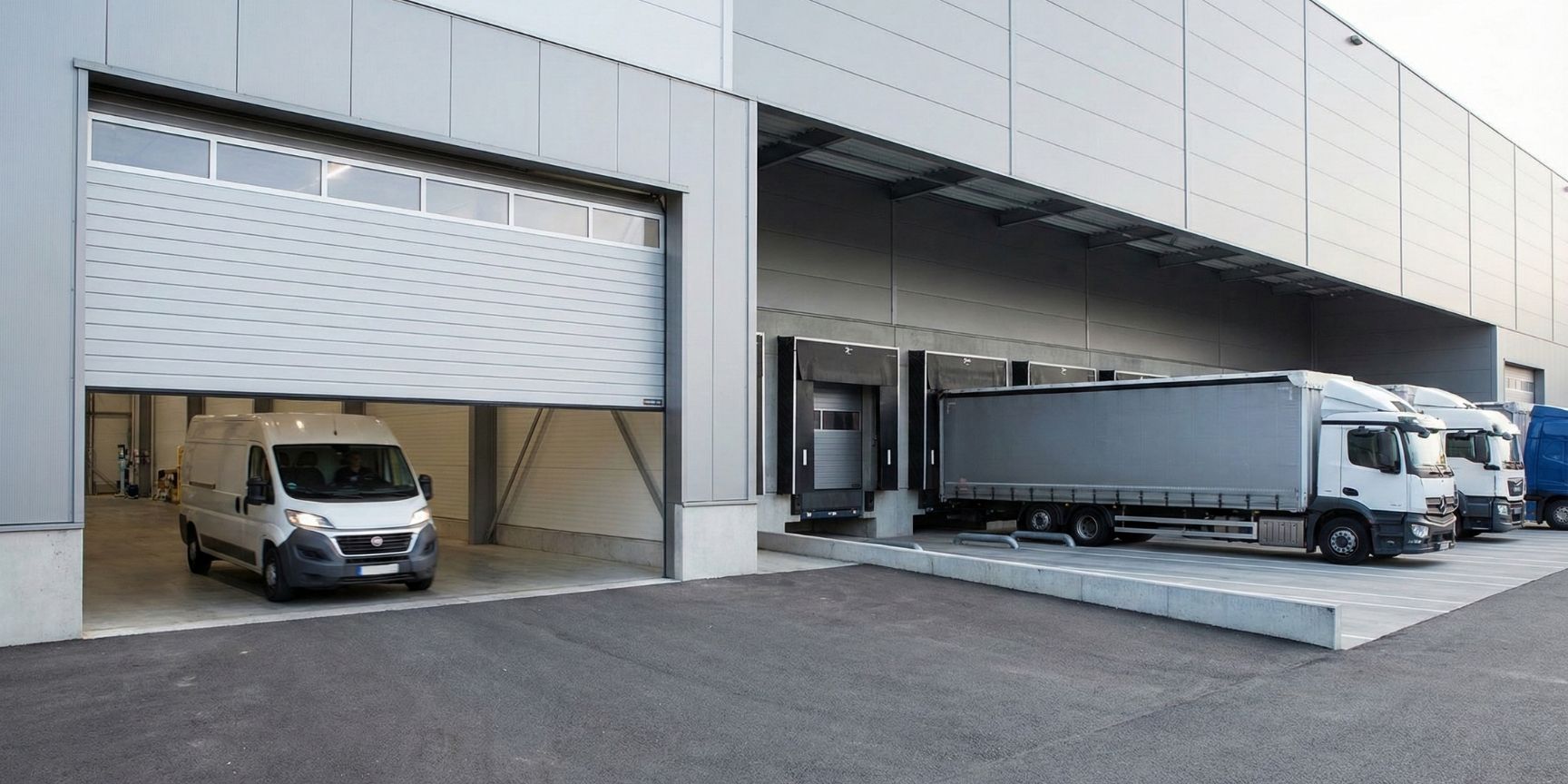
In contrast to the classic "ramp warehouse", in which the hall floor is approx. 1.20 metres above the yard level (dock level), ground-level delivery offers specific advantages for niche applications, heavy goods and city logistics.
Structural requirements for ground-level logistics properties
From the perspective of the logistics property, the ground-level hall differs from standard logistics construction in several technical respects:
- Soil condition & load-bearing capacity: Since ground-level surfaces are often used for heavy goods or trucks drive directly into the hall, the demands on the floor slab (base plate) are enormous. While standard logistics areas are often calculated at 50 kN/m² (approx. 5 t/m²), ground-level heavy-duty areas often require 75 kN/m² to 100 kN/m² or more. In addition, the floor must have the highest flatness values in accordance with DIN 18202 (tolerances in building construction) in order to minimise vibrations during direct entry.
- Door dimensions: A standard loading gate on a ramp often measures approx. 3.00 x 3.00 m. For ground-level delivery, doors of 4.00 x 4.50 m or larger (jumbo gates) are standard to ensure the passage of trucks including bodies or forklifts with high masts.
- Drainage and weather protection: Since the water could theoretically run into the hall at ground level during heavy rainfall, complex drainage systems (gutters in front of the gates) and a slight slope of the outer surfaces away from the gate are absolutely necessary.
Process advantages in contract logistics and intralogistics
In contract logistics, flexibility is the most important currency. Ground-level surfaces offer decisive advantages for specific process chains:
- Handling of long and heavy cargo: Goods that are not palletized (e.g. machines, steel girders, cable drums) are difficult to load via ramps. In the case of ground-level access, a forklift can remove the goods directly from the side of the truck (side-loading) or the truck can be unloaded inside by an indoor crane.
- Accelerated "last mile" processes: For courier, express and parcel services (CEP), the ground-level hall is often more efficient. Sprinters and vans can drive directly into the hall ("drive-in"), be loaded there and drive out again protected from the weather. This saves the time lost due to pallet truck transports to the ramp.
- Combination of indoor/outdoor: Forklift trucks can switch between outdoor and indoor storage without wasting time, without time-consuming ramp rides or the use of lifting tables.
Suitability profile: For whom is ground-level delivery worthwhile?
Not every type of logistics benefits from this type of construction. Clear segmentation helps with the choice of location:
| Feature | Ramp storage (dock level) | Ground-level storage (grade-level) |
| Vehicle type | Standard 40t semitrailer / container | Pick-up trucks, special trucks, side loaders |
| Cover type | Rear loading (rear-docking) | Side loading, crane loading, drive-in |
| Type of goods | Palletized standard goods (Euro/Chemical) | Heavy Lift, Machinery, Long Cargo, Hazardous Substances |
| Cross-docking | Very high (fast pass) | Lower (more likely long-term storage or project business) |
Questions and Answers (Q&A) on ground-level storage space
Question: Why are ground-level doors often equipped with strip curtains or high-speed doors?
Answer: Since vehicles often drive in and out of the hall with ground-level doors, the doors are open longer than with a sealed docking station. In order to avoid heat loss (energy efficiency) and draughts, high-speed foil doors or PVC strip curtains are often installed behind the solid sectional doors.
Question: Is a ground-level hall cheaper to build than a ramp hall?
Answer: Generally yes, as there is no need to fill in the terrain or construct a "base" for the 1.20 m height difference. However, higher demands on the floor slab (due to truck traffic) and special drainage systems can partially offset the cost savings.
Question: Can a ground-level hall be retrofitted with ramps?
Answer: This is extremely complex in terms of construction and usually uneconomical. The common solution for mixed forms is the installation of loading pits or the use of mobile ramps/dock levellers in order to still be able to load and unload standard trucks at the rear from time to time.
Special feature: Storage of hazardous substances and WHG
An often overlooked aspect of the storage of water-polluting substances (according to AwSV/WHG) is the advantage of ground-level construction. In the event of an accident, extinguishing water or escaping liquid must be retained. In ground-level halls, retention barriers (stop log systems) on the gates or floor pans are often easier to integrate, as the entire hall level can be designed as a "trough" without having to take into account the statics of an elevated floor slab (as in ramp warehouses). In addition, access for the fire brigade in ground-level halls is barrier-free in an emergency.
The "hybrid form": The gold standard of modern logistics real estate
In modern project development of logistics parks ("Big Box"), a hybrid construction method has become established. Pure ground-level halls have become rare because they limit the ability to use them for third parties (a classic e-commerce retailer absolutely needs ramps).
Today, the standard often looks like this: On 10,000 m² of hall space, there are about 10 to 12 loading gates (ramps) and at least one or two ground-level jumbo doors. This ensures that the tenant can handle mass business via the ramps, as well as control special transports or the entry of forklifts into the outdoor area via the ground-level access.
Conclusion and outlook
The ground-level storage area is not a relic of the old days, but a highly relevant component for specialized logistics processes. While the classic handling of consumer goods remains firmly in the hands of the ramp warehouses, ground-level delivery dominates wherever goods are bulky, vehicles have to be flexible or the "last mile" begins directly in the hall. For investors and project developers, the integration of at least one ground-level door per hall section (unit) is now mandatory in order to ensure rentability to a broad target group from production, trade and contract logistics.