




Rear loading in warehouse logistics
Table of contents
- Rear loading and rear handling: The interface of modern logistics
- Structural requirements: The ramp as a key element
- Key figures for the logistics property: planning and performance
- The operational process: Procedure and industrial trucks
- Special case: ISO loading bays and thermal docks
- Advantages of rear loading over side loading
- Challenges: Jumbo, Mega and Sprinter
- Questions and answers (FAQ) on rear loading
- Conclusion and outlook
Rear loading and rear handling: The interface of modern logistics
Rear loading (often used synonymously with the term rear handling) refers to the process of loading and unloading commercial vehicles via their back. Unlike side loading, which often takes place outdoors or under pitched roofs, rear loading is the industry standard for logistics centers, cross-docking facilities, and modern contract logistics locations. It enables a seamless connection between the cargo area of the truck and the hall floor, protected from the weather and optimized for the use of industrial trucks.
Structural requirements: The ramp as a key element
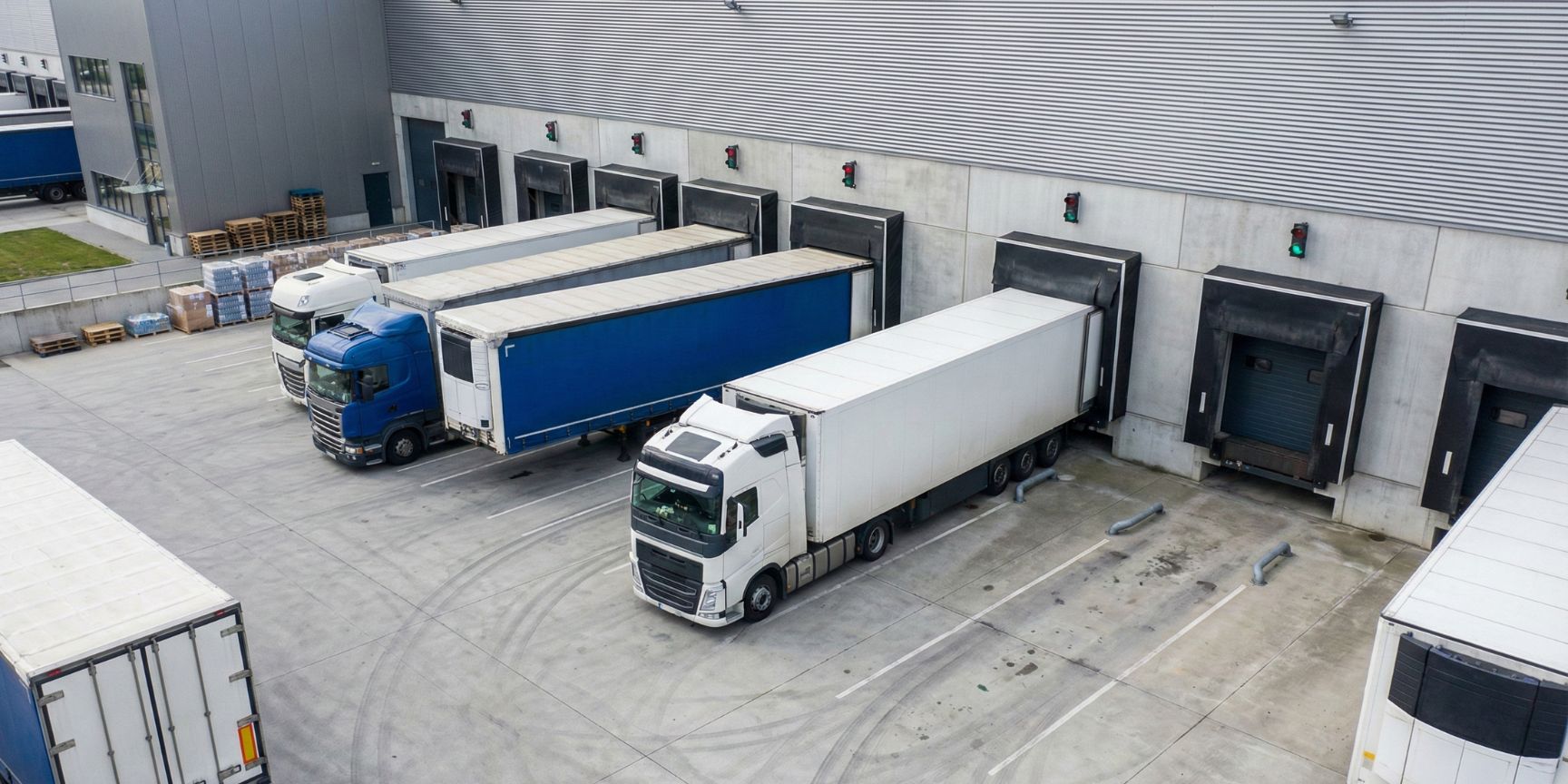
The architectural design of the logistics property is crucial for a functioning rear load. The aim is to compensate for the height between the hall level and the loading area of the truck.
- Ramp height: The standard for so-called "dock-high" gates is approx. 1.20 meters to 1.30 meters above the yard level. This corresponds to the common loading height of semi-trailers.
- Dock Levelers: Because truck heights vary (loaded vs. unloaded, megatrailer vs. standard), mechanical or hydraulic dock levelers are essential. In modern halls, moving bridges are mainly used, whose lip can be infinitely extended to ensure precise support on the truck floor.
- Shelters: In order to minimise energy losses and protect goods and personnel, dock shelters enclose the rear of the docking truck. Inflatable seals offer the highest tightness and are indispensable for temperature-controlled warehouses (refrigerated logistics).
Key figures for the logistics property: planning and performance
For investors, project developers and contract logistics companies, the number and design of the rear loading doors is a key evaluation criterion for a property. A hall without sufficient "ramp density" can become a bottleneck in supply chain management.
- Gate ratio (gates per sqm): The rule of thumb for modern standard logistics properties is: one goal per 1,000 m² of hall space.
- High-throughput properties: In the case of specialized cross-docking facilities or CEP service providers (courier, express, parcel), this rate is significantly increased, often to one door per 300 to 500 m², in order to maximize parallel handling processes.
- Yard planning: Rear loading requires space. There must be sufficient manoeuvring space (loading yard) in front of the gates. The industry standard requires a yard depth of at least 35 meters, preferably 40 meters, in order to enable an 18-meter articulated train to dock at right angles without having to maneuver several times.
The operational process: Procedure and industrial trucks
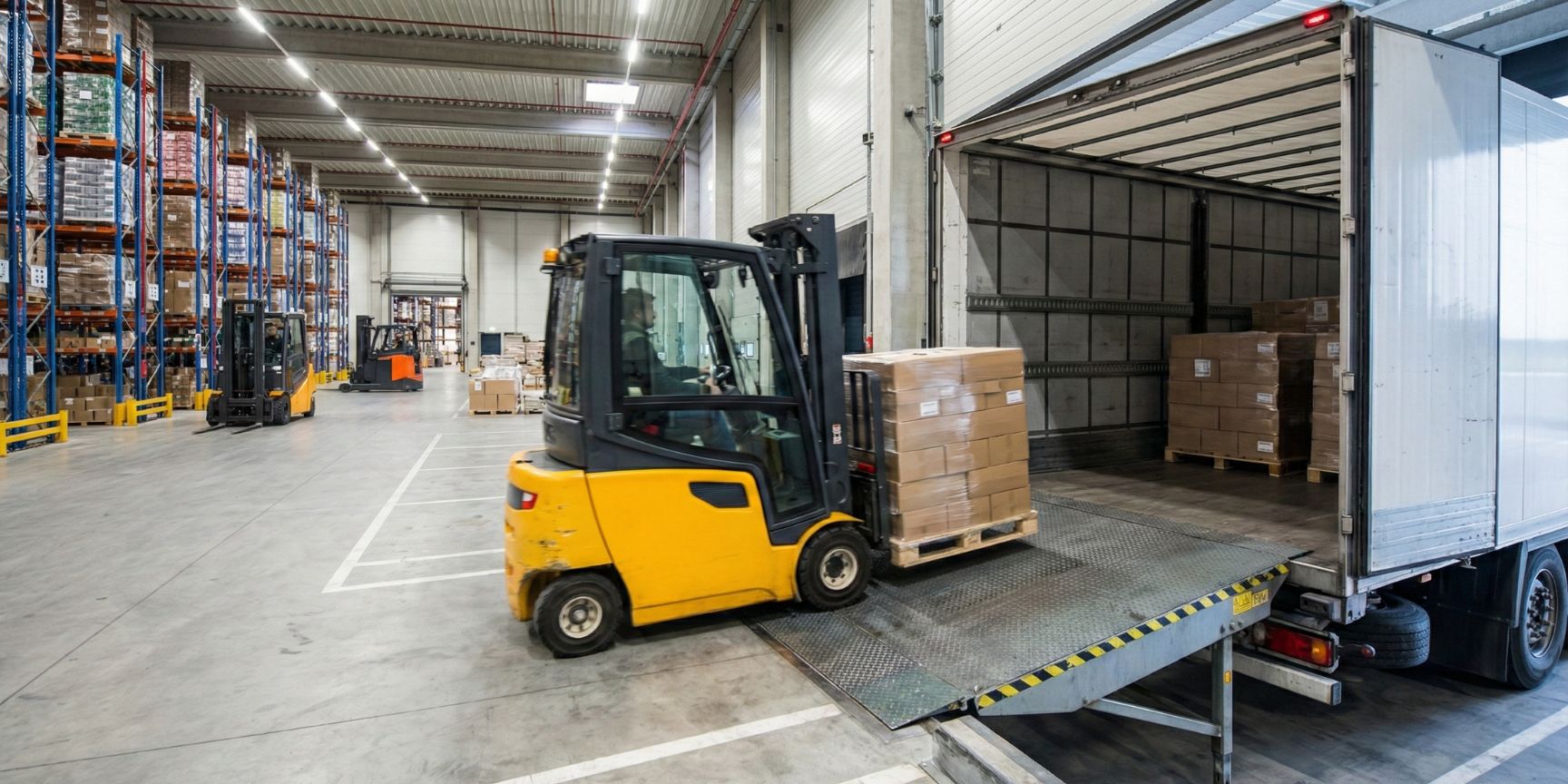
The rear handling is optimized for speed and safety. The truck drives backwards to the loading gate. As soon as the vehicle is docked and secured against rolling away (e.g. by automatic restraint systems or wheel chocks), the sectional door of the hall opens. Only then is the dock leveller positioned.
Technology used: Since the path is barrier-free, forklifts or electric pallet trucks (e-ants) can drive directly into the truck. This speeds up handling enormously compared to side loading, where the goods often have to be placed on the floor first and then picked up. A complete semitrailer (33-34 pallet spaces) can be unloaded in less than 30 minutes by means of rear loading and double-deck ants.
Special case: ISO loading bays and thermal docks
In the field of refrigerated logistics (Fresh & Frozen) or pharmaceutical logistics, rear loading represents a thermal weak point. So-called ISO loading docks have been established here.
With this concept, the doors of the truck only open after docking inside the building envelope or a special front-end lock. The truck docks with the doors closed, the seal inflates, and only then are the rear doors opened. This guarantees that the cold chain is not interrupted for a second ("Unbroken Cold Chain").
Advantages of rear loading over side loading
Why does rear loading dominate the logistics real estate market?
- Safety: Forklift traffic takes place separately from pedestrian traffic and protected from the outdoor area.
- Theft protection: Since the truck docks directly to the building, there is no gap through which unauthorized persons can enter or goods can be removed unnoticed.
- Weather protection: Sensitive goods (paper, electronics, food) do not get wet.
- Efficiency: Distances are shorter and the process is highly standardizable.
Challenges: Jumbo, Mega and Sprinter
Not every vehicle fits on every ramp. A common problem in contract logistics is the variance of truck types:
- Jumbo articulated trucks: Often have a lower loading height. Longer dock levellers are necessary here to keep the angle of inclination for industrial trucks flat enough (max. 12.5% gradient according to the employers' liability insurance association).
- Sprinters / delivery vehicles: These are much lower than the standard ramp (approx. 60-80 cm). Modern logistics properties therefore often equip some doors with special moving bridges or scissor lift tables or plan ground-level gates (jumbo gates) in order to be able to serve the "last mile".
Questions and answers (FAQ) on rear loading
Q: What is the difference between a launching bridge and a bascule wedge bridge? A: With the bascule wedge bridge, the extension piece at the front end simply folds down. It is the more cost-effective option. The moving bridge has a telescopic lip that can be extended continuously. It is the standard in contract logistics, as it allows for more precise positioning and better reaches the loading area in the truck ("the last pallet").
Question: Do I need a building permit for the ramps for the rear loading?
Answer: The ramps are part of the logistics property and therefore subject to building permits. Aspects of immission control law (noise protection) are also important here, as the manoeuvring and hitting of the dock levellers causes noise emissions that are regulated in mixed areas ("TA Lärm").
Question: What is a "sawtooth design" in loading docks?
Answer: In the sawtooth design, the gates are arranged at an angle to the hall wall. This is used when the outer courtyard does not provide enough depth for straight docking (less than 35m). The angle (often 45° or 60°) reduces the required manoeuvring space, but storage space is lost inside the hall.
Question: Why are bumpers so important?
Answer: When a 40-tonne truck docks backwards, enormous forces act on the building structure. Rubber buffers or movable steel buffers absorb this energy. Without them, the concrete of the ramp would quickly crack ("spalling"), which would result in expensive repairs to the logistics property.
Question: Is rear loading suitable for all goods?
Answer: Almost, but with exceptions. Long goods (e.g. 6-metre-long steel girders or wooden profiles) are very difficult to unload via the stern because they cannot be "pulled in". For such goods, side loading via ground-level gates is usually mandatory. Therefore, good logistics centers always have at least one ground-level gate.
Conclusion and outlook
Rear loading remains the gold standard in logistics real estate. Future developments are aimed at greater automation: Automatic truck loading systems (ATLS) can push pallets over the rear into the trailer in a matter of minutes without the need for a forklift. For operators and investors, this means that the quality of the "hardware" (ramp technology, courtyard size) determines the future viability of the location.