




Dock levellers in warehouse logistics
Table of contents
- Definition and functioning: The heart of the ramp
- Types in detail: folding wedge vs. feed wedge
- Sizing and angle of inclination: The mathematics of loading
- Load capacity: Dynamic vs. static
- Energy efficiency and ISO loading
- Safety technology and standards
- Selection criteria for investors and operators
- FAQ – Frequently asked questions from practice
- Conclusion
Definition and functioning: The heart of the ramp
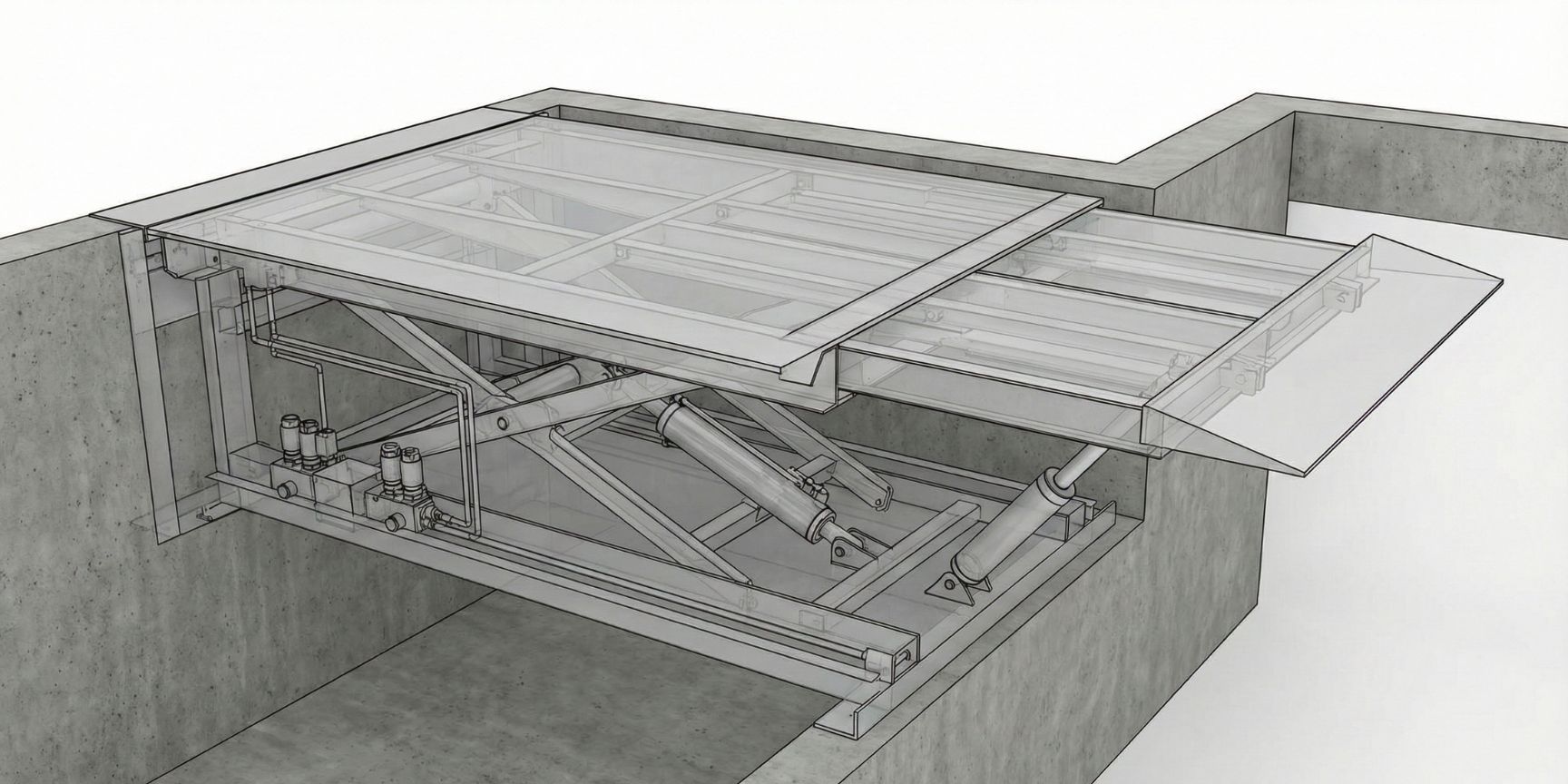
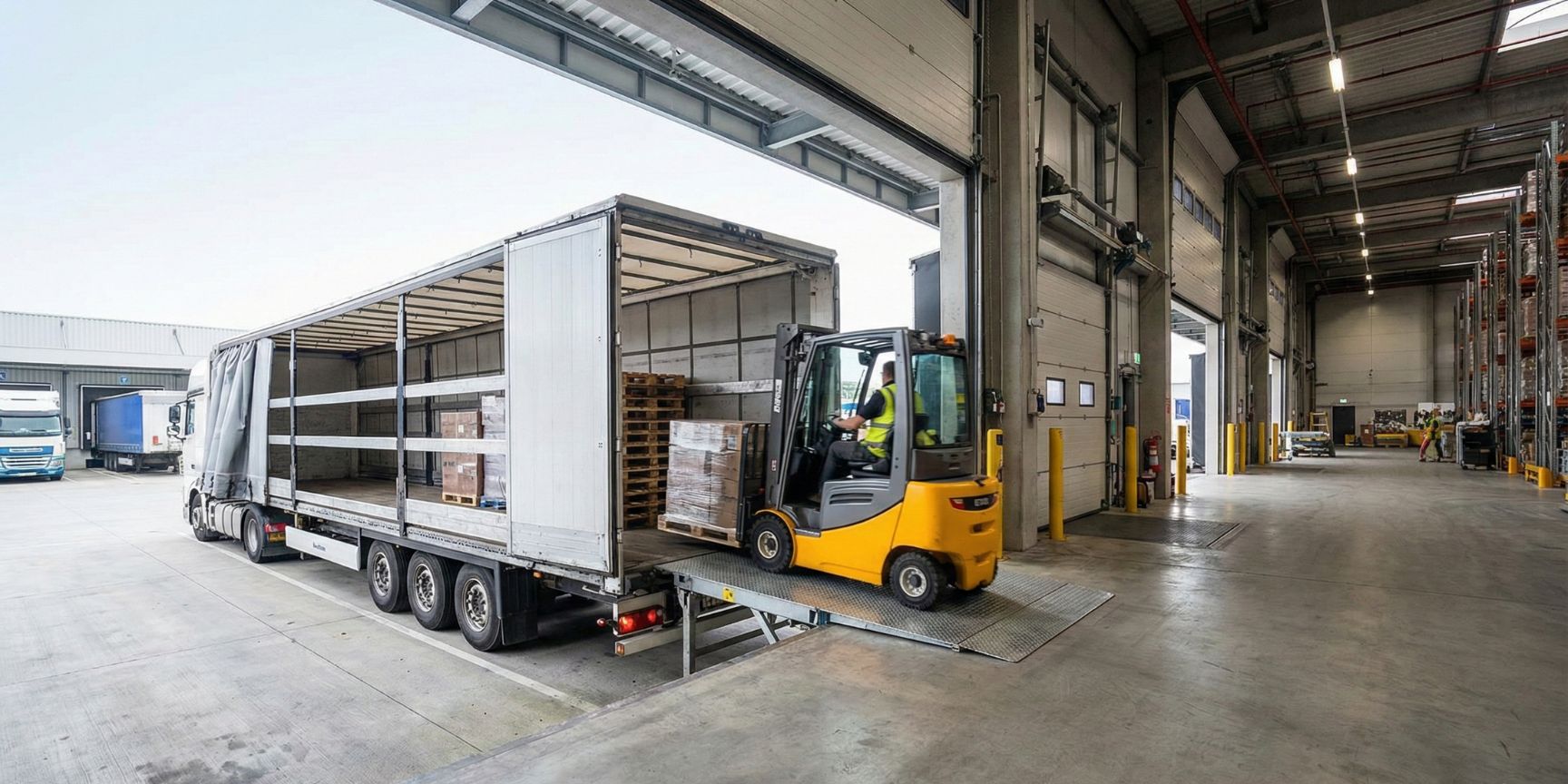
A dock leveler is used to compensate for height differences and distances between the loading ramp of a logistics property and the loading area of a docking truck. Since truck loading areas vary depending on the load condition and vehicle type (from sprinters to jumbo trailers), a rigid ramp is not optimal in logistics in these cases.
From a technical point of view, the dock leveller forms a variable level. Not only does it have to adjust statically to a height, but it also has to follow the spring movements of the truck during the loading and unloading process (floating position). In contract logistics, where time windows are tightly scheduled, the reliability of this component determines the throughput of the entire warehouse.
Types in detail: folding wedge vs. feed wedge
For specialist planners and operators of logistics properties, the choice of system is crucial. We primarily distinguish between two hydraulic systems, as mechanical bridges are hardly relevant in new buildings due to ergonomic disadvantages.
The Swing Lip
This is the standard solution for homogeneous fleets. After lifting the platform, a lip folds out and lies down on the truck.
- Advantage: Cost-effective to purchase, robust technology.
- Disadvantage: The support area is fixed. If the truck is too fully loaded (pallets are all the way to the back of the edge), the lip cannot rest without damaging the goods.
The Telescopic Lip
Here, the lip is infinitely hydraulically extended.
- Advantage: Precision. The forklift driver can position the lip with centimetre precision. This is essential for fully loaded trucks ("last-pallet problem") and offers greater safety.
- Logistics real estate aspect: Drawer bridges often allow for better thermal separation, as the lip can remain retracted behind the sectional door when at rest (ISO loading).
Sizing and angle of inclination: The mathematics of loading
Incorrect dimensioning leads to the attachment of pallet trucks or forklifts. DIN EN 1398 provides clear framework conditions here.
The most important factor is the incline or descent. To ensure smooth handling with electric industrial trucks (FFZ), the inclination should not exceed 12.5% (approx. 7 degrees).
- Calculation example: In order to bridge a height difference of 30 cm (e.g. ramp 1.20 m, truck 1.50 m), a bridge length of at least 2,400 mm is required with a maximum gradient of 12.5 %.
- Standard dimensions: In practice, lengths from 2,000 mm to 3,000 mm and widths from 2,000 mm (for standard trucks) to 2,250 mm have become established.
Practical tip: If trucks with tail lifts (lifting platform) are expected, the dock leveller or pit must be accessible (letterbox opening) so that the tail lift can be pushed under the ramp.
Load capacity: Dynamic vs. static
This is where misunderstandings often arise in tenders. The nominal load according to DIN EN 1398 refers to the axle load of the forklift, not to the total weight.
- Standard: 60 kN (6 tons). This covers most forklift applications.
- Heavy load: In paper logistics or beverage logistics, 100 kN or more are often necessary.
Important for contract logistics companies: Oversizing the load capacity increases the service life ("return on investment"), as the construction suffers less material fatigue under standard loads (fatigue strength).
Energy efficiency and ISO loading
In the context of ESG criteria (environmental, social, governance) and rising energy costs, the tightness of the loading dock is coming into focus. A classic dock leveller is a solid thermal bridge (steel conducts cold directly into the hall).
Solutions for modern halls:
- Step Docking: The truck doors are only opened after the truck has docked.
- ISO dock: The dock leveller is located behind the extremely well-insulated sectional door. The pit is insulated at the bottom. This is standard in fresh food logistics (cold stores), but is increasingly also required for high-quality dry storage (pharmaceuticals, electronics).
Safety technology and standards
Safety at the ramp is a focus of occupational safety. Serious accidents happen when the truck drives away prematurely.
Relevant security features include:
- Emergency stop function: Hydraulic valves block immediately in the event of a power failure or actuation.
- Floating position monitoring: Prevents the bridge from sagging if the truck drives away while the forklift is still standing on it.
- Side protection: Yellow and black markings and toe guards are mandatory.
- Traffic light controls & immobilizers: Modern bridges are coupled with gate control and often a truck restraint system. The bridge can only be operated when the truck is fixed.
Selection criteria for investors and operators
From the perspective of logistics real estate and asset management, there are conflicting goals:
- The investor wants low construction costs (inclination to standard folding wedge, 60kN).
- The tenant (contract logistics provider) needs flexibility for changing clients and high availability.
Recommendation: The installation of 2,500 mm long moving bridges offers the best compromise between investment and rentability (third-party usability). They cover the widest range of vehicles and allow efficient insulation concepts.
FAQ – Frequently asked questions from practice
Question: How long does a dock leveller last?
Answer: With regular maintenance (legally required at least 1x annually according to UVV) and proper use, the service life is 15 to 20 years. Hydraulic hoses and seals are wearing parts (approx. every 5-8 years).
Question: Can existing ramps be converted to new dock levellers?
Answer: Yes, the so-called "ramp renovation" is a major issue in existing buildings. Old mechanical bridges are often replaced by hydraulic systems. Special installation frames are often used to minimise chiseling work on the concrete.
Question: What does "nominal width" vs. "effective width" mean?
Answer: The nominal width is the outer dimension. The effective usable width can be lower due to lateral sealing lips or railings. For container loading, the lip should be tapered to fit into the narrower container openings.
Conclusion
The dock leveller is a complex technical trade that intervenes deeply in the statics and thermals of the logistics property. For future-proof hall construction, there is no way around hydraulic moving bridges with integrated energy-saving concepts. If you save money in the wrong place, you will pay for it over the lifetime of the property through energy losses, process disruptions and accident risks.