




Düsseldorf pallet in warehouse logistics
Table of Contents
- The Dusseldorf Pallet: The Backbone of Retail Logistics
- Technical specifications: Facts, figures, data
- Warehouse logistics: Efficiency in half the area
- Contract logistics: The bridge to the point of sale (POS)
- Logistics Real Estate and Hall Planning: What Planners Need to Know
- Cost-effectiveness and exchange pool
- Questions and Answers (Q&A)
- Conclusion for practice
The Düsseldorf Pallet: The Backbone of Retail Logistics
In the world of load carriers, the Düsseldorf pallet (DP) – often referred to as a "half pallet" – is much more than just a little brother of the classic Euro pallet. It is specifically designed to bridge the gap between transportation and retail merchandise display. While the standard Euro pallet (EPAL 1) is optimised for volume, the Düsseldorf pallet scores with its manoeuvrability and multifunctionality.
Technical specifications: Facts, figures, data
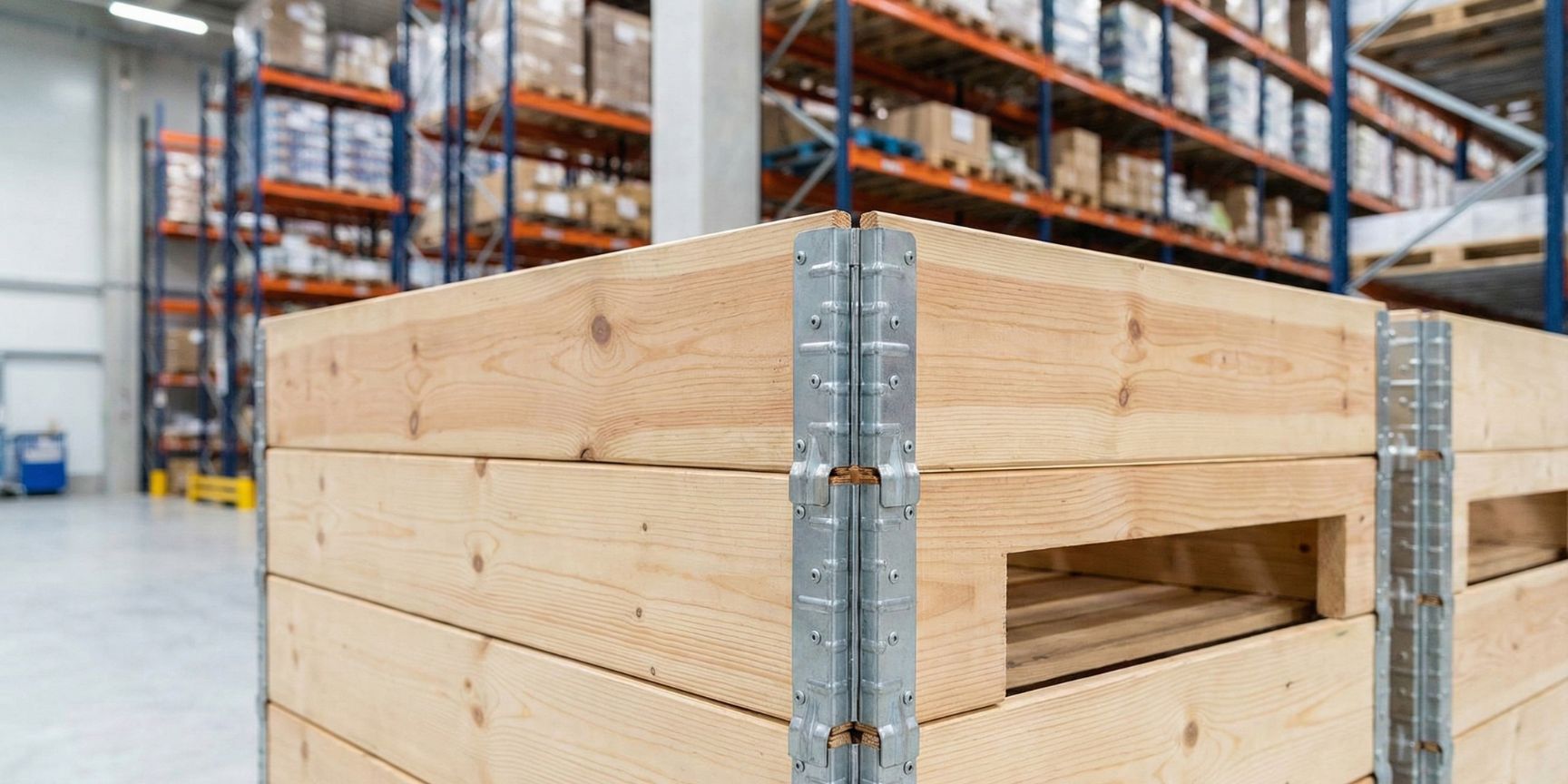
In order to integrate the Düsseldorf pallet into a logistics system, the technical parameters must be precisely known. In contrast to pure wooden pallets, it is characterized by a combination of materials.
| Feature | Detail |
| Dimensions | 800 x 600 x 160 mm (half Euro pallet) |
| Dead weight | approx. 10.5 kg |
| Load capacity | up to 1,000 kg (statically significantly higher) |
| Material | Wood (boards), plastic or wooden blocks, galvanized steel rivets/round steel brackets |
| Retractability | 4-sided (four-way pallet) |
| Standardization | Based on DIN 15146 |
The special feature lies in the construction: the use of steel round brackets gives it significantly greater stability than comparable disposable half pallets made of pure wood.
Warehouse logistics: Efficiency in half the area
In modern warehouse logistics, DP represents both a challenge and an opportunity. In automated high-bay warehouses (HRL), it often cannot be transported on the chain conveyors alone, as its runners could be transverse to the direction of travel or the dimensions do not correspond to the sensors.
- Sub-pallet principle: Two Düsseldorf pallets are often placed on a Euro pallet to ensure compatibility with the conveyor system.
- Parking space optimization: In block warehouses, the DP allows for finer granularity. Small-scale assortments or fast-moving products with a lower volume per pick unit can thus be provided in a more space-saving manner.
Contract logistics: The bridge to the point of sale (POS)
For contract logistics companies that take on fulfillment tasks for food retailers (LEH) or discounters, the DP is the measure of all things. Their biggest advantage is the display capability.
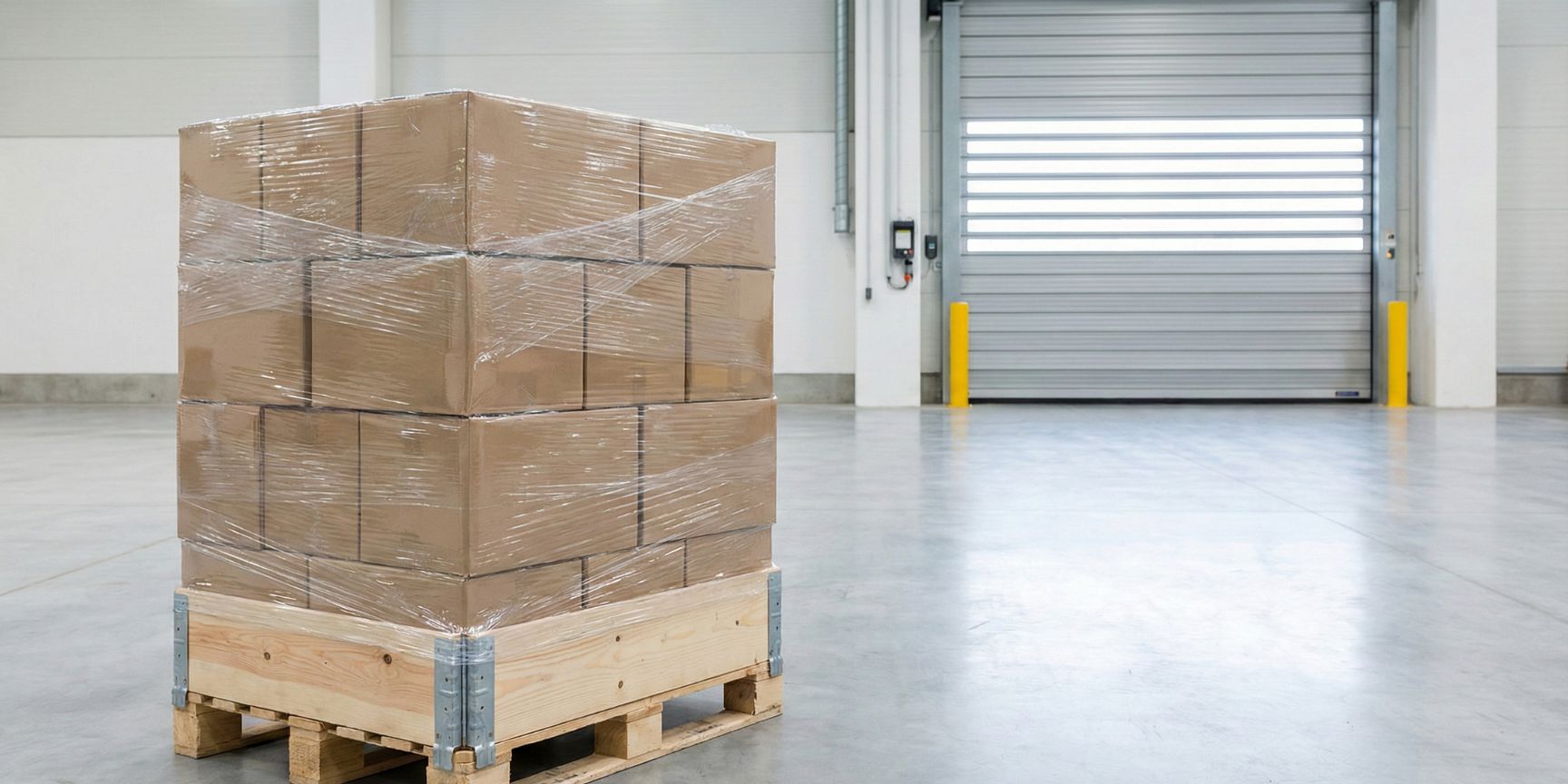
Goods no longer have to be repacked from the transport pallet to a display in the logistics service provider's warehouse. The goods are picked directly on the DP, secured and pushed one-to-one into the shelf or promotion area in the supermarket. This massively reduces handling costs (touchpoints) and minimizes the risk of damage.
Logistics Real Estate and Hall Planning: What Planners Need to Know
When building or renting a logistics hall, the use of the Düsseldorf pallet has an impact on the infrastructure:
- Shelving systems: Standard pallet racks are designed for a depth of 1,200 x 800 mm (Euro longitudinal storage). Düsseldorf pallets are often stored in pairs. However, planners have to recalculate the point loads and the deflection of the crossbeams if two unevenly loaded half pallets are placed instead of one heavy Euro pallet.
- Fire protection: The metal brackets and the often tight packing patterns change the fire load and the behavior in the event of a sprinkler triggering. The distribution of water between the pallets must be guaranteed.
- Floor load: Due to the smaller skid surface, the specific pressure on the hall floor is higher at maximum load than with a Euro pallet.
Cost-effectiveness and exchange pool
The Düsseldorf pallet is a reusable load carrier. In contrast to the Euro pallet, which is exchanged in the open EPAL pool, the DP is often subject to specific exchange agreements between trade and industry. A critical point in practice is quality assurance. Since the DP often makes its way into the sales room, visual cleanliness and technical integrity (no splintering boards) are essential.
Questions and Answers (Q&A)
Question: Why is the Düsseldorf pallet often referred to as the "VDA pallet"?
Answer: Originally, this type was strongly influenced by the German Association of the Automotive Industry (VDA) in order to deliver supplier parts to the assembly line in handy units. Today, the term is more common in the trade, but the constructive roots lie in the standardization of the industry.
Question: Can the Düsseldorf pallet be moved with any pallet truck?
Answer: Yes, due to the 4-sided retractability, it is extremely flexible. However, care should be taken when picking up the pallet crosswise, as the forks of standard pallet trucks are often longer than the pallet is deep, which can lead to damage to goods behind them.
Question: Is the pallet suitable for export?
Answer: Yes, as long as it has been heat-treated according to the ISPM 15 standard. However, because it contains metal components, it is heavier compared to pure plastic half pallets, which can be a cost factor in air freight.
Conclusion for practice
The Düsseldorf pallet is the ideal tool for the last mile in the logistics chain. Anyone planning logistics real estate or optimising contract logistics processes must plan for DP as a fixed standard. Their strength does not lie in the quantity, but in the tailor-made provision of goods flows.