




Assembly in Warehouse Logistics
Table of Contents
- What is Assembly and Co-Packing? A Definition
- The Role of Assembly in Warehouse Logistics
- Questions and Answers on Assembly and Co-Packing
- Strategic Importance for Contract Logistics
- Requirements for Logistics Real Estate and Warehouses
- Data and Facts: The Economy of Assembly
- Conclusion: More Than Just Packaging
What is Assembly and Co-Packing? A Definition
In general terms, assembly (or "Konfektionierung" in German) refers to the process of grouping, packaging, and labeling goods into a new, marketable unit. This process goes far beyond simple packing; it encompasses a variety of activities aimed at preparing a product for the end customer or the next stage in the supply chain.
The core objective is to create new assortments or sets from multiple individual parts. This can range from simple bundling (e.g., "buy one, get one free" packs) to the complex technical assembly of components. In a niche logistics context, assembly is the bridge between production and point-of-sale, ensuring that products meet specific market, retail, or consumer requirements.
The Role of Assembly in Warehouse Logistics
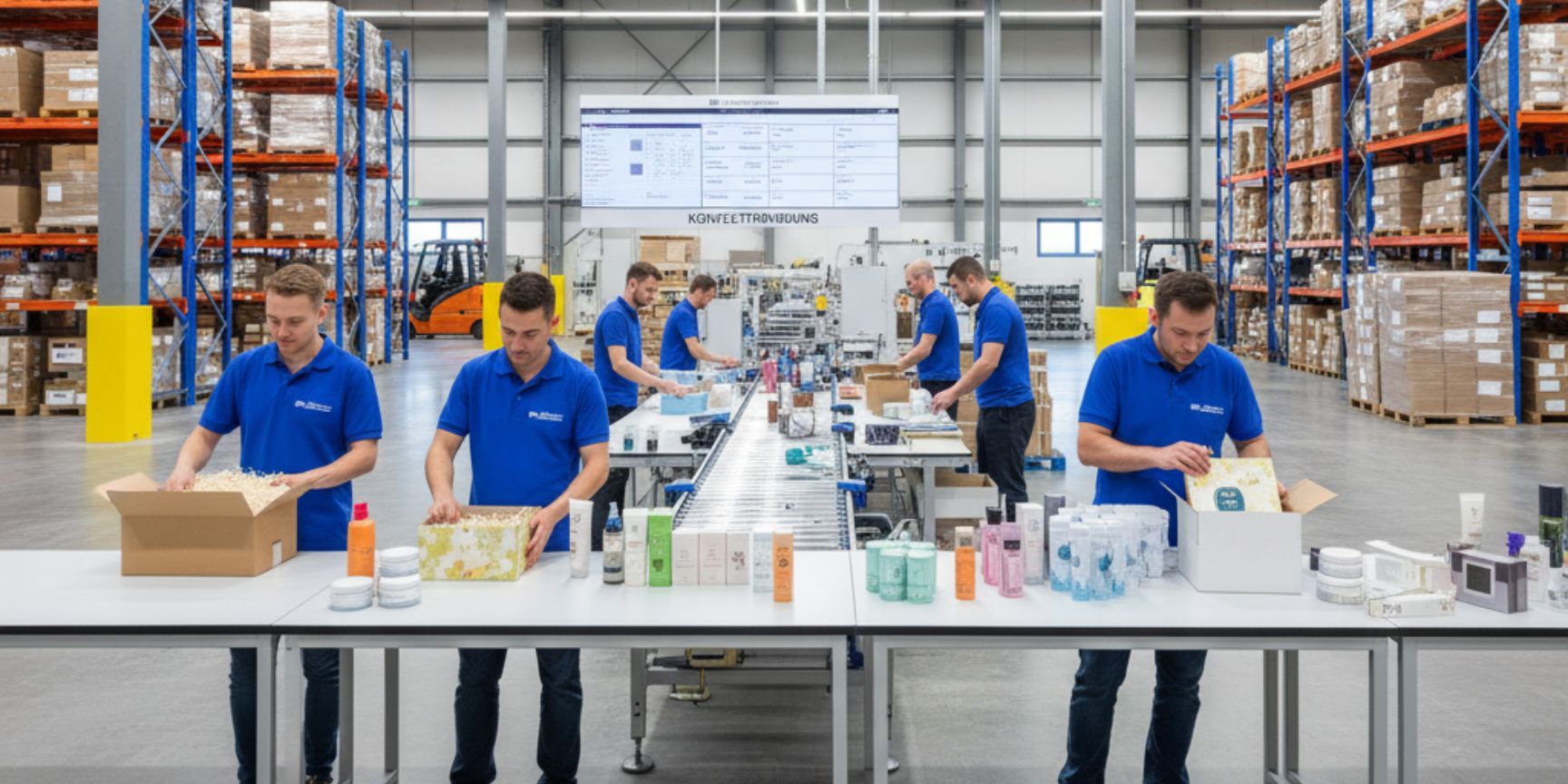
In warehouse logistics, assembly is a central Value Added Service (VAS). It typically takes place in specialized areas of a distribution center, often after the goods have been picked. Here, the merchandise is not just stored and moved, but actively refined.
Typical assembly tasks in the warehouse include:
- Kitting/Set Formation: Combining different items into a new set (e.g., gift sets, starter kits, or tool bundles).
- POS Display Build: Assembling point-of-sale displays for retail, often including the filling of these displays with products.
- Repackaging: Moving products from bulk containers into smaller, retail-ready units or promotional packaging.
- Labeling and Pricing: Applying specific labels, barcodes, price tags, or country-specific security stickers.
- Collating: Adding manuals, promotional flyers, or samples to the product.
These activities require high flexibility in warehouse processes. Modern Warehouse Management Systems (WMS) are essential here, as they must track the "transformation" of inventory: several SKUs (Stock Keeping Units) go into the process, and one new SKU (the finished set) comes out.
Questions and Answers on Assembly and Co-Packing
Question: Is assembly the same as picking?
Answer: No. Picking is the process of retrieving items from storage to fulfill an order. Assembly/Co-packing is a downstream process where those picked items are physically modified, combined, or refined into a new product unit.
Question: Why do companies outsource these tasks to 3PL providers?
Answer: Companies outsource to focus on their core competencies. Logistics providers offer specialized labor, high-speed packaging machinery, and scalable floor space that manufacturers often lack. This converts fixed costs into variable costs.
Question: What are the "hidden" costs in assembly?
Answer: Often, the complexity of waste management (disposal of original packaging) and the precise synchronization of "just-in-time" components are underestimated. Efficient assembly requires precise timing to avoid bottlenecks in the shipping department.
Strategic Importance for Contract Logistics
In contract logistics, which is based on long-term partnerships, assembly is a key differentiator. For the client, integrating assembly into the contract simplifies the entire supply chain. Instead of moving goods between a factory, a third-party co-packer, and a warehouse, everything happens under one roof.
This integration leads to measurable advantages:
- Reduced Lead Times: Eliminating transport steps between packing and shipping can save 24–48 hours in the supply chain.
- Cost Efficiency: Handling costs are reduced by up to 15% when assembly is integrated directly into the flow of goods.
- Flexibility: Quick reaction to market trends or short-term marketing campaigns (e.g., adding a "World Cup" sticker to existing stock).
Requirements for Logistics Real Estate and Warehouses
Not every logistics property is suitable for high-intensity assembly work. The requirements for the hall go beyond mere storage volume.
- Zoning and Mezzanines: Specialized areas are needed, often using mezzanines (intermediate floors) to separate manual work from heavy forklift traffic.
- Technical Infrastructure: Assembly areas require significantly higher lighting levels (at least 300 to 500 lux) compared to standard racking areas (approx. 150 lux). Additionally, multiple power outlets, compressed air lines, and high-speed Wi-Fi for mobile data entry are essential.
- Climate and Hygiene: Depending on the sector (e.g., Food or Pharma), areas must meet HACCP standards or be temperature-controlled.
- Employee Facilities: Since assembly is labor-intensive, the property must provide expanded social rooms, break areas, and sanitary facilities to accommodate a higher number of staff per square meter.
Data and Facts: The Economy of Assembly
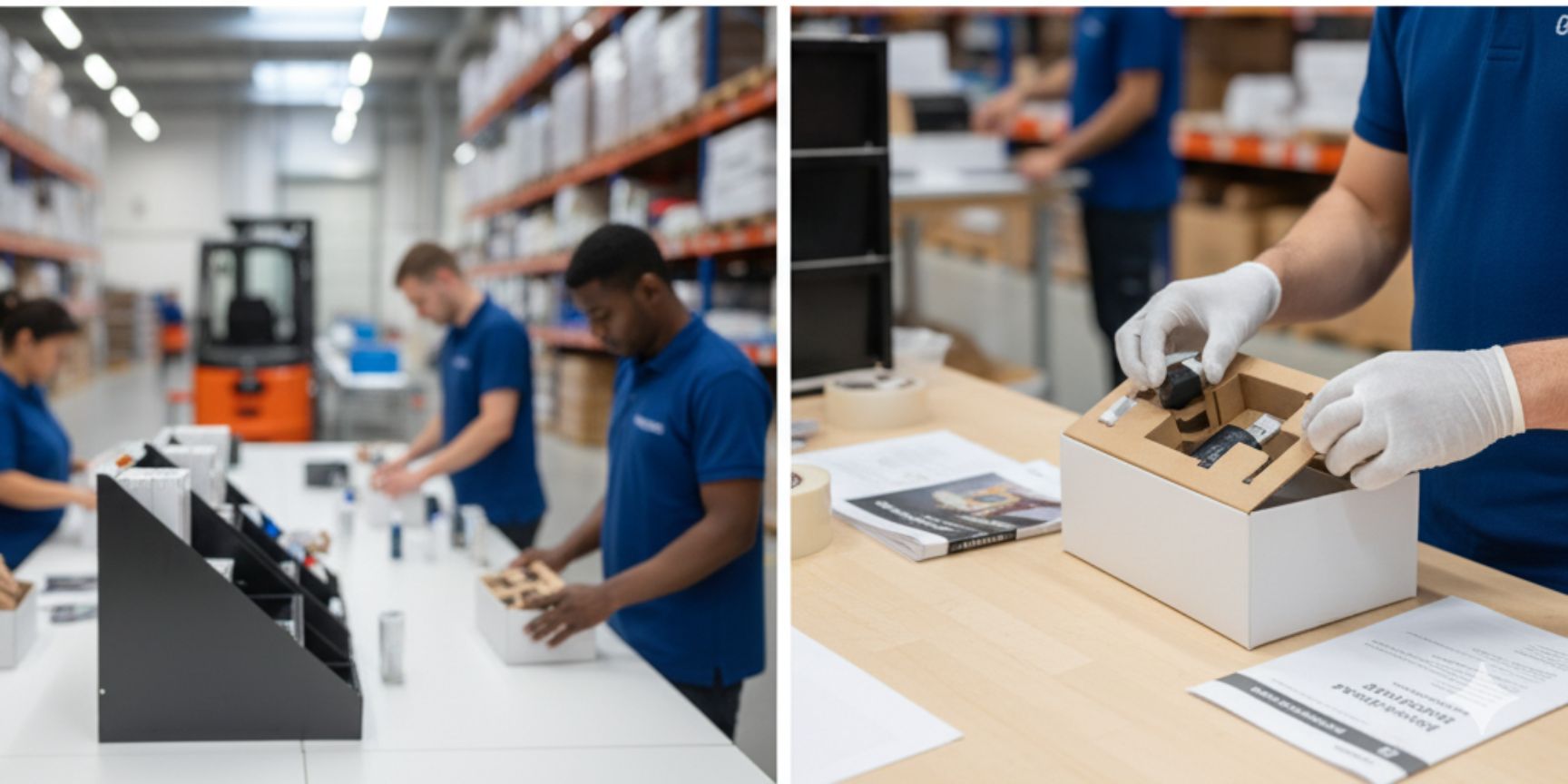
To understand the depth of this niche, consider these industry benchmarks:
- Space Allocation: In modern fulfillment centers, up to 10–20% of the total floor space is now dedicated to Value Added Services rather than pure storage.
- Labor Intensity: While standard picking can be highly automated, assembly remains 70–80% manual, making labor availability a primary location factor for assembly-heavy warehouses.
- Error Rates: Integrated assembly processes with barcode-supported verification can reduce "wrong set" errors to less than 0.05%.
Conclusion: More Than Just Packaging
Assembly is a prime example of how logistics has evolved from a pure transport function into an integral part of the value chain. It allows companies to individualize products, implement powerful sales promotions, and react flexibly to customer demands. For warehouse and contract logisticians, it is an indispensable service for staying competitive and building deep, strategic partnerships with clients.