




Adaptation ramp in warehouses
Table of Contents
Definition and operation
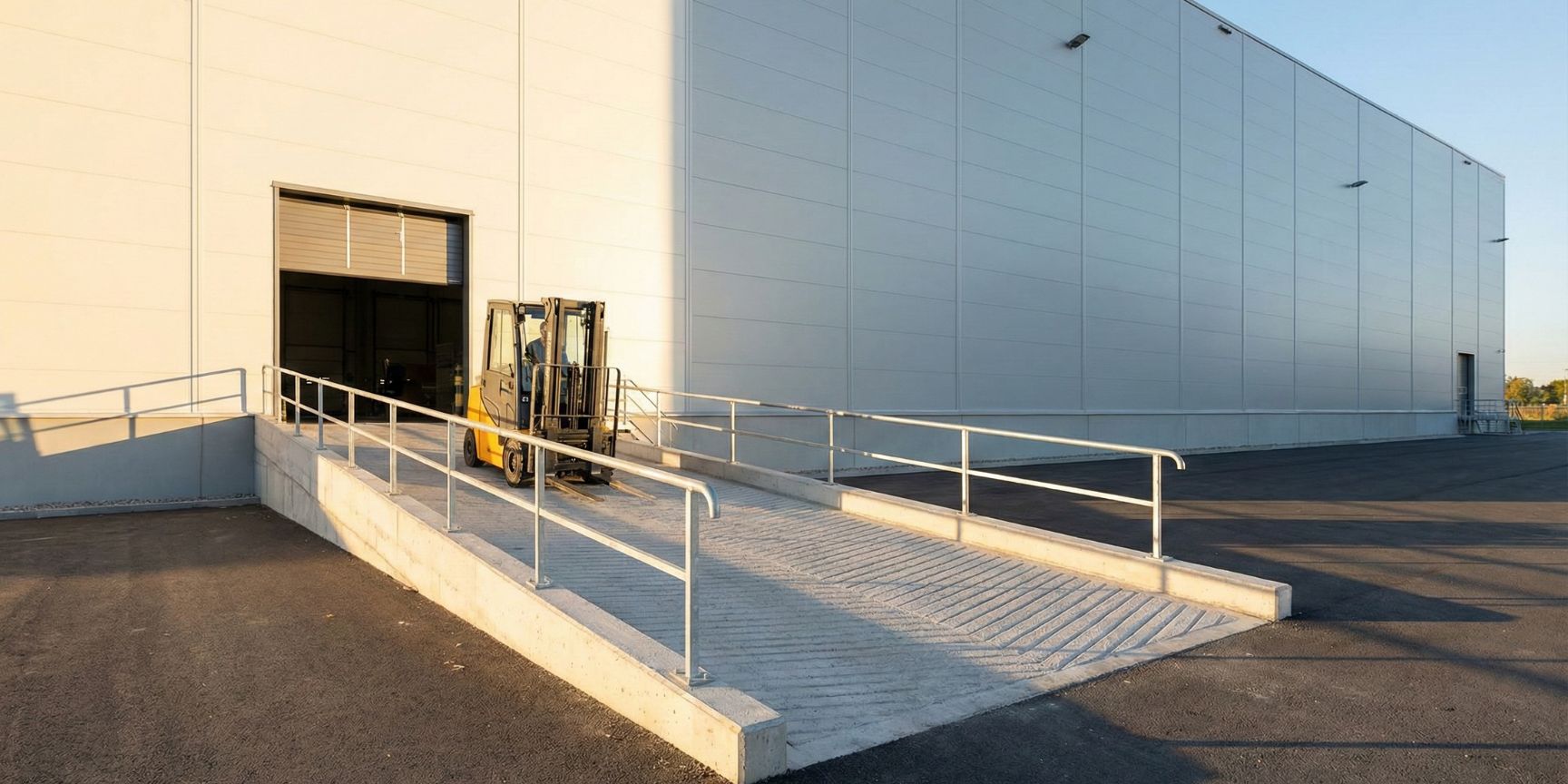
An adaptation ramp (often called an access ramp, logistics ramp or courtyard ramp) is a structural or mobile device that is used to overcome a greater difference in height between two levels. In the context of the logistics property, it usually connects the courtyard level (level 0) with the ramp level (usually approx. 1.20 m high) or enables the direct loading of trucks from the ground if there are no fixed loading gates (docks).
In contrast to the dock leveller, which compensates for only small differences in height between the truck and the edge of the dock, the adjustment ramp is a long inclined plane that allows forklifts and industrial trucks to drive in or out of the hall.
Relevance for contract logistics and logistics real estate
For investors, project developers and contract logistics specialists, the presence of adaptation ramps is an essential quality feature of a "third-party" property.
- Multifunctionality: A pure dock hall is often unusable for "last mile" delivery staff, as sprinters and vans cannot dock at 1.20 m high docks. An adaptation ramp makes it possible to drive these vehicles into the hall (drive-in).
- Process efficiency: It allows the rapid exchange of forklifts between different hall sections or the outdoor area, without complex lifting technology.
- Increase in value: Logistics properties with a combination of sectional doors on ground-level access (via ramp) and classic docks achieve higher rents because they can be used more flexibly.
Types: Fixed vs. Mobile
There are basically two main categories, which are used depending on the lease and structural conditions:
The fixed concrete ramp
This is an integral part of the property. It is usually cast on the front or long side of a logistics hall.
- Advantages: Extremely durable, high load capacity, low maintenance.
- Disadvantages: Permanently takes up space in the marshalling yard, cannot be changed flexibly.
The Mobile Yard Ramp
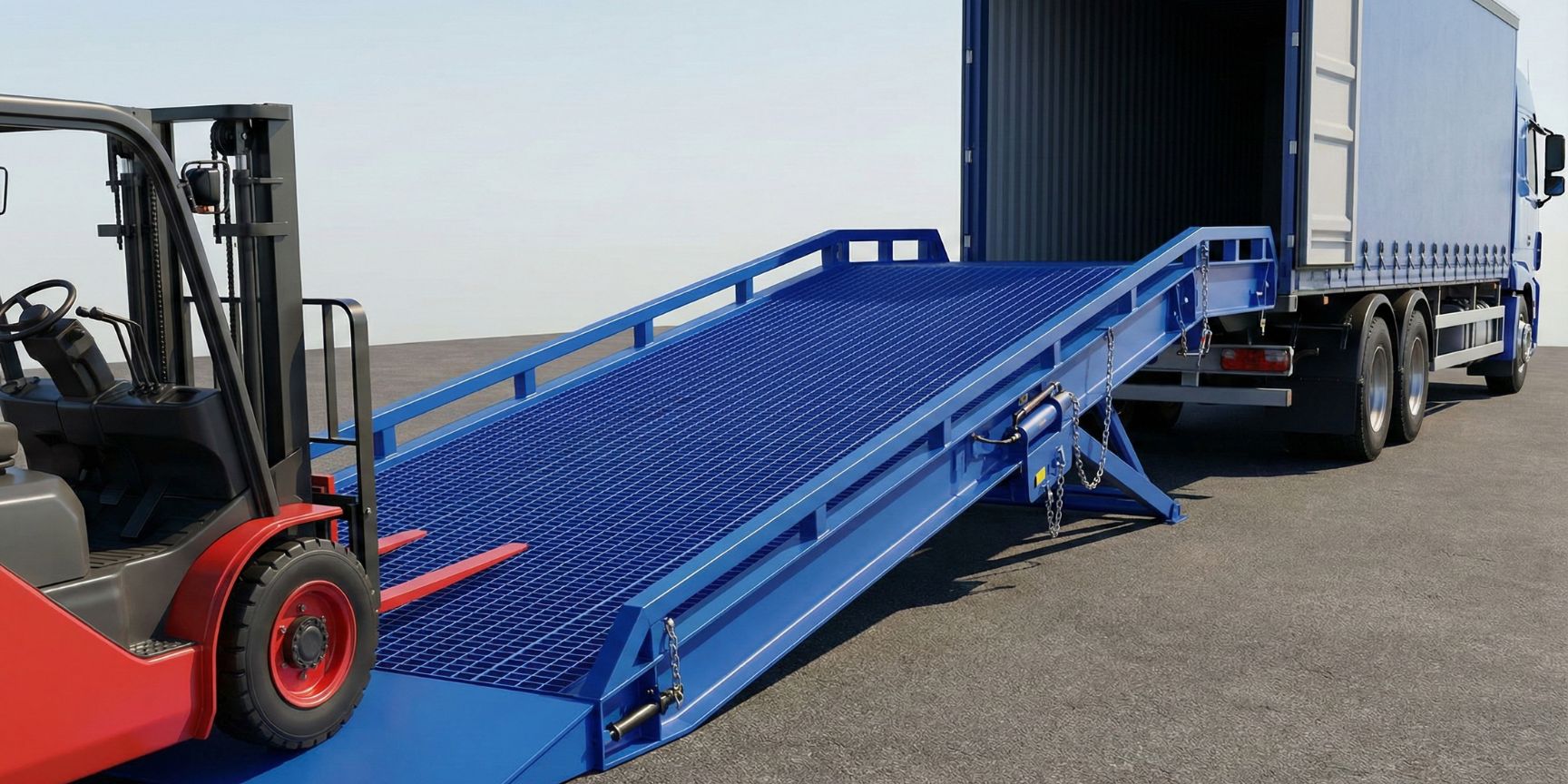
This variant is often used in contract logistics during seasonal peaks or in rented halls without sufficient infrastructure. It is manoeuvred by forklift to the truck bed or the hall gate.
- Advantages: Flexible, no building permit procedure (as "flying construction"), high resale value.
- Disadvantages: More maintenance-intensive (hydraulics, grating), often smaller usable width.
Technical parameters: pitch and length
This is the most critical point in planning. An incorrectly calculated ramp becomes a danger or an impossibility for certain industrial trucks.
The key question: How long does a ramp have to be? The length is determined by the difference in altitude to be overcome and the permissible gradient ( in %).
Guideline values for the slope:
- Hand Pallet Truck / Electric Ant: Max. 3 – 5 % (otherwise the device touches down or the brake does not hold).
- Forklift (electric/diesel): Max. 10 – 12.5 %.
- Car / Sprinter: Max. 15%.
Example calculation: If a height difference of 1.20 m (standard ramp height) for forklifts (max. 10% gradient) is to be overcome, the ramp must be at least 12 meters long. In addition, there are horizontal run-off zones at the top and bottom to prevent the forklift from "touching down" (ground clearance!).
Constructive safety features (buckling angle & surface)
A simple slope is not enough. In order to ensure occupational safety in accordance with DGUV Rule 108-006, the following aspects must be observed:
- Angle of departure (bend angle): The transition from the slope to the plane must not be abrupt. It must be gently rounded so that the forklift with its forks or battery box does not touch down.
- Slip resistance: Outdoor ramps are exposed to the weather. Concrete must be rough-brushed or fluted. Steel ramps require interlocking gratings (at least slip resistance class R12 or R13).
- Side boundary: A curb or railing is mandatory to prevent the FFZ from falling sideways.
- Roofing: High-quality adaptation ramps are covered or heated to prevent black ice formation in winter.
Questions and Answers (Q&A) on the Adaptation Ramp
Question: Do I need a building permit for a mobile adaptation ramp?
Answer: Usually no, as mobile ramps are considered "devices" or "flying structures" as long as they are not firmly anchored to the ground. For fixed concrete ramps, a building permit is mandatory.
Question: How much does an adaptation ramp cost?
Answer: A mobile industrial steel ramp (load capacity 7-10 tons) costs between €10,000 and €20,000, depending on the equipment. A solid concrete ramp is highly dependent on earthworks and foundation, but is often in the similar range but will last for decades.
Question: Can I drive on any ramp with any forklift?
Answer: No. Forklifts handle inclines well. Warehouse trucks (reach trucks, pallet trucks) often have low ground clearance and weaker drive motors. Standard ramps are often too steep for these devices.
Question: How wide should the ramp be?
Answer: For safe oncoming traffic (if necessary) or comfortable manoeuvring, the width should be at least 2.50 m to 3.00 m. One-way ramps should have at least the vehicle width + 70 cm safety distance.
Strategic Planning for Facility Managers
When planning new warehouses, at least one ground-level access via adaptation ramp should always be planned. In practice, the following problem often arises: A hall has 50 gates, but no ramp. If a heavy machine has to go into the hall for maintenance or a forklift is replaced, an expensive truck-mounted crane has to be ordered to lift the device over the gate. An adaptation ramp often pays for itself through the savings of external service providers and the flexibility in day-to-day business.
Conclusion
The adaptation ramp is much more than just a piece of concrete or steel. It is an essential flexibility instrument in modern logistics real estate. While dock levellers ensure standard handling, adaptation ramps ensure the connection of "non-standard" traffic (Sprinters, forklift traffic, large equipment). When choosing, the angle of inclination is the limiting factor – in case of doubt, the building should always be flatter (and thus longer) in order to ensure compatibility with future industrial trucks.
Your Ideal Logistics Warehouse
Browse listings for warehouse space, logistics real estate, industrial land, and contract logistics solutions.
Browse Exposés
Maximize Exposure for Your Warehouse Space
Showcase your logistics properties and attract qualified inquiries.
Discover Products