




Handling in the Warehouse
Table of Contents
- What is handling in logistics? A definition
- Manual vs. Machine Handling: Strategies and Areas of Application
- Automated handling: The future of warehouse logistics
- The influence of handling on warehouse organization
- Costs and key figures (KPIs) in handling
- Safety and ergonomics: The human factor in handling
What is handling in logistics? A definition
In warehouse and contract logistics, the term "handling" refers to all the physical processes necessary to move, manipulate and prepare goods within a warehouse or distribution center. It is much more than just moving from A to B. Handling encompasses the entire life cycle of goods in the warehouse: from unloading at incoming goods, through storage, relocation, picking and consolidation, to loading at outgoing goods. Each of these touchpoints is a "handling process". The efficiency and cost of these processes are a crucial lever for the competitiveness of a logistics service provider, as they account for a significant part of the operational storage costs. In contract logistics, the handling effort is often billed as a separate fee (handling fee) per unit, pallet or order and is therefore a central commercial variable.
Manual vs. Machine Handling: Strategies and Areas of Application
Choosing the right handling strategy depends on factors such as item structure, turnover rate, weight and volume of goods.
- Manual handling: Here, goods are moved by employees without or with simple aids (e.g. hand truck, forklift). It is flexible and requires low investment costs. It is ideal for small-scale, lightweight items, small quantities or complex, non-standardizable processes (e.g. value-added services such as set formation). The disadvantages lie in the lower handling capacity, the high physical strain and the potentially higher error rate.
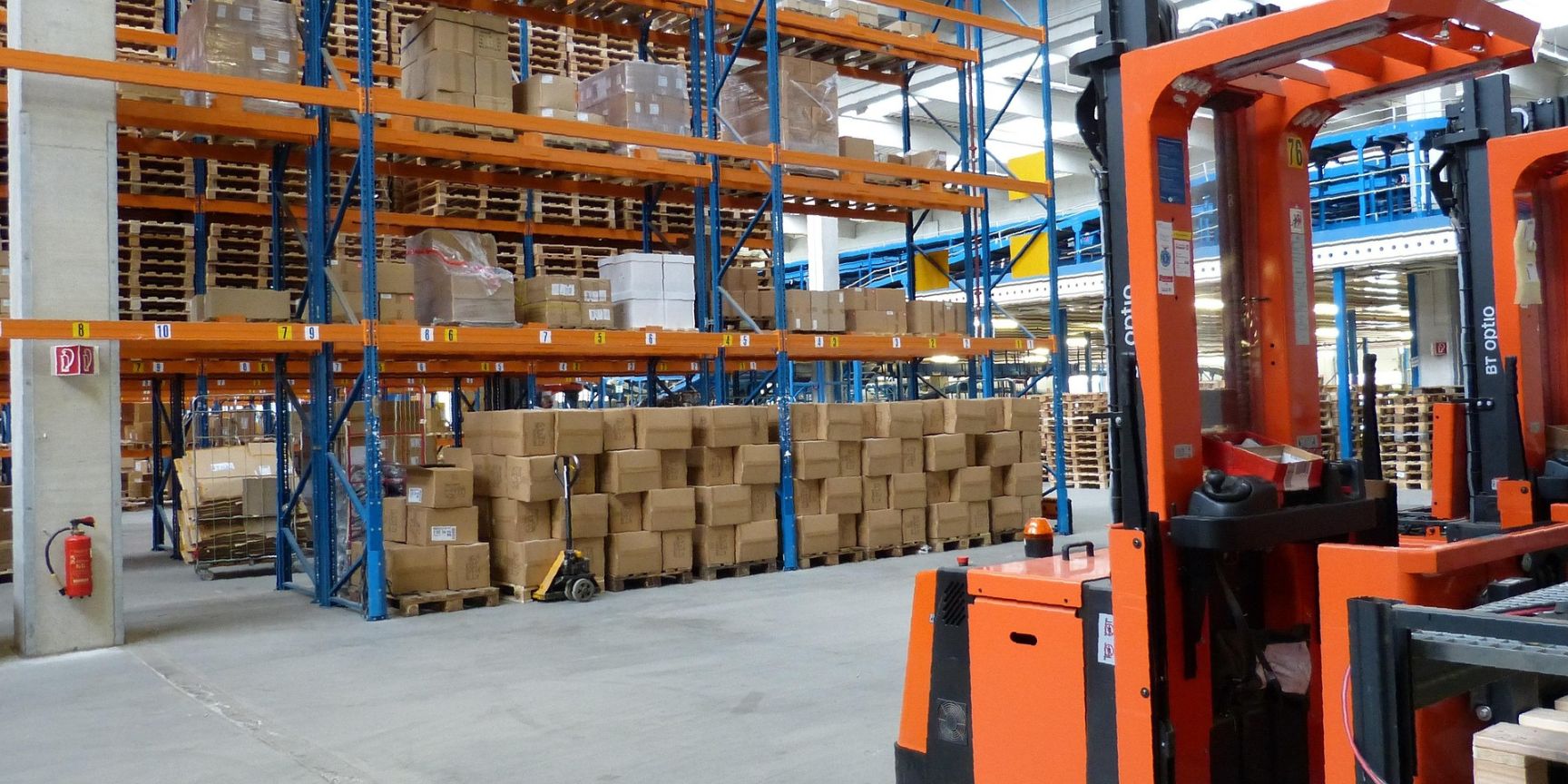
- Mechanical (or mechanized) handling: The use of industrial trucks such as forklifts, reach trucks or order picking vehicles forms the backbone of most modern warehouses. It enables the efficient movement of pallets and heavy goods, the use of high racks and significantly increases handling performance. The challenge lies in optimal route guidance (minimization of travel times), safety in the warehouse and the operating and maintenance costs of the fleet.
Automated handling: The future of warehouse logistics
Automation is revolutionizing handling and is a response to a shortage of skilled workers, increasing speed requirements and cost pressure. Automated handling systems range from partially to fully automated solutions:
- Conveyor technology: Roller conveyors, belt conveyors and sorters automatically transport containers or cartons between different storage areas (e.g. from goods receipt to picking area).
- Stacker cranes (SRMs): In automatic high-bay or small parts warehouses, stacker cranes take over the storage and retrieval of pallets or containers fully automatically with the highest speed and precision.
- Automated guided vehicles (AGVs) / Autonomous Mobile Robots (AMR): These autonomous vehicles take over the internal transport of goods, e.g. from picked goods to the packing station ("goods-to-person" principle). In contrast to older AGVs, AMRs navigate flexibly and avoid obstacles.
- Robot picking: Gripping robots (pick-by-robot) can already pick individual items from containers fully automatically, which replaces the most strenuous manual activity in the warehouse.
Investing in automation requires a detailed analysis of processes and product ranges, but offers enormous potential for increasing efficiency and reducing errors.
The influence of handling on warehouse organization
The chosen handling system has a direct impact on the layout and organization of the entire warehouse. A warehouse that relies on manual picking from shelving racks is fundamentally different from a fully automated high-bay warehouse. The width of the aisles is determined by the industrial trucks used. The arrangement of the functional areas (incoming goods, quality assurance, order picking, packaging, outgoing goods) must be planned in such a way that the transport routes – and thus the handling times and costs – are minimized. An intelligent warehouse management system (WMS) is indispensable in order to efficiently control transport orders and avoid empty runs.
Costs and key figures (KPIs) in handling
The success of handling processes is measured and controlled by specific key performance indicators (KPIs). The most important key figure is the handling costs per unit (e.g. per pick, per pallet, per order). They put the total operating costs (personnel, industrial truck fleet, energy) in relation to the service provided. Other important KPIs are:
- Handling capacity: Number of units moved per hour/employee.
- Pick quality: The error rate during picking.
- Distance per job: An indicator of the efficiency of the layout and process control.
- Utilization: The degree of utilization of industrial trucks or automated systems.
By continuously monitoring these KPIs, weak points can be identified and processes can be optimized in a targeted manner (e.g. through ABC analysis to optimize storage locations).
Safety and ergonomics: The human factor in handling
Despite all the automation, people remain a central player in the warehouse. Ensuring occupational safety and ergonomics is therefore not only a legal obligation, but also economically reasonable. Incorrect lifting and carrying is one of the main causes of incapacity for work in logistics. Measures such as the provision of lifting aids (vacuum lifters, cranes), ergonomically designed workplaces (height-adjustable packing tables), regular safety training for the handling of industrial trucks and clear traffic rules in the warehouse are essential. They reduce the risk of accidents, reduce absenteeism due to illness and increase employee motivation and productivity in the long term.