




Hub and Spoke in Logistics
Inhaltsverzeichnis
- Was ist ein Gewerbemakler für Logistikimmobilien?
- Die Kernaufgaben in der Logistikimmobilien-Vermittlung
- Wandel des Berufsbilds: Vom Vermittler zum strategischen Berater
- Wer nutzt die Dienste eines spezialisierten Maklers?
- Der konkrete Mehrwert: Warum ein Gewerbemakler unverzichtbar ist
- Was kostet ein Gewerbemakler? Die Maklerprovision erklärt
- Zukunftsaussichten: Digitalisierung und Nachhaltigkeit als Treiber
- Sustainability and Energy Efficiency in the Modern Warehouse
- What are the security aspects of a warehouse?
- Key Success Factors for Entrepreneurs in Choosing the Optimal Warehouse
Hub-and-Spoke: The Backbone of Efficient Network Logistics
The "hub and spoke" principle originated in aviation, but has become the gold standard in general cargo logistics, courier express parcel services (CEP) and, increasingly, in specialized contract logistics. While classic point-to-point connections reach their limits as complexity grows, the hub-and-spoke system offers a structured response to the requirements of globalization and just-in-time deliveries.
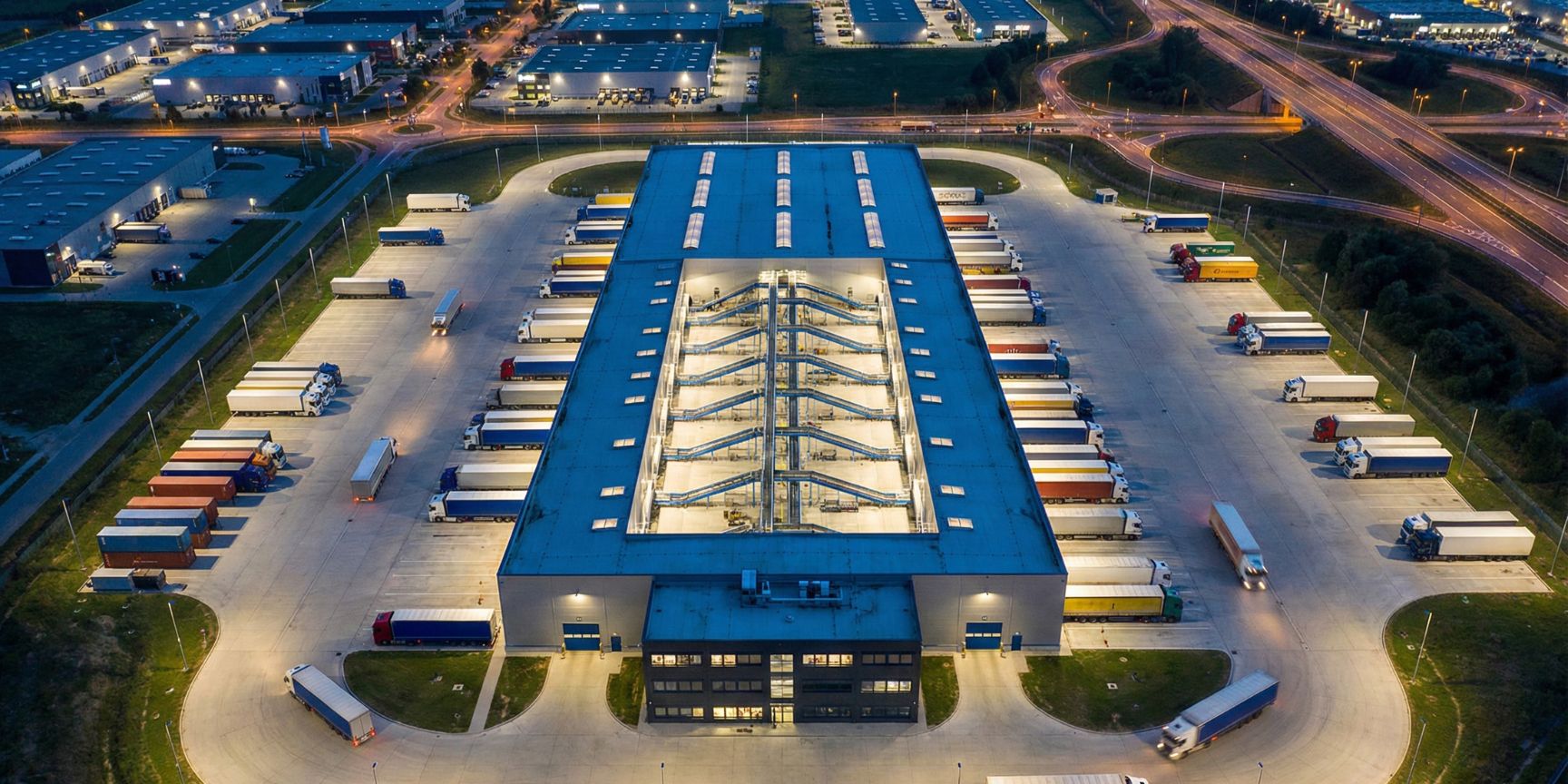
The architecture of the system: definition and operation
At its core, the model consists of a central transshipment node, the hub, and several star-shaped depots or endpoints, the spokes. Instead of connecting each location directly to each other (which would lead to connections in the case of locations), all flows of goods are transported to the hub in bundles.
Numerical example: With 10 locations, 45 lines would be needed for direct traffic . In the hub-and-spoke system, 9 lines are enough to network all points with each other. This massive reduction in complexity enables significantly higher utilization of the means of transport (Heavy Goods Vehicles - HGV).
The Hub as a Logistics Property: Specific Requirements
A property that functions as a hub is not a classic "warehouse" in which goods linger. It is a material handler. For project developers and investors, this results in clear structural requirements:
- Cross-docking design: Hubs are usually elongated buildings with a high number of loading gates on opposite sides (I-shape or T-shape).
- Throughput speed: The depth of the hall is often shallower (approx. 40–60 meters) in order to minimize the distances for industrial trucks between incoming goods (Spoke A) and goods issue (Spoke B).
- Yard management: Since the cycle rate of the trucks is extremely high, spacious manoeuvring areas and waiting areas for trailers (swap body parking spaces) are essential. The ratio of hall space to land area is often lower than for standard logistics properties.
Contract logistics: added value through centralization
In contract logistics, the hub-and-spoke model provides the basis for value-added services (VAS). Since the flow of goods converges at the hub anyway, central services can be efficiently bundled here:
- Consolidation: Different suppliers send components to the hub, where they are sequenced for an end customer (e.g. an automotive plant) (pick-by-light, just-in-sequence).
- Inventory management: A "central warehouse hub" reduces safety stock across the network. Instead of maintaining buffers at 10 locations, a central buffer at the hub is sufficient, which significantly reduces tied-up capital.
The "Spokes": Regional depots and last-mile logistics
The spokes act as regional distribution centers. In the modern logistics real estate landscape, these are often smaller halls (light industrial) that are close to urban centers. Their task is the "fine sorting" for the last mile. While the hub is optimized for efficiency and scale, the spokes are trimmed for responsiveness and customer proximity.
FAQ: In-depth questions about the system
Question: Why is the system more susceptible to disruptions than direct traffic? Answer: The hub represents a "single point of failure". A strike, a storm or a technical defect in the sorting system at the hub paralyzes the entire network. Therefore, operators are investing massively in redundancy and IT security.
Question: How does hub-and-spoke affect the CO2 balance? Answer: It is a double-edged sword. On the one hand, empty runs are minimized by bundling (positive economies of scale). On the other hand, detours often occur because goods are physically transported from A to B via hub C, even if A and B are geographically close to each other.
Question: From which shipment structure is a hub system worthwhile? Answer: It is primarily worthwhile for small shipment sizes (LTL - Less than Truckload) and high flexibility in terms of time at night. For FTL (Full Truckload), direct transport is almost always more economical.
Mathematical Optimization and Capacity Planning
In specialist planning, the efficiency of a hub is often defined by the throughput per square metre . While a standard warehouse may achieve 2-4 stock turnover per year, a hub often turns over its entire volume completely within 24 hours.
Sorting capacity is also crucial for contract logistics . Modern sorter systems in hubs achieve outputs of over 15,000 parcels per hour. This requires a high-performance IT infrastructure (WMS - Warehouse Management System) that decides in real time to which gate a parcel is routed.

Conclusion for practice: When is hub-and-spoke the right choice?
The model is not a panacea. It is the optimal solution for networks with many participants and heterogeneous flows of goods.
| Criterion | Hub-and-Spoke | Direct transport (Point-to-Point) |
Shipment size | Small Parts, LTL, Packages | Large, FTL, Bulk |
Vehicle utilization | Very high due to bundling | Often problematic (empty runs) |
Duration | Fixed time slot (usually over-night) | Individual, often faster |
Real Estate Invest | High (Specialty Property Hub) | Lower (standard halls) |
For companies in contract logistics, the decision for a hub system often means a long-term strategic commitment. The property must be understood as an integral part of the supply chain – a location error or too few gates can hardly be corrected afterwards.