




Light Industrial Facility in Warehouse Logistics
Table of contents
- Was ist ein Gewerbemakler für Logistikimmobilien?
- Die Kernaufgaben in der Logistikimmobilien-Vermittlung
- Wandel des Berufsbilds: Vom Vermittler zum strategischen Berater
- Wer nutzt die Dienste eines spezialisierten Maklers?
- Der konkrete Mehrwert: Warum ein Gewerbemakler unverzichtbar ist
- Was kostet ein Gewerbemakler? Die Maklerprovision erklärt
- Zukunftsaussichten: Digitalisierung und Nachhaltigkeit als Treiber
- Sustainability and Energy Efficiency in the Modern Warehouse
- What are the security aspects of a warehouse?
- Key Success Factors for Entrepreneurs in Choosing the Optimal Warehouse
Light Industrial Facilities: The Link between Production and Logistics
In the modern real estate industry, the term "light industrial" has established itself as a fixed asset class. But what is technically and functionally behind this designation, which is often used synonymously with "business park" or "service property"? At its core, a light industrial facility describes a property that is designed for light industrial activities – i.e. the processing, assembly and storage of goods – without causing the negative emissions of heavy industry (noise, vibrations, pollutants).
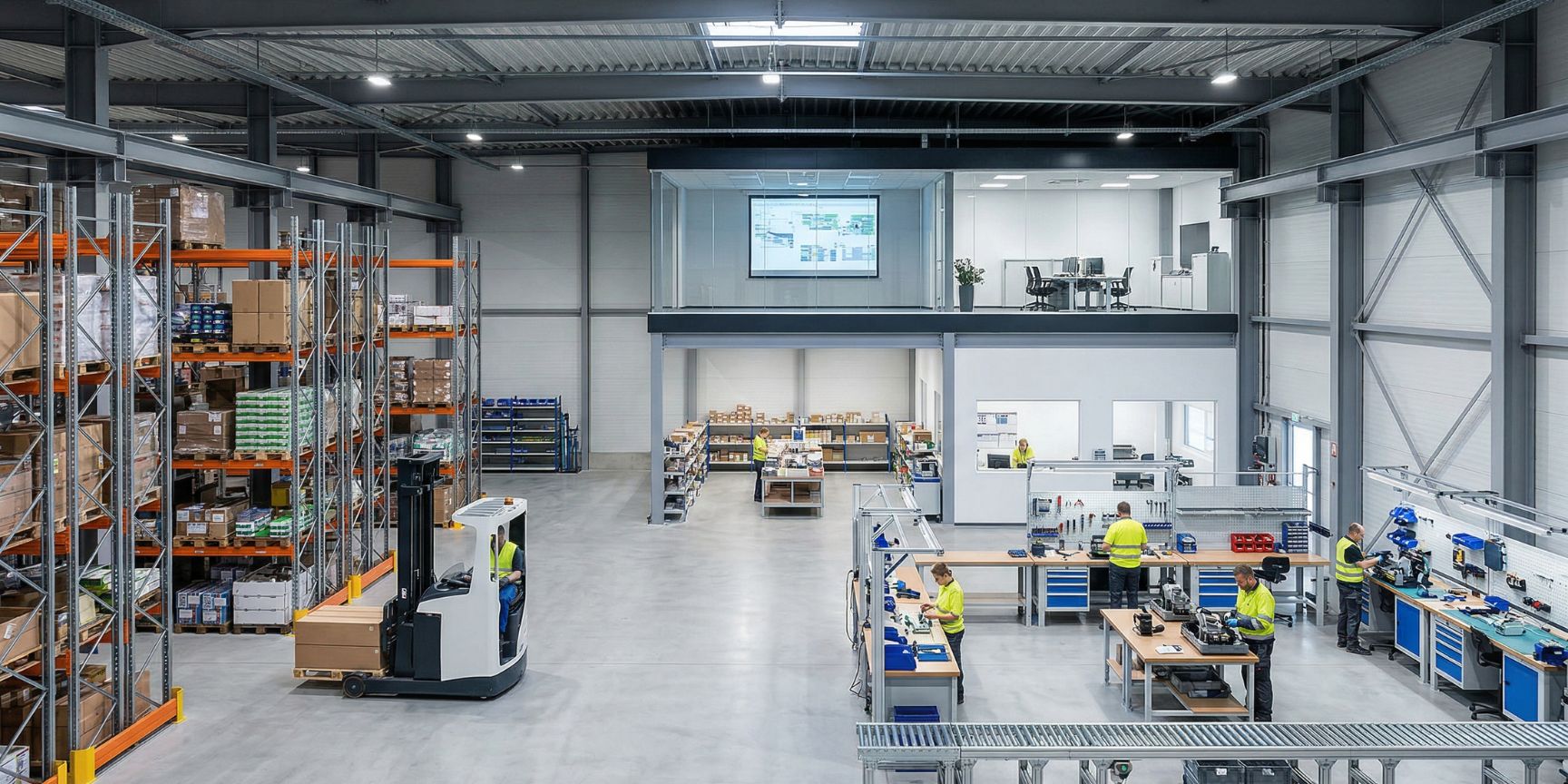
Differentiation: Light Industrial vs. Big Box Logistics
While the classic big-box logistics property is designed for pure volume efficiency and handling speed (often over 10,000 square meters, 12 meters of hall height), the light industrial property is characterized by its hybridity.
The surface structure is more small-scale and multifunctional. A typical property usually comprises units between 500 and 2,500. A key feature is the high proportion of office, social and mezzanine space, which is often between 15% and 25% of the total usable space. In this way, the construction method responds to the needs of companies that want to concentrate administration, research and operational value creation at one location.
Technical Specifications and Construction Requirements
For experts in project development and warehouse logistics, the technical key figures are the decisive criterion for third-party usability.
- Hall height: The clear height (lower edge of the truss) is usually between 6.50 m and 10.00 m. This is lower than in modern logistics centers, but sufficient for common racking systems or crane runways.
- Floor load capacity: Since these properties often have machines or small-scale high racks are used, a floor load capacity of at least 5.0 is standard.
- Delivery: A mix of ground-level gates (for Sprinters and smaller trucks) and dock levellers (for 40-tonne trucks) is essential.
- Flexibility: The column grids have been chosen in such a way that a flexible room layout is possible in order to be able to react quickly to tenant changes.
Light Industrial in Contract Logistics
For contract logistics companies, light industrial properties offer ideal conditions for "value-added services". This is not just about storage, but about production-related processes:
- Packaging and display construction: The assembly of sales displays for the retail trade.
- Finishing: Painting work, small assembly steps or software installations for technical devices.
- Repair and returns management: The physical proximity of workshop areas and storage areas makes light industrial areas the ideal hub for reverse logistics.
Due to their often central location, these properties are also ideally suited as last-mile depots for courier express parcel services (CEP), which depend on fast connections to urban conurbations.
Location Factors and Planning Law
In contrast to heavy industry, light industrial properties can often be located in mixed areas or classic commercial areas. Proximity to residential areas is a strategic advantage when it comes to recruiting employees – a critical factor in times of a shortage of skilled workers.
In terms of numbers, rents for light industrial space are significantly higher than those of standard logistics halls due to the higher quality of fit-out and the favourable location. In top logistics regions, prime rents are achieved, which are often 20% to 40% above the level of pure warehouses.
Profitability and Investment Perspective
Investors appreciate the high level of third-party usability of light industrial properties. If a tenant moves out, the space can usually be rented to a company from a completely different industry (e.g. from electrical wholesale to medical technology assembly company) without massive conversion measures due to the granular structure and the good technical equipment.
Facts & Figures in a Nutshell:
- Yield: Historically slightly above traditional logistics properties (approx. 4.0% to 5.5%).
- Vacancy risk: Low, as the demand for space by SMEs (small and medium-sized enterprises) is very stable.
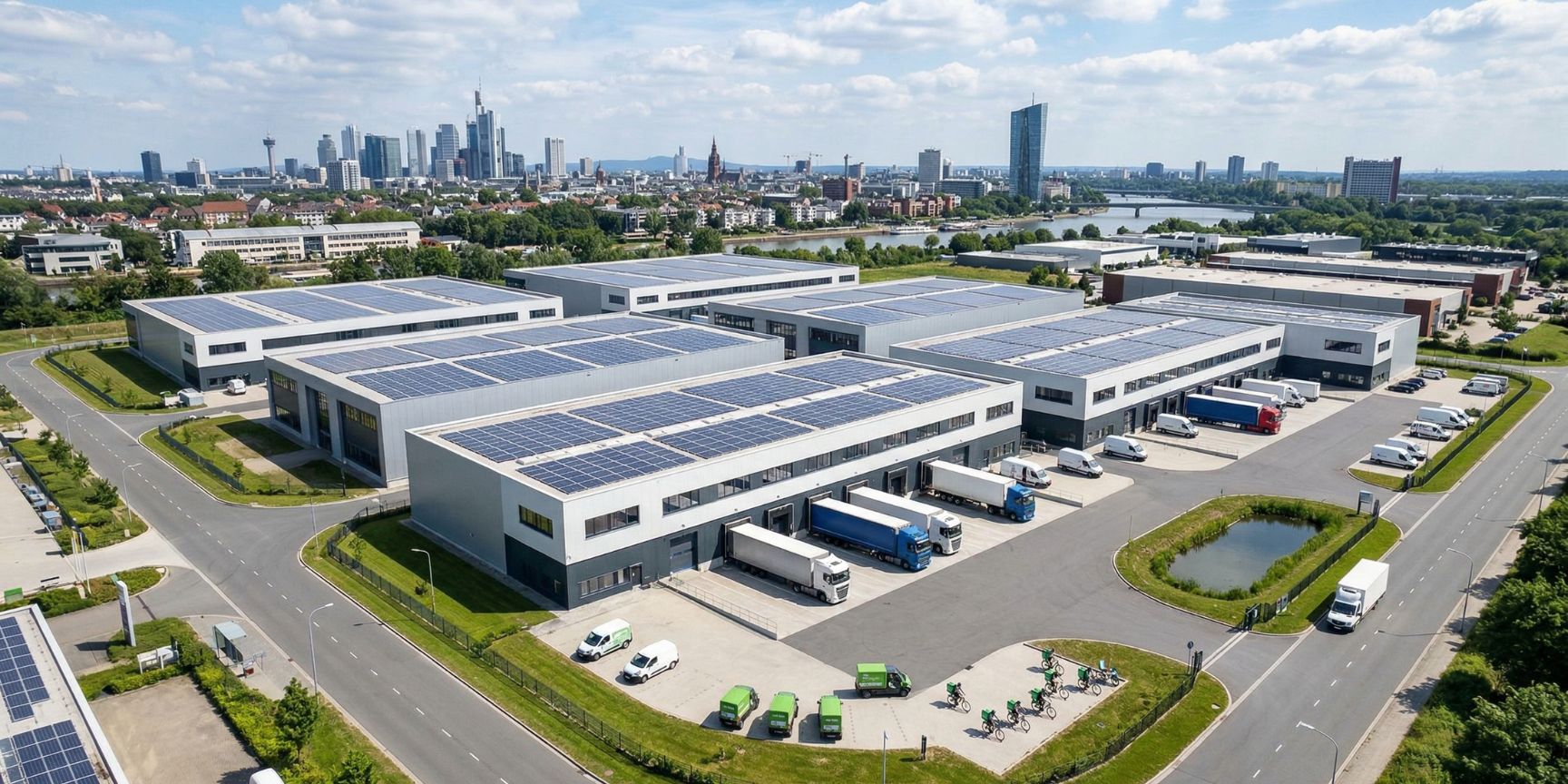
- Sustainability (ESG): Modern properties almost without exception have photovoltaic systems on the flat roofs and use heat pump technology, which reduces operating costs (OPEX) for the tenant.
FAQ – Practical Questions and Answers
Question: Is every commercial property automatically a light industrial property?
Answer: No. A pure workshop without significant storage capacity or a pure office complex do not meet the criteria. The decisive feature is the hybrid use of production, storage and administration in one structural unit.
Question: What role does the mezzanine area play?
Answer: In light industrial properties, the mezzanine level is often the place for picking or small-scale assembly. It optimises the use of space by utilising the height of the hall without increasing the floor area.
Question: Why are light industrial facilities so important for e-commerce?
Answer: E-commerce needs flexibility. Many online retailers use this space not only as a warehouse, but also for the photography of their products, quality assurance and fast shipping. The proximity to the end customer massively reduces transport costs.
Conclusion for Practice
For companies in warehouse logistics and contract logistics, the Light-Industrial asset class offers the necessary flexibility to react to volatile markets. The combination of high-quality office space and robust hall fabric makes it the ideal location for modern industrial service providers. Anyone who invests in light industrial or rents space today should pay particular attention to energy-efficient refurbishment and the digital infrastructure (fibre optic connection), as these factors are increasingly determining long-term intrinsic value.