




Workshop in warehouse logistics
Table of contents
- The workshop in warehouse logistics: More than just repairs
- Strategic integration into contract logistics
- Requirements for the logistics property: Architecture of maintenance
- Facts, figures, data: The economy of the workshop
- Technology in Transition: Automation and E-Mobility
- FAQ – Practical questions answered in a compact way
- The workshop as a recruiting argument
- Conclusion: The underestimated success factor
The workshop in warehouse logistics: More than just repairs
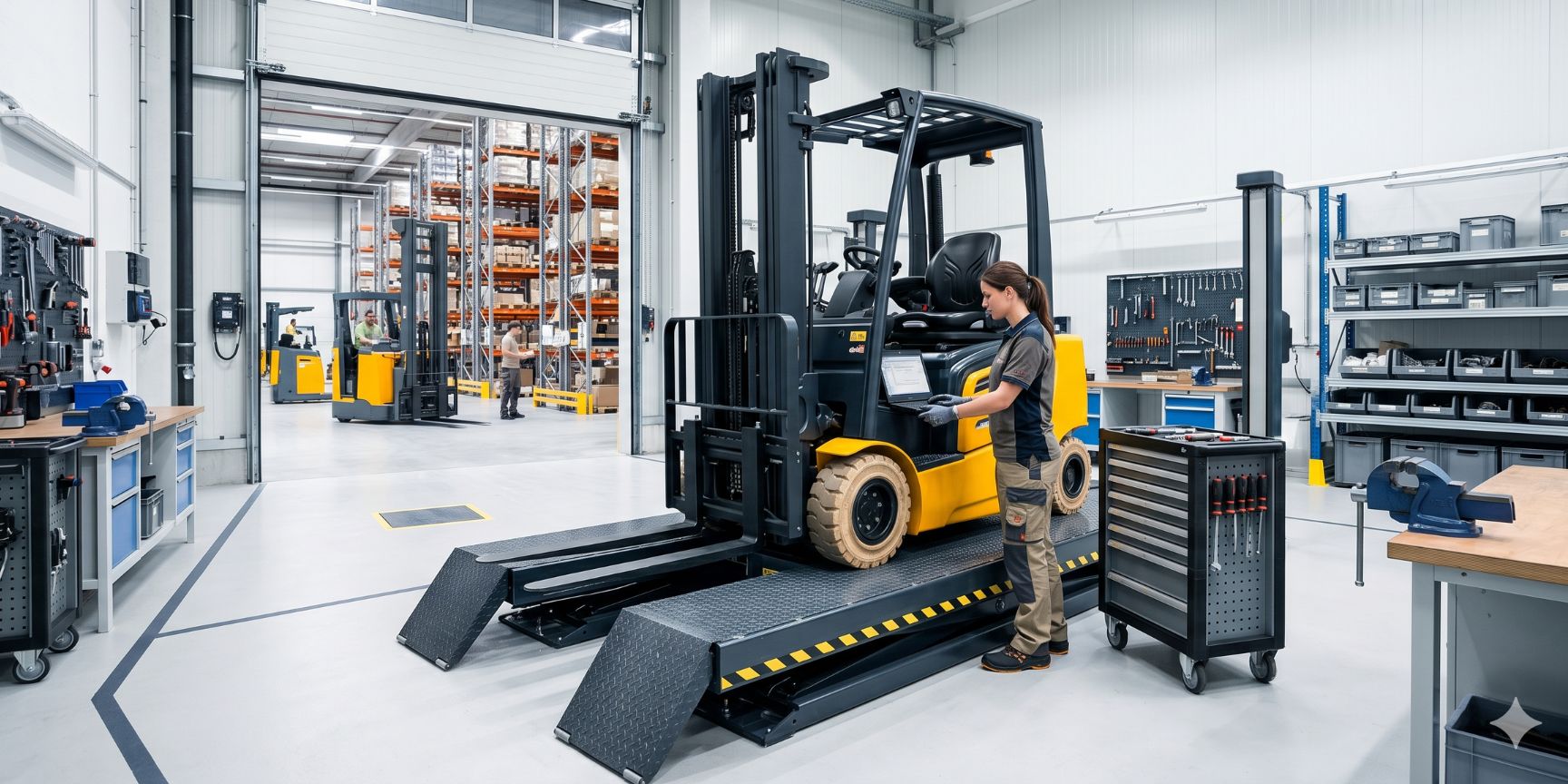
In the dynamic world of warehouse logistics, downtime is the biggest enemy of profitability. The internal workshop is the "enabler" for a smooth material flow. Whereas in the past people primarily thought of the classic forklift truck, today the area of responsibility covers the entire spectrum of intralogistics: from automated high-bay warehouses to conveyor technology and automated guided vehicles (AGVs).
A professionally managed workshop within a logistics property ensures that the technical availability of the fleet is often over 98%. Without direct access to technicians and spare parts, this value drops rapidly in intensive multi-shift operations.
Strategic integration into contract logistics
In contract logistics, the workshop often takes on a dual role. In addition to classic maintenance, it often serves as a place for value-added services (VAS).
- Finishing: Assembly of components shortly before shipping.
- Customizing: Adaptation of products to country-specific requirements.
- Returns management: Professional refurbishment of returns in order to transfer them back to the A-stock as quickly as possible.
The workshop thus becomes a profit center, as it enables services that go beyond mere storage and picking.
Requirements for the logistics property: Architecture of maintenance
If you are planning a logistics property, you must not consider the workshop as a "residual area". An efficient workshop requires specific structural requirements:
- Soil conditions: Increased load capacities and WHG (Water Resources Act) conformity to protect against leaking oils or acids.
- Power supply: High-voltage connections and charging stations for modern lithium-ion fleets.
- Clear height: Enough space for lifting platforms; often at least 6 to 8 meters.
- Gates and access roads: Direct connection to the hall, but also an external access for external service providers and deliveries.
Facts, figures, data: The economy of the workshop
Efficiency can be measured. In practice, the following guidelines apply to workshop areas in logistics:
- Proportion of space: In large distribution centers (approx. 20,000 m²), the workshop usually takes up 2% to 5% of the total area.
- Response time: The goal is a "Mean Time To Repair" (MTTR), which is less than 120 minutes for critical bottleneck equipment.
- Cost factor: A preventive maintenance concept reduces the total cost of ownership of industrial trucks by up to 15%.
MTTR = Total Downtime / Number of Repairs
This key figure is crucial to justify the performance of the workshop to the management.
Technology in Transition: Automation and E-Mobility
Advancing automation is changing the job profile in the logistics workshop. The classic mechanic becomes a mechatronics technician for system technology.
- Diagnosis: Instead of wrenches, laptops and sensor technology dominate today.
- Predictive maintenance: By evaluating real-time data (IoT), the sorting system reports its wear and tear before it breaks.
- Battery management: The switch from lead-acid to lithium-ion batteries eliminates the need for complex battery exchange stations, but the requirements for fire protection concepts in the workshop increase.
FAQ – Practical questions answered in a compact way
Question: Is it worthwhile to have your own workshop or is outsourcing better?
Answer: That depends on the size of the fleet. From about 20-25 industrial trucks, it is often worthwhile to have a permanently stationed technician (possibly provided by the manufacturer, so-called "in-house service"). For smaller warehouses, mobile service assignments are more economical.
Question: Which legal inspections must be documented in the workshop?
Answer: The annual UVV inspections (in accordance with DGUV Regulation 68 for industrial trucks) as well as the inspection of racking systems (DIN EN 15635) and electrical equipment are central.
Question: How does the workshop affect the insurance premiums of the property?
Answer: A workshop is considered an "increased hazard zone" (fire hazard due to welding or loading). Clear spatial separation by fire protection walls (F90) is essential to keep the premiums for the entire logistics hall stable.
The workshop as a recruiting argument
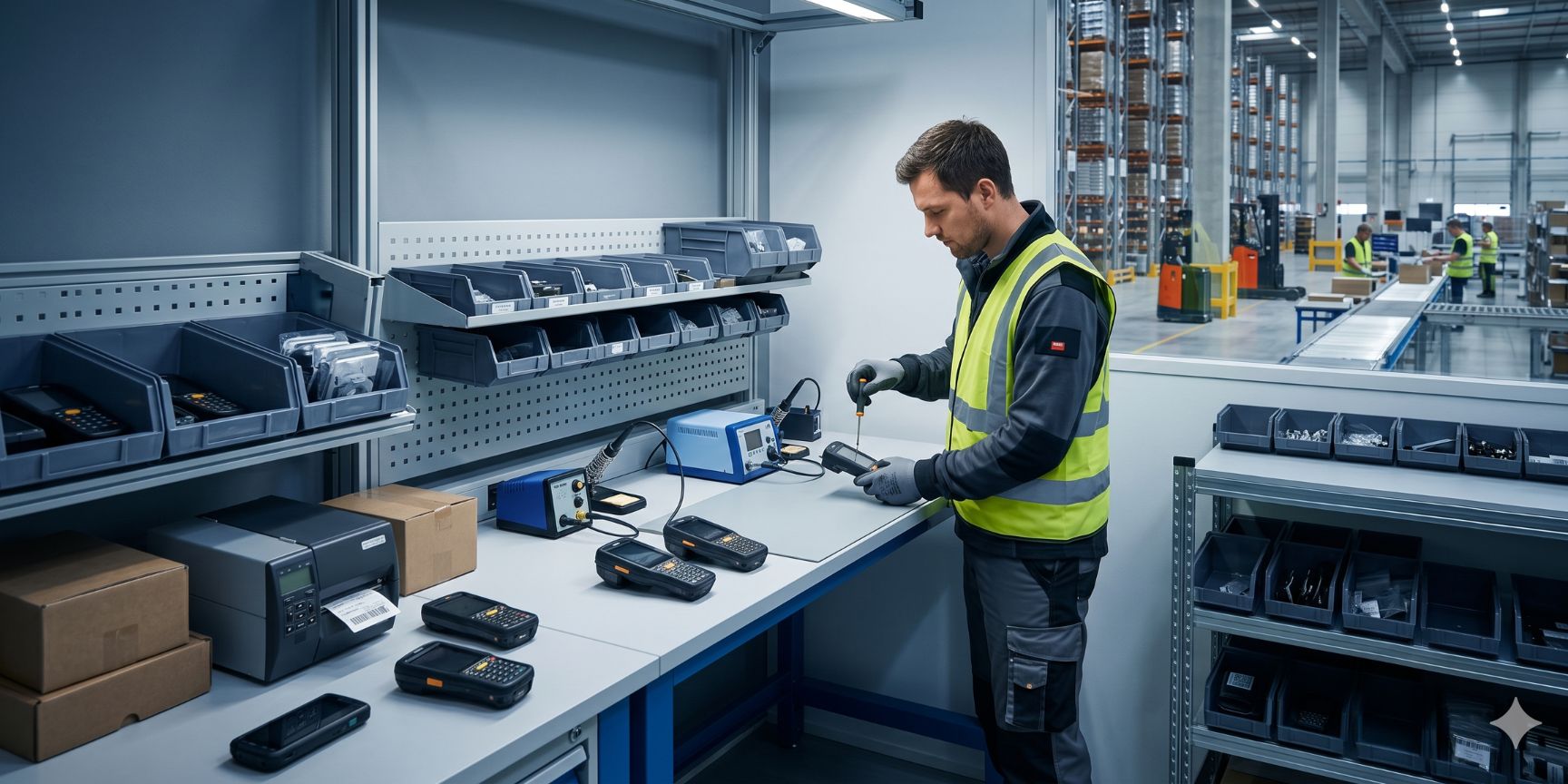
In times of a shortage of skilled workers, a modern, clean and technically well-equipped workshop is a magnet for qualified personnel. Technicians prefer to work in an environment that allows for ergonomic work (e.g. through pits or lifting platforms) and uses digital tools rather than having to improvise in dark corner areas.
Conclusion: The underestimated success factor
The workshop in warehouse logistics is much more than a cost center. It is the insurance against downtime and the engine for additional services in contract logistics. Those who think about the workshop as early as the planning phase of a logistics property and keep it technologically up-to-date secure a decisive competitive advantage in the supply chain.
Your Ideal Logistics Warehouse
Browse listings for warehouse space, logistics real estate, industrial land, and contract logistics solutions.
Browse Exposés
Maximize Exposure for Your Warehouse Space
Showcase your logistics properties and attract qualified inquiries.
Discover Products