




Wide aisle racking in warehouse logistics
Table of Contents
- The wide-aisle racking: definition and technical foundation
- Requirements for the logistics property and the hall
- The Role in Contract Logistics: Flexibility as an Asset
- Industrial trucks: The interaction between aisle width and equipment
- Cost-effectiveness: Facts and figures
- Focus on safety and occupational safety
- Comparison: Wide Aisle vs. Narrow Aisle – A Strategic Decision
- FAQ – In-depth insights for practice
- Conclusion for decision-makers
The Wide-aisle Racking: Definition and Technical foundation
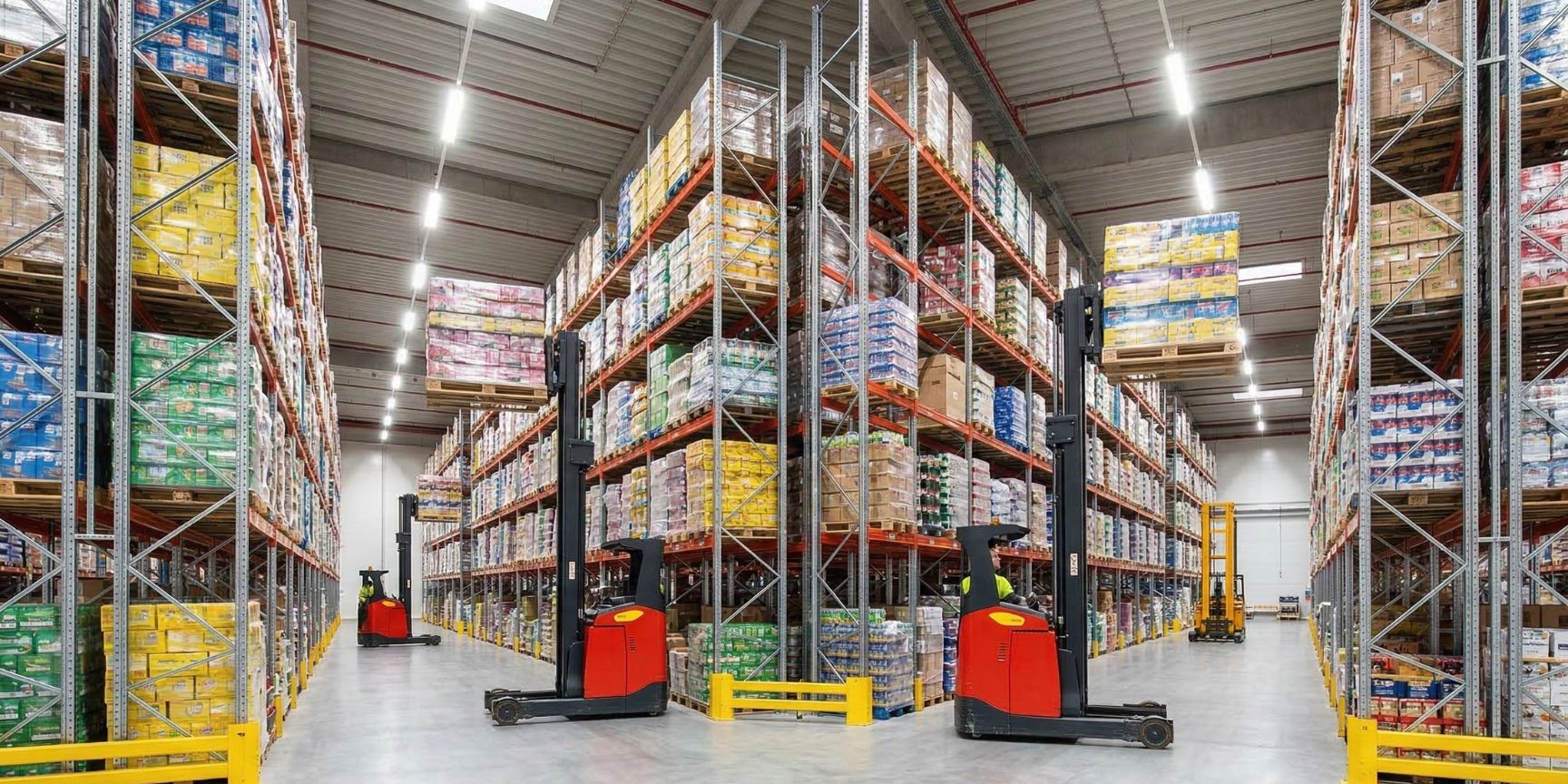
The wide-aisle racking is a form of pallet racking in which the aisle width (AST) is dimensioned in such a way that conventional industrial trucks – such as counterbalance forklifts or reach trucks – can easily manoeuvre, store and retrieve. In contrast to the narrow-aisle rack, the devices here do not require mechanical or inductive tracking.
Technically, the system consists of vertical frames and horizontal trusses. The dimensions are carried out in accordance with DIN EN 15512. A decisive feature is random access: each individual pallet can be reached directly at any time, which makes the wide-aisle rack the ideal system for a high variety of articles.
Requirements for the Logistics Property and the Hall
When building or renting a logistics property for wide-aisle systems, specific structural parameters must be taken into account:
- Floor conditions: Although the requirements are lower than in narrow aisles (where VDMA guidelines for flatness are extremely strict), the point loads of the rack supports must be absorbed. As a rule, a floor load capacity of 5 to 10 tonnes per square meter is used.
- Hall height: Wide aisle warehouses often use usable heights (UKB) of 10 to 12 meters. Higher constructions are technically possible, but are limited by the lifting height of the common reach trucks (often up to a maximum of 13 meters).
- Lighting and fire protection: The arrangement of the shelves must correspond to the roof lighting and the sprinkler heads. ESFR (Early Suppression Fast Response) sprinklers are often used in wide-aisle warehouses, as the free space between the shelves allows for good extinguishing water distribution.
The Role in Contract Logistics: Flexibility as an Asset
In contract logistics, predictability is often limited by short contract terms. This is where the wide-aisle shelving system shows its greatest strength: scalability.
Since the aisles are wide enough for standard equipment (typically between 3.30 m and 4.50 m), the logistics service provider can use its fleet flexibly. If an area needs to be quickly converted for a new customer project, truss heights can be adjusted with minimal effort. The system also easily supports various load carriers – from Euro pallets (800 x 1200 mm) to industrial pallets (1000 x 1200 mm) and lattice boxes.
Industrial trucks: The Interaction Between Aisle Width and Equipment
The efficiency of a wide-aisle warehouse stands and falls with the choice of forklifts.
- Forklifts: Require the largest aisle width (approx. 4.0 - 4.5 m), but offer a high handling capacity when loading and unloading trucks.
- Reach truck: Reduce the required aisle width to approx. 2.80 to 3.20 m. This significantly increases the storage density while maintaining flexibility.
A practical value: By using reach trucks instead of front forklifts, storage capacity can be increased by up to 20-25% on the same floor space.
Cost-effectiveness: Facts and Figures
If you look at the total cost of ownership (TCO), the wide-aisle rack is unbeatable in terms of investment costs per storage space.
| Parameters | Reference value / key figure |
| Investment costs | approx. 40 € – 80 € per pallet space (purely racking) |
| Degree of land use | approx. 35% – 45% (ratio of storage area to total area) |
| Access speed | High (100% access to all SKUs) |
| Maintenance costs | Low (annual rack inspection according to DGUV 108-007) |
In comparison, the costs in an automated high-bay warehouse are often five to ten times higher per storage space, but require significantly less personnel and space.
Focus on Safety and Occupational Safety
Despite the generous space available, the wide-aisle warehouse is a hazardous area. DGUV Rule 108-007 (formerly BGR 234) prescribes clear protective measures:
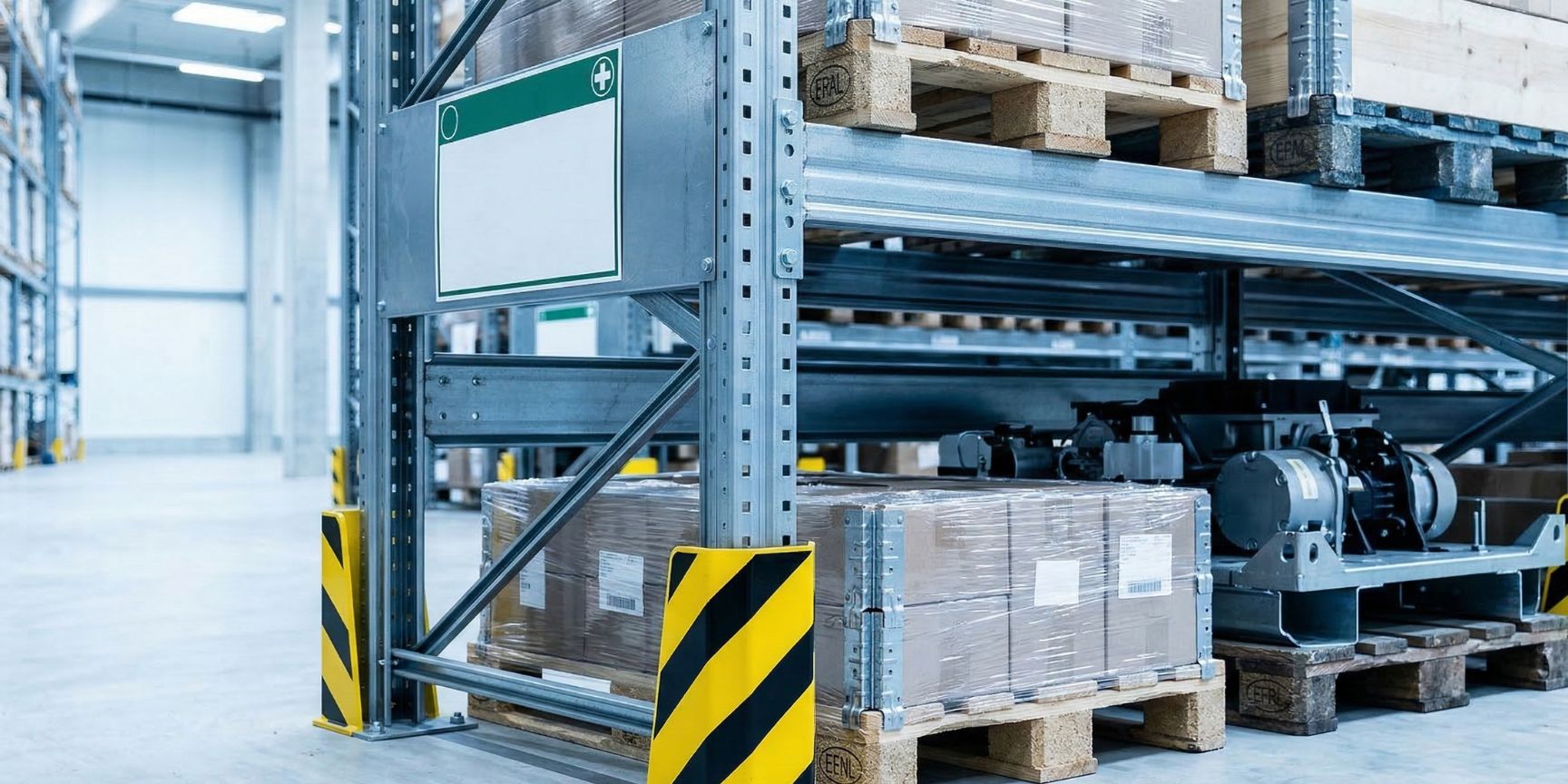
- Collision protection: Yellow and black collision protection of at least 400 mm height is mandatory on all corner posts and passageways.
- Push-through protection: If pallets are less than 100 mm apart (back to back), safety devices must prevent them from falling into the adjacent aisle.
- Marking: Each rack must bear a load plate that shows the maximum shelf and bay loads.
Comparison: Wide Aisle vs. Narrow Aisle – A Strategic Decision
When should you decide against the wide aisle?
- Land prices: In the case of extremely high land costs, the degree of land use forces narrow aisles or high-bay warehouses.
- Throughput: If the pure pallet movement per hour has to be massively increased, automated systems offer advantages.
- Staff availability: Wide aisle warehouses are personnel-intensive. In regions with an acute shortage of skilled workers, the bill for automation is shifting.
For most standard applications in distribution, however, the wide-aisle rack remains the first choice due to the low barriers to market entry.
FAQ – In-depth insights for practice
Question: How exactly do you calculate the optimal aisle width?
Answer: The formula is:
AST = Wa + ((l6 - x)2 + (b12/2)2)0.5 + a
Here, Wa stands for the turning radius, I6 for the load length, and a for the safety distance (usually 200 mm according to VDI 2198).
Question: Can wide-aisle racks be used in earthquake zones?
Answer: Yes, but the frame profiles and ground anchors must be reinforced in accordance with DIN EN 16681. This increases the steel tonnage and thus the price per parking space by about 15-30%.
Question: Is a wide-aisle warehouse suitable for FIFO (First-In-First-Out)?
Answer: Absolutely. Since each location is directly accessible, any warehouse strategy (FIFO, LIFO, FEFO) can be controlled purely on the software side via the Warehouse Management System (WMS) without having to modify the hardware.
Conclusion for decision-makers
The wide-aisle shelving is much more than just "steel in the hall". It is a strategic decision for maximum operational freedom. It offers the best third-party usability for logistics real estate developers, the lowest financial risks for contract logistics companies and the highest transparency for warehouse managers. If you are looking for a robust, low-maintenance and highly flexible solution, there is no way around the wide-aisle system.

Your Ideal Logistics Warehouse
Browse listings for warehouse space, logistics real estate, industrial land, and contract logistics solutions.
Browse Exposés
Maximize Exposure for Your Warehouse Space
Showcase your logistics properties and attract qualified inquiries.
Discover Products