




FIFO Principle in warehouse
Inhaltsverzeichnis
- The FIFO Principle: Definition and Strategic Significance
- Industry-specific relevance and areas of application
- Requirements for the logistics property and hall layout
- Optimal shelving systems and storage technology for FIFO
- Benefits for quality, transparency and efficiency
- Challenges and solutions in practice
The FIFO Principle: Definition and Strategic Significance
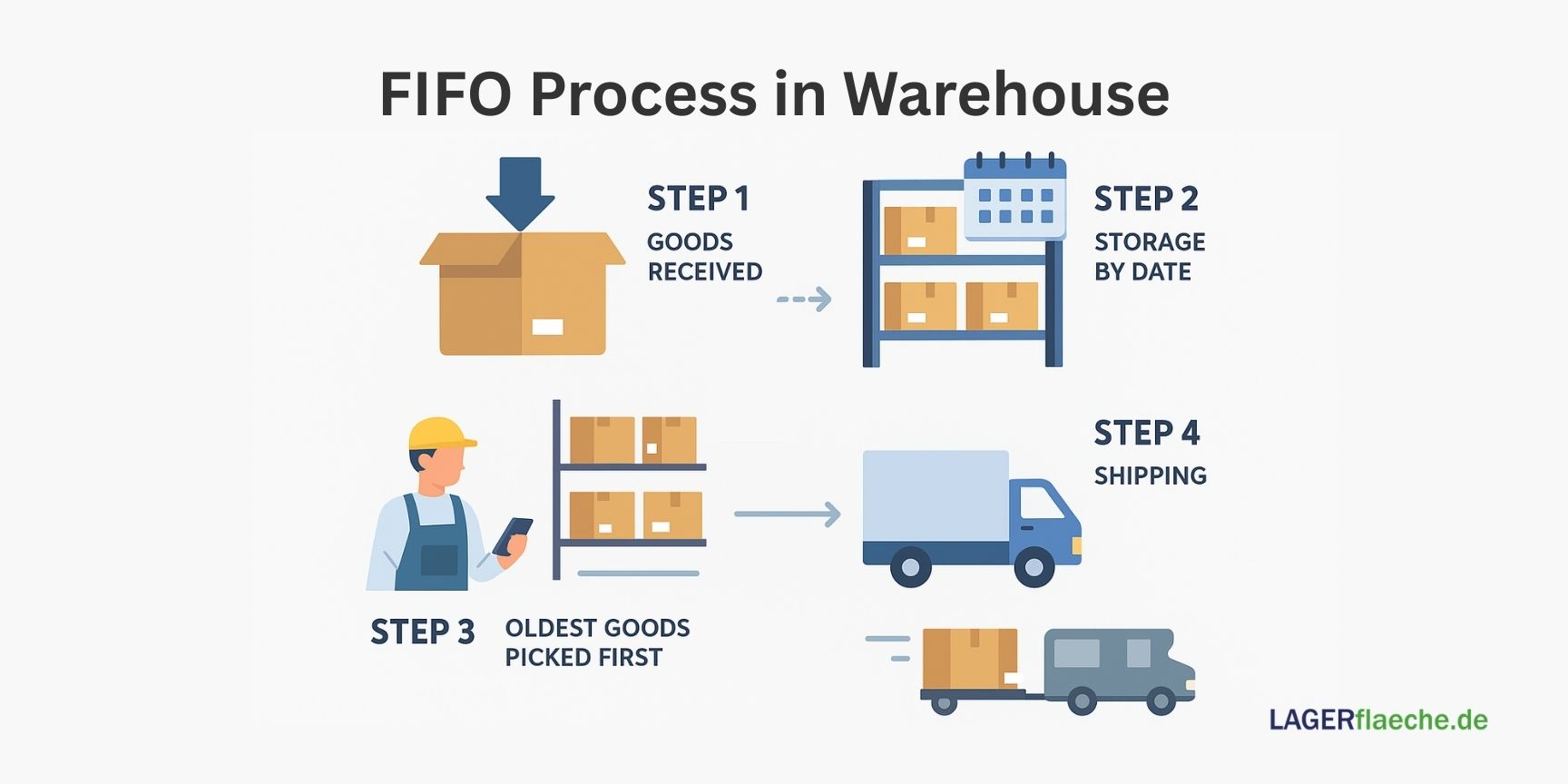
The First-In, First-Out (FIFO) principle is a method of warehousing in which the goods or commodities that are stored first are also the first to be retrieved. You can think of it like a queue: first come, first served. In warehouse logistics, this means that the items with the oldest stock date are picked in a prioritized manner. This procedure is crucial to ensure product quality, avoid loss of value due to obsolescence and ensure complete compliance with legal requirements such as batch traceability. In contrast to the LIFO (Last-In, First-Out) principle, where the latest items are taken first, FIFO forces a consistent rotation of the entire inventory and is therefore indispensable for many industries.
Industry-specific relevance and areas of application
The necessity of the FIFO principle results primarily from the nature of the stored products. The application is particularly critical in the following sectors:
- Food and beverage industry: Here, compliance with best-before dates (BBD) is essential to prevent spoilage and guarantee food safety.
- Pharmaceutical industry: In the case of drugs and pharmaceutical products, the effectiveness is often linked to an expiration date. In addition, legal regulations (e.g. GDP – Good Distribution Practice) require strict batch tracking, which is supported by FIFO in terms of process technology.
- Cosmetics industry: Cosmetics also have limited shelf life and application periods, compliance with which is ensured by FIFO.
- Electronics and technology: Components can lose value due to technological obsolescence or changes in production. A FIFO strategy ensures that the oldest but still current batches are always included in production.
Requirements for the logistics property and hall layout
The decision in favour of the FIFO principle has direct structural and infrastructural consequences for a logistics property. A hall must be designed in such a way that a logical and forced flow of goods is possible. Ideally, delivery (incoming goods) takes place on one side of the building and delivery (outgoing goods) on the opposite side. This "tunnel character" prevents cross-traffic and ensures that the goods pass through the warehouse in the correct order.
Other structural aspects are:
- Sufficient manoeuvring and staging areas at both ends of the flow of goods.
- A clear separation of storage, picking and traffic zones in the hall layout.
- The statics of the hall floor must be designed for the loads of the often dense and high shelving systems.
Optimal shelving systems and storage technology for FIFO
The physical implementation of FIFO requires specialized racking systems that allow access to the oldest commodity without having to move the newer commodity. The most common solutions are:
- Drive-Through Racks / Flow Racks: This is the classic FIFO solution. The goods are inserted into inclined rack channels on one side (loading side) and roll by gravity to the removal side. This guarantees perfect compliance with the FIFO principle.
- Drive-in racks in the drive-through version: Here, a forklift can enter the rack channel from both sides. Feeding is done from one side, removal from the other.
- Push-back racks with through-loading function: A less frequently used but possible variant that is specially designed for FIFO.
- Automated storage systems: Shuttle systems or storage and retrieval machines (SRMs) in an automated small parts warehouse (AS/RS) or pallet warehouse are controlled via the Warehouse Management System (WMS). The WMS knows the storage date of each individual loading unit and controls the retrieval strictly according to FIFO specifications, regardless of the physical storage position.
Benefits for quality, transparency and efficiency
The consistent application of the FIFO principle brings tangible operational advantages. The most obvious benefit is quality assurance, as products with expiration dates or aging potential rotate systematically and are not "forgotten" in the warehouse. This minimizes depreciation and returns due to quality defects.
Another decisive advantage is the complete batch traceability. In the event of a product recall, it is possible to trace exactly which batches were delivered to which customers. This reduces the damage and meets legal requirements. Finally, the clear process structure leads to a high level of transparency and efficiency in the warehouse. Walking distances are optimized, search times are eliminated and the error rate during picking is reduced.
Challenges and solutions in practice
Despite the clear advantages, the FIFO principle also poses challenges. The largest is the need for space. Flow racks or separate storage and retrieval sides require more traffic and manoeuvring space than compact block storage (LIFO). The storage density can be lower as a result. In addition, the investment costs for special FIFO racking systems or automation technology are higher than for simple pallet racks.
However, these disadvantages can be compensated for by intelligent planning and the use of technology. A powerful warehouse management system (WMS) is key. It can also organise "chaotic warehousing" in a standard pallet rack in compliance with the FIFO principle by specifically assigning the forklift driver the location with the oldest goods. In this way, the advantages of FIFO can be combined with a high storage density.