



Shuttle systems in the warehouse
Table of Contents
- What are shuttle systems? A definition
- Core components and operation of a shuttle warehouse
- Types of shuttle systems: From captive to roaming
- Shuttle systems in contract logistics: Flexibility as a trump card? (Q&A)
- Requirements for the logistics property: What does a shuttle warehouse need?
- Key Performance Indicators (KPIs) and Profitability
- Opportunities, Risks and the Future of Technology (Q&A)
What are shuttle systems? A definition
Shuttle systems, often referred to as "shuttle warehouses", are a subcategory of automated small parts warehouses (AS/RS). At their core, they replace the traditional, aisle-bound storage and retrieval machines (SRMs) with a fleet of autonomous vehicles – the shuttles.
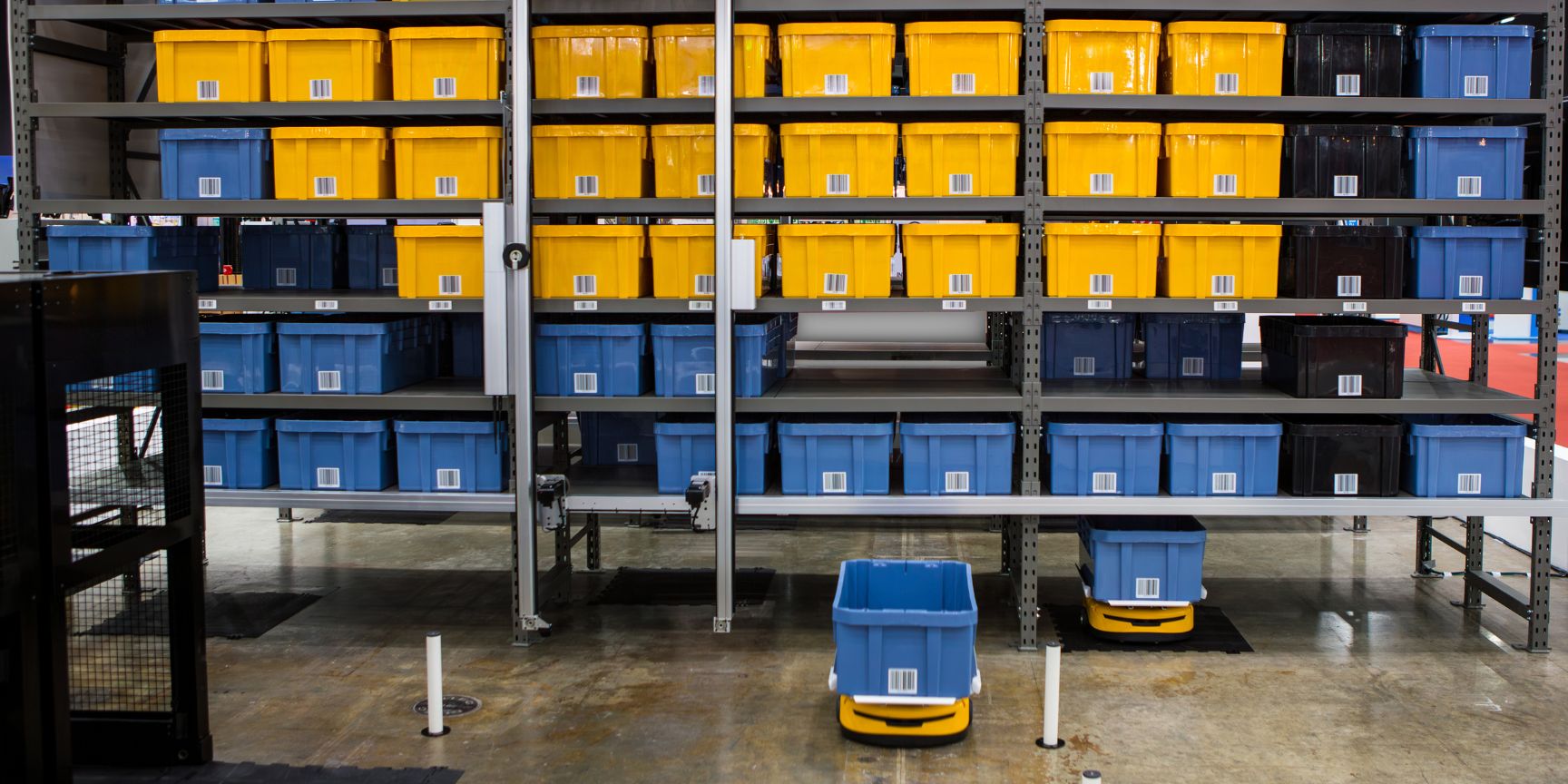
These shuttles move horizontally within a specially designed rack construction. Their main task is to transport loading equipment (usually containers or cartons) from a storage location to a vertical lift system (lifters) and vice versa. The overarching goal is almost always the implementation of the "goods-to-person" (GzP) principle, in which the articles are brought fully automatically to a stationary picking station.
The decisive difference to stacker crane systems lies in the decentralization of performance: While an stacker crane can only carry out one storage or retrieval at a time per aisle, dozens of vehicles can work in parallel in a shuttle system.
Core components and operation of a shuttle warehouse
A shuttle system is a complex interplay of several technical components that are coordinated by an intelligent control system:
- The racking system: This is more than just a storage location; it's the infrastructure. It consists of specially made channels or compartment levels on which the shuttles travel. The density is extremely high, as there are no aisles for forklifts or people.
- The shuttles (carriages): The autonomous vehicles. They are responsible for moving horizontally on a plane (1D) or across planes (2D). They are supplied either via permanently integrated busbars or via high-performance on-board batteries or supercapacitors, which are charged at docking stations (often on the lifter).
- The lifters (vertical conveyors): They are the eye of the needle and at the same time the performance engine of the system. Lifters transport the shuttles (in the case of 2D systems) or the loading aids (containers/cartons) vertically between the storage levels and the pre-zone. High-performance systems often use multiple lifters per aisle to maximize throughput.
- The pre-zone (conveyor technology): This is the interface to humans or other automation steps (e.g. robot picking). It consists of conveyor technology (roller conveyors, belt conveyors) that transports the containers to the picking, packing or goods receipt stations.
- Control (WMS/WCS): The brain. The Warehouse Management System (WMS) manages inventory and orders. The Warehouse Control System (WCS) or Material Flow Controller (MFC) translates the orders into concrete transport orders for the shuttles and lifters and optimizes the movement sequences.
Types of shuttle systems: From captive to roaming
The architecture of shuttle systems differs primarily in how flexibly the vehicles can act:
1D systems (captive shuttles):
- Definition: Each shuttle is "captive" on a single level within a single alley.
- Function: To retrieve a container from level 5, the shuttle of level 5 travels to the shelf compartment. To retrieve a container from level 10, the shuttle from level 10 runs.
- Advantage: Extremely high throughput, as all levels can work in parallel and independently of each other.
- Disadvantage: Less flexibility and higher investment costs, as one shuttle is required per level.
- Application: Ideal for buffer warehouses in production or high-performance distribution centers with relatively homogeneous article distribution.
2D systems (roaming shuttles):
- Definition: The shuttles can change the level and often also the alley.
- Function: A shuttle picks up a container on level 5, drives to the lifter, hands over the container and can then be brought by the lifter to level 12 to carry out the next job there.
- Advantage: High flexibility and scalability. Performance (throughput) can be increased by adding more shuttles to the fleet without rebuilding the racking system. Lower basic investment, as not each level needs its own vehicle.
- Disadvantage: The total performance is limited by the number of lifts and the travel distances of the shuttles.
- Use: Perfect for e-commerce, multi-channel logistics and contract logistics, where order volumes and assortments change rapidly.
Special form: Pallet shuttles (satellite vehicles):
These are often used in the context of sewer warehouses (e.g. for beverages or in deep-freeze warehouses). Here, a forklift or a stacker crane drives the shuttle to the sewer, the shuttle then drives into the canal to store pallets deep (LIFO/FIFO). This is primarily for density, less for GzP picking.
Shuttle systems in contract logistics: Flexibility as a trump card? (Q&A)
For contract logistics service providers (3PL), investments in automation are challenging, as customer contracts often only run for 3-5 years. Shuttles offer interesting answers here.
Question: Our order volume fluctuates extremely seasonally. Are shuttles suitable for this?
Answer: Yes, 2D roaming systems are ideal here. The decisive advantage is the decoupling of storage capacity and performance. The capacity is defined by the shelf (steel construction). The performance (throughput) is defined by the number of shuttles and lifters. In the seasonal business (peak season), a 3PL can temporarily increase its shuttle fleet (e.g. by renting or leasing) in order to double the service without changing the physical property.
Question: We serve four different clients (customers) in one hall. How do shuttles manage this?
Answer: The WMS is crucial here. For the shuttle system, a container is just an ID. The WMS ensures the logical separation of the portfolios (multi-client capability). The advantage for the 3PL lies in the density: thanks to the compact storage, more clients can be accommodated on the same floor space, which makes the property more profitable. The high performance of the shuttles makes it possible to efficiently process the different order structures (e.g. a B2B customer with large orders, an e-com customer with many small ones) in parallel.
Requirements for the logistics property: What does a shuttle warehouse need?
The implementation of a shuttle system places high demands on the logistics property, which go far beyond those of a manual warehouse:
- Bottom plate: This is the most critical point. Shuttle systems, especially tall systems (up to 25 meters), require an extremely flat and load-bearing base plate. Deviations (in accordance with DIN 18202 or more specific VDMA guidelines) can lead to vibrations, increased wear and, in the worst case, malfunctions. Renovation is often more expensive than a new building on a greenfield site.
- Room height (UKB): Shuttles are ideal for taking advantage of the height. While manual warehouses often reach their limits at 10-12 meters, shuttle systems take advantage of the full height of the building. This maximises the degree of space utilisation (storage capacity per cubic metre) and reduces the footprint.
- Power supply: A fleet of dozens or hundreds of shuttles, as well as several high-power lifters, require a stable and strong power supply, including buffering for peak loads.
- Fire protection: The extreme storage density (high fire load in a confined space) requires special fire protection concepts. Standard sprinkler systems are often not enough. Common solutions are in-rack sprinklers (expensive to maintain and install) or oxygen reduction systems (OxyReduct), which permanently lower the oxygen content in the storage aisle to such an extent that an open fire cannot occur.
Key Performance Indicators (KPIs) and Profitability
When is a shuttle system worthwhile? The decision is based on hard key performance indicators (KPIs).
- Throughput (performance): The most important KPI. Measured in storage and retrieval per hour. While a stacker crane may manage 80-120 double cycles (storage and retrieval combined) per hour, high-performance shuttle systems achieve 500 to over 1,000 double cycles per lane per hour.
- Storage density: (storage capacity per m² floor space). Shuttle systems offer one of the highest densities in the AS/RS range.
- Scalability: The ability to increase performance (throughput) by adding vehicles.
- Error rate: Due to the "goods-to-person" principle and automated tracking, the pick error rate drops to zero.
When is the investment worthwhile (ROI)? A shuttle warehouse is a high CAPEX investment. The return on investment (ROI) is typically achieved in 3 to 7 years. It pays off if one or more of the following factors apply:
- High personnel costs: The system drastically reduces the need for (often hard-to-find) warehouse staff.
- High land/rental costs: The extreme density saves expensive floor space.
- High throughput requirements: (e.g. same-day e-commerce fulfillment).
- Zero-defect tolerance: (e.g. pharmaceutical logistics or automotive production supply).
Opportunities, Risks and the Future of Technology (Q&A)
Question: What are the biggest risks when implementing a shuttle system?
Answer: The biggest risk is complexity. The integration of IT (WMS/WCS) is demanding and error-prone. Secondly, there is a high level of technical dependency: If a central element (e.g. the main lifter or the IT) falls, the system is in place. Redundancy (e.g. multiple lifters, redundant servers) is essential, but expensive. The third risk is the lack of suitability of the property (see floor slab).
Question: Where is shuttle technology headed?
Answer: The future lies in intelligence and autonomy. Instead of just processing commands from a WCS, next-generation shuttles communicate with each other (swarm intelligence). They optimize their routes decentrally and independently in order to proactively avoid bottlenecks (e.g. traffic jams in front of the lifter). Another trend is cooperation with other robots: shuttles that transfer containers not only to the conveyor system, but also directly to autonomous mobile robots (AMR), which then flexibly transport the goods to mobile packing stations.