



Greenfield in warehouse construction
Table of Contents
- What is greenfield warehouse construction? A definition
- The strategic contrast: greenfield vs. brownfield
- Focus on warehouse logistics: Processes dictate the design
- Focus on contract logistics: flexibility and value-added services
- Focus on logistics real estate: The asset as an investment
- Questions & Answers (Q&A) on the Greenfield Project
- Conclusion: The strategic decision for the future
What is Greenfield Warehouse Construction? A Definition
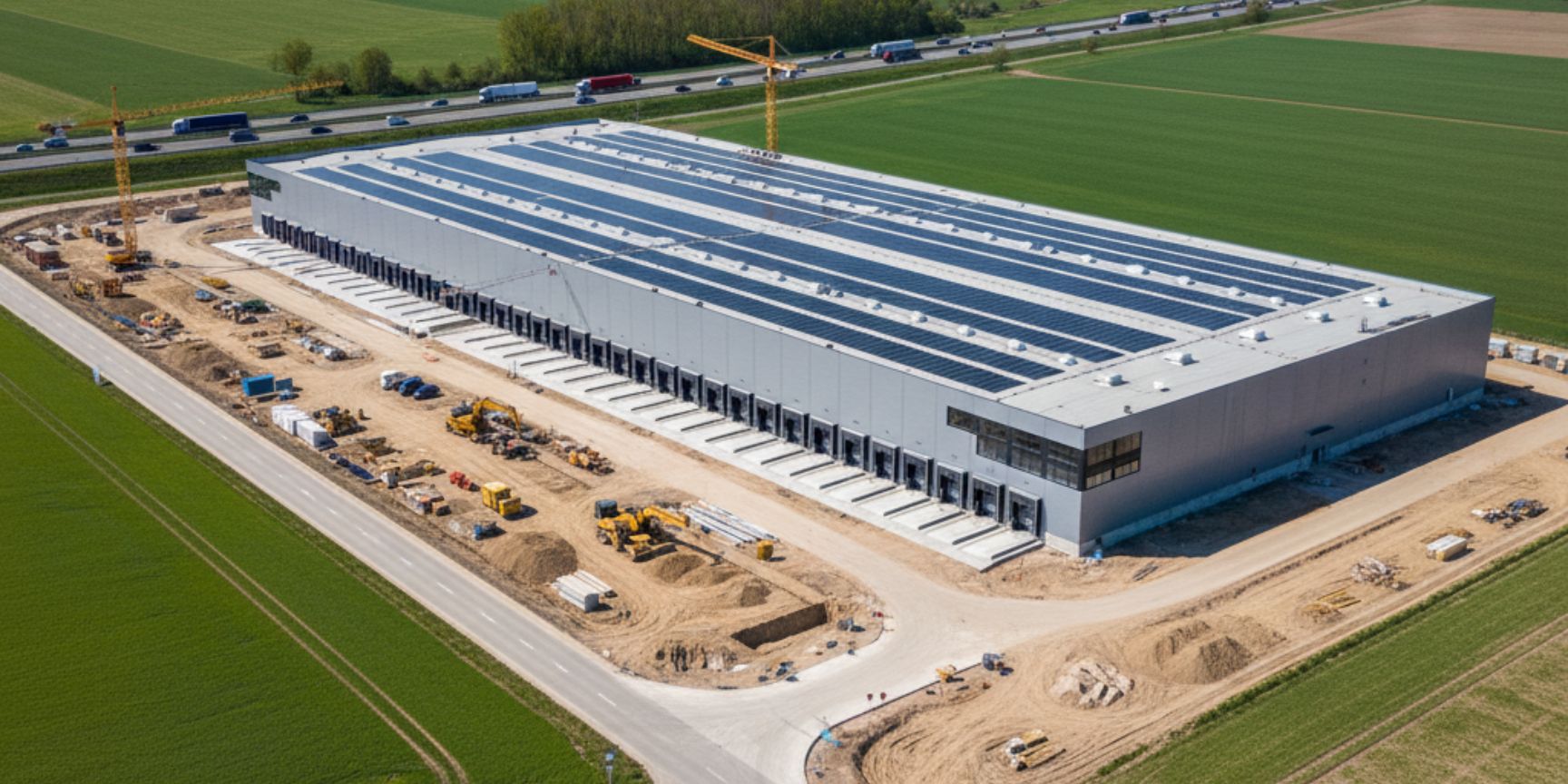
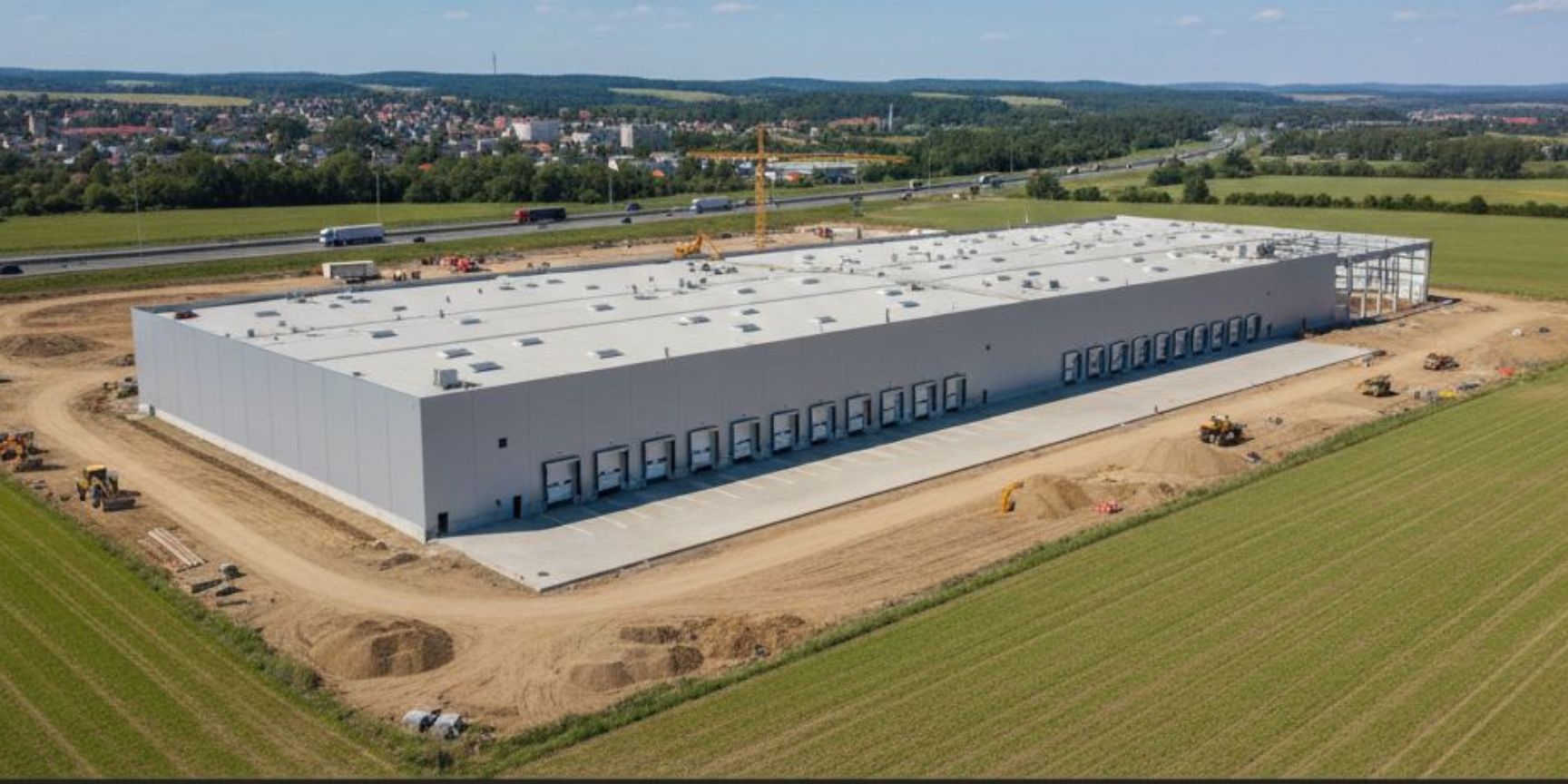
In the context of logistics real estate, the term greenfield (literally: "greenfield") describes a new building on a plot of land that was not previously subject to commercial, industrial or structural use. These are typically arable land or meadows that are newly designated as industrial or commercial areas.
The decisive factor is the lack of prior uses. This means:
- No existing building structures that need to be demolished.
- No industrial contamination in the soil.
- No restrictions from old foundations or infrastructure.
This approach offers maximum design freedom, as the layout, the building orientation and the infrastructure (access roads, media connections) can be tailored from scratch and ideally tailored to the future user.
The Strategic Contrast: Greenfield vs. Brownfield
To fully understand the greenfield approach, one must distinguish it from its counterpart, the brownfield approach.
Greenfield:
- Advantages: Maximum planning freedom, optimal process mapping, state-of-the-art building standards (e.g. ESG compliance), often faster construction time, no renovation costs.
- Disadvantages: High land consumption (sealing), often complex and lengthy approval procedures (creation of building permits, species protection assessments), potentially poorer connections to existing urban infrastructure or labour markets.
Brownfield:
- Advantages: Revitalization of existing areas (less resealing), often better inner-city location, existing building rights, potentially faster overall availability if no renovation is necessary.
- Disadvantages: High risks due to contaminated sites, considerable demolition and renovation costs, strong compromises in the layout due to plot layout or existing requirements.
The decision between greenfield and brownfield is one of the most fundamental strategic decisions in logistics real estate development.
Focus on Warehouse Logistics: Processes Dictate the Design
From the point of view of pure warehouse logistics (intralogistics), the greenfield approach is the supreme discipline. Here, the property is uncompromisingly planned around the process.
Process optimization right from the start: Even before the first excavator rolls, the material flow (MHE) is defined. Whether wide-aisle, narrow-aisle (VNA) or automated small parts warehouses (AS/RS) – the layout of the hall (column grid, hall height) adapts to the technology, not the other way around.
Key technical factors (facts & figures):
- Clear height (UKB): The usable height below the trusses. While the standard was 10 meters for a long time, today almost exclusively 12.2 meters of UKB are realized. This enables optimal utilisation with VNA forklifts or pallet shuttles (up to 8 levels high).
- Floor slab: It is not only the load (standard: 5–7 t/m²) that is decisive, but also the flatness (according to DIN 18202) in the case of automation. High-rack forklifts or AMRs (Autonomous Mobile Robots) require extremely flat floors.
- Column grid: A wide grid (e.g. 12m x 24m) maximises flexibility for shelving systems.
- Fire Safety: Early Suppression Fast Response (ESFR) sprinkler systems are standard. They do not require expensive and inflexible in-rack sprinkler systems.
Greenfield makes it possible to build a warehouse "from a single source" that is trimmed for maximum picking performance, throughput and efficiency – a basic requirement for modern e-commerce or production logistics.
Focus on Contract Logistics: Flexibility and Value-added Services
Contract logistics (3PL/4PL) places different demands on a property than pure warehousing. A contract logistics provider often manages complex processes for different customers (multi-users) or provides value-added services (VAS).
Building flexibility is key: a greenfield construction for a 3PL must be able to "breathe".
- Multi-user capability: The hall must be easily divisible into separate fire compartments (often 5,000–10,000 m²). Each section needs its own media meters and, ideally, separate office and social wings.
- Mezzanine areas: For VAS (packaging, returns management, quality control, easy assembly), mezzanines above the loading zones are essential. These require a higher load capacity (approx. 500 kg/m²) and good lighting.
- Gates & Docks: The door frequency is higher in contract logistics (goods handling) than in warehouse logistics (storage). As a rule of thumb, 1 truck door per 800-1,000 m² of storage space. In addition, different types of gates are often required (standard docks, jumbo gates for swap bodies, ground-level gates).
A greenfield project gives the contract logistics company the opportunity to optimally integrate these flexible structures (office extensions, mezzanine, gate situation) instead of "forcing" them into a rigid inventory.
Focus on Logistics Real Estate: The Asset as an Investment
For the developer or investor, the greenfield logistics hall is primarily an asset. What counts here is location, quality and long-term intrinsic value.
Sustainability (ESG) as standard: No modern greenfield development today can do without sustainability certification (e.g. DGNB Gold/Platinum or BREEAM Excellent). Investors are demanding this. These include:
- Standard installation of photovoltaic systems (or at least pre-installation).
- Use of sustainable building materials.
- Efficient building technology (heat pumps instead of gas radiant heaters).
- Charging stations for e-mobility (cars and trucks).
Third-party usability: Investors avoid highly specialized "single-tenant" buildings (e.g. hazardous materials warehouses) unless there is an extremely long-term lease (15+ years). A greenfield building must be designed in such a way that it can be easily re-let after the first tenant has moved out. The above-mentioned standards (12.2m height, 5t/m² floor load, ESFR) ensure this universal usability.
Questions & Answers (Q&A) on the Greenfield Project
Question: What is the single biggest risk in a greenfield project?
Answer: Clearly the creation of building rights. While the construction of a 20,000 m² hall often takes only 9-12 months, the preceding B-Plan process (development plan) including all expert opinions (species protection, traffic, noise) can take 24 to 48 months. The search for land and the approval phase are the bottleneck, not the construction itself.
Question: Are greenfield projects more expensive than brownfield?
Answer: That is a fallacy. The pure land costs on greenfield sites may be high, but brownfield projects carry incalculable risks. The costs of demolishing old structures and remediating the soil (decontamination) can quickly outweigh the potential savings on land purchases, putting the schedule at massive risk.
Question: What role does location (macro/micro) play in greenfield construction?
Answer: A fundamental one. The macro location (region, motorway connection) defines the basic potential. The micro-location (exact access to the property, visibility, labor availability, 24/7 operating permit) determines operational excellence and the subsequent property value.
Conclusion: The Strategic Decision for the Future
Greenfield warehouse construction is the "supreme discipline" of logistics real estate development. It offers a unique opportunity to uncompromisingly combine operational efficiency, technological innovation (automation) and the highest sustainability standards (ESG). While the land consumption and the lengthy approval procedures are disadvantages, the advantages of a tailor-made, highly efficient property that remains competitive for decades to come outweigh the disadvantages for specialized logistics companies (contract logistics, e-commerce) and future-oriented investors.