




Greyfields in Warehouse Construction
Table of Contents
- Definition: What is a greyfield in logistics real estate development?
- The drivers: Why is greyfield warehouse construction coming into focus?
- Q&A: Greyfield vs. Brownfield – What is the decisive difference for developers?
- Hurdles in practice: The challenges of building logistics halls
- The Opportunities: Strategic Advantages for Contract Logistics and Urban Supply
- ESG and profitability: Does the revitalization of a logistics property pay off?
- Conclusion: Greyfield as a necessity instead of a freestyle
Definition: What is a Greyfield in logistics real estate development?
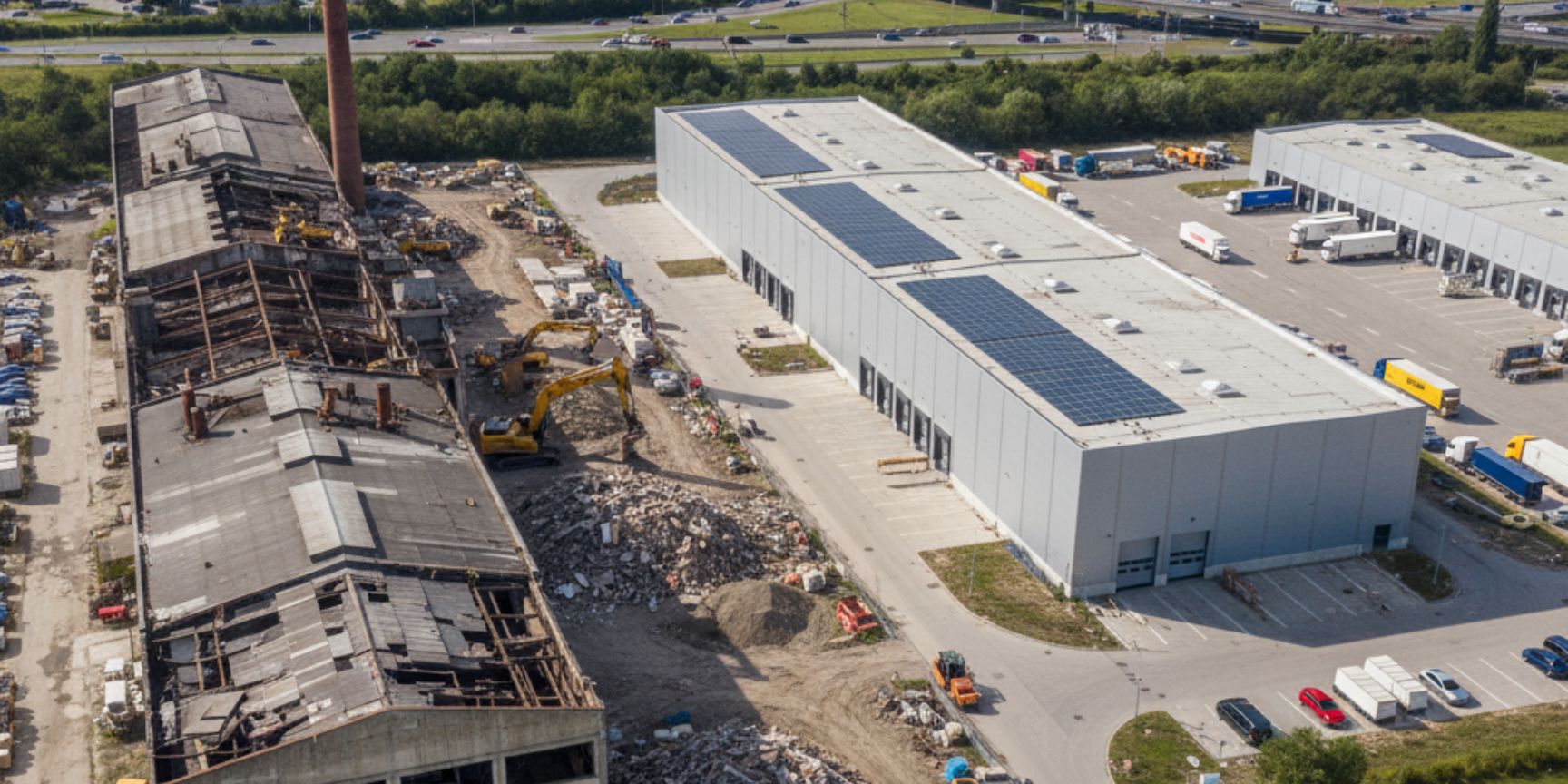
In the context of the real estate industry and urban development, the term greyfield refers to an already developed, built-up area whose use has become obsolete or which is severely underused. In contrast to "greenfields" (green spaces/undeveloped plots), no new area is sealed here.
In the focus of logistics real estate development, these are typically:
- Old, inefficient warehouses or production halls that no longer meet today's standards (e.g. 10-12m UKB – lower edge of truss).
- Former military barracks or conversion areas.
- Abandoned retail locations (e.g., old supermarkets, hardware stores) or outdated business parks.
The decisive factor is that the existing building fabric often has to be demolished (dismantled) to make room for a modern, efficient logistics hall.
The drivers: Why is greyfield warehouse construction coming into focus?
The German logistics real estate market, especially in the top regions (Big 7) and along the main transport axes, is characterized by an acute shortage of space . Greenfield development is encountering increasing hurdles:
- Political resistance: The "land grabbing" is hardly communicable politically and socially. The federal government's goal (often referred to as "net-zero sealing") favors internal development over external development.
- Long approval procedures: New development plans (B-plans) for greenfields often take years.
- Location advantage: Greyfields are often located in already established commercial areas or in urban areas.
For contract logistics and warehouse logistics (especially in e-commerce), proximity to customers' production sites or urban centers (for the "last mile") is a critical competitive factor. Greyfields often offer precisely these strategically valuable locations that are no longer available on greenfield sites.
Q&A: Greyfield vs. Brownfield – What is the decisive difference for developers?
This distinction is fundamental for the risk assessment and calculation of a logistics real estate project.
Question: Aren't greyfields and brownfields both fallow land?
Answer: No. The main difference lies in the risk of contamination.
- Brownfields are properties where there is a reasonable suspicion of contaminated sites or contamination (e.g. by the chemical industry, petrol stations, heavy metal processing). The development of a brownfield almost always requires complex and costly soil remediation (soil replacement, washing, in-situ procedures). The costs for this are difficult to calculate and can make a project uneconomical.
- Greyfields are built-up, but usually not contaminated or only marginally contaminated. The main problem here is not the remediation of the soil, but the dismantling (demolition) of the old buildings and the often necessary preparation of the construction site (e.g. backfilling of old cellars). Although the costs for dismantling are high, they are much easier to calculate than remediation of contaminated sites.
For a project developer, this means that a greyfield primarily carries a structural and calculative risk (demolition costs), while a brownfield carries an environmental and financial risk (renovation costs).
Hurdles in practice: The challenges of building logistics halls
The revitalization of Graufelder is not a sure-fire success. Developers of logistics real estate face specific challenges that have a massive impact on costs and schedules.
Cost factor dismantling
The demolition of old structures is expensive. Depending on the complexity (e.g. solid foundations, basements), the dismantling costs can range from 50 to 150 euros per square metre of land area (or more). These costs must be accommodated in the overall profitability calculation (in addition to land and construction costs), which can only be compensated for by the strategically good location and correspondingly achievable rents.
Time factor construction site clearance
Demolition, the professional disposal of (including non-hazardous) building materials and the preparation of the subsoil (e.g. ensuring the load-bearing capacity for heavy-duty racks and truck traffic) cost time. This process can take 6 to 12 months before the actual building construction of the new hall can begin.
Complexity of building law
This is often the biggest hurdle. The old development plan (B-Plan) rarely fits the desired new use.
Question: Can I simply build a 24/7 logistics hall on an old DIY store property (Greyfield)?
Answer: Usually not directly. A DIY store may have been designated as a "special retail area" (SO) or "commercial area" (GE) with limited operating hours. However, a modern logistics hall, especially for contract logistics or e-commerce, often requires 24/7 operation and generates a high frequency of trucks.
- Noise protection: The biggest hurdle is often noise (truck movements, delivery at night). If residential buildings are in the vicinity ("mixed situation"), the hurdles for a 24/7 permit are extremely high (TA Lärm).
- B-plan amendment: Often the B-plan must be changed (e.g. from GE to "GI area" - industrial area that allows higher noise emissions) or it must be argued via § 34 BauGB (insertion into the immediate vicinity), which can be legally uncertain.
The Opportunities: Strategic Advantages for Contract Logistics and Urban Supply
Despite the hurdles, greyfields offer invaluable advantages that greenfield developments can no longer provide.
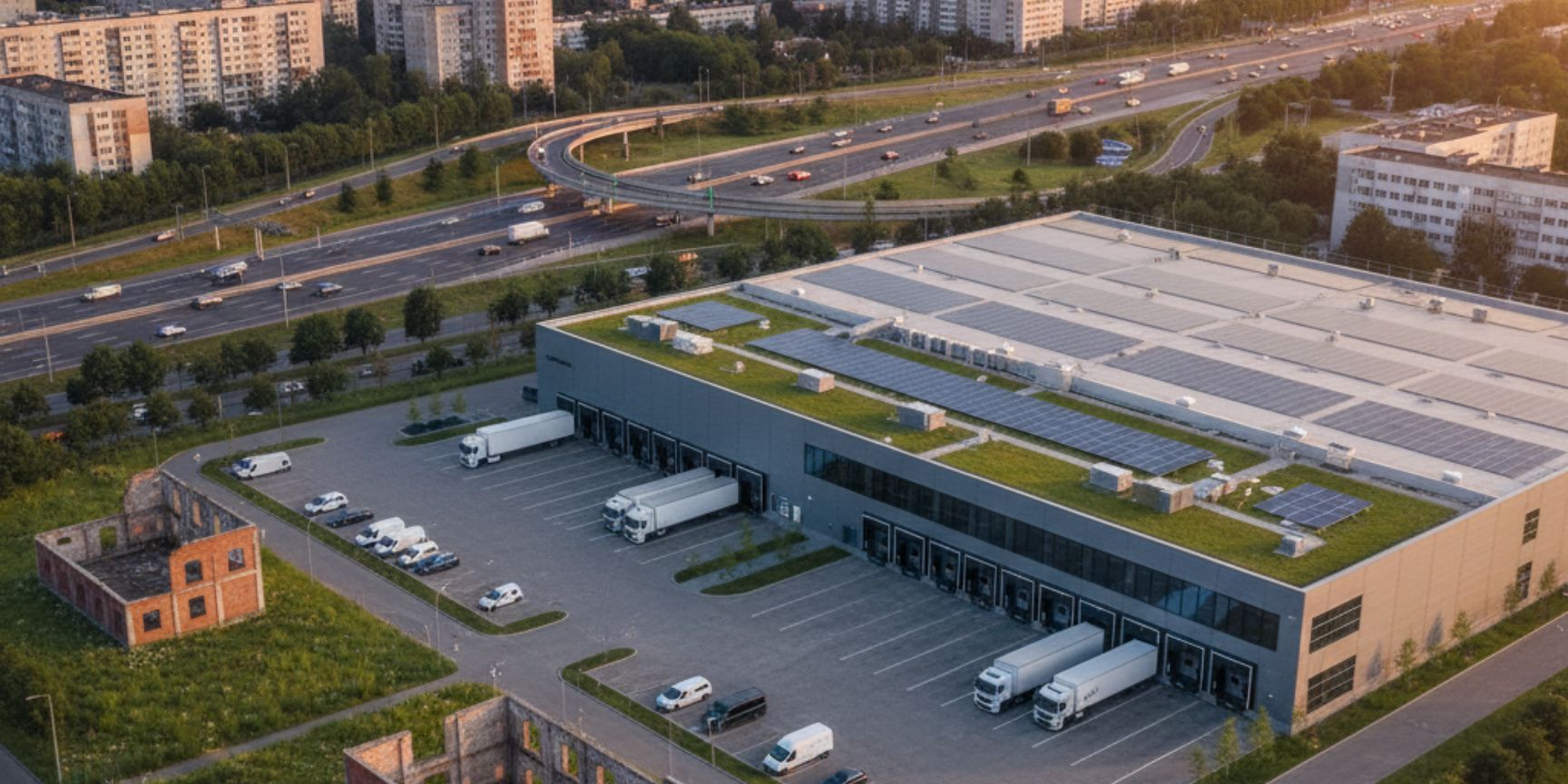
- Urban proximity (last-mile): For the "last mile" in e-commerce or city logistics, greyfields are often the only way to create warehouse space within or on the outskirts of metropolitan areas. Shorter distances mean faster delivery and potentially lower transport costs.
- Existing infrastructure: The areas are already connected to the road network (often near the motorway) and to the media (electricity, water, gas, fibre optics). This saves development costs.
- Labour potential: Unlike remote greenfields, urban greyfields are often better connected to public transport and are located in the catchment area of a larger labour pool – a decisive factor in the competition for warehouse staff.
- Faster activation (ideally): If the building law (§ 34 BauGB or a suitable B-Plan) allows the conversion, a greyfield (despite demolition) can "go online" faster than a greenfield, which requires a 3-5 year B-Plan procedure.
ESG and profitability: Does the revitalization of a logistics property pay off?
For institutional investors and funds that dominate the logistics real estate market today, ESG ( Environmental, Social, Governance) compliance is a must-have.
Environmental: Greyfield developments have a clear advantage here. The most important point is to avoid resealing. By using existing land, the ecological footprint of the new building will be drastically reduced ("net zero"). The revitalization of a brownfield site is considered the most sustainable form of project development.
Cost-effectiveness: The calculation is sharp. The total cost of development (land + demolition + construction) of a greyfield is often significantly higher than that of a greenfield.
These additional costs must be compensated for by two factors:
- Higher rents: Due to the better, more urban location, occupants (tenants) are willing to pay higher rents.
- Lower transport costs (TCO): The tenant (e.g. the contract logistics provider) saves transport costs (driver, toll, fuel) due to the proximity to the customer or the motorway. This saving (part of the Total Cost of Occupancy - TCO) justifies the higher rent.
Only if the quality of the location more than compensates for the high entry costs (demolition) is a greyfield project economically viable.
Conclusion: Greyfield as a necessity instead of a freestyle
The Greyfield warehouse construction is the logical consequence of the shortage of space in Germany. While development is more complex, expensive and risky than standardised greenfield construction, the revitalised areas are often the only options available in strategically important locations.
For warehouse and contract logistics, dealing with greyfields is vital in order to ensure proximity to markets and workers. For project developers and investors, they are a sophisticated but increasingly indispensable asset that meets high ESG standards and, if calculated correctly, enables stable returns in prime locations.