




Gross storage space in warehouse logistics
Table of Contents
- Gross warehouse space: The operational foundation of the logistics property
- Definition and classification under building law according to DIN 277
- The "net shock": Why gross is not the same as usable area
- The logistics property: column grid and clear height
- Contract logistics: The gross area as a basis for calculation
- Facts, figures, data: Key figures for land valuation
- FAQ – Frequently asked questions about gross storage space
- Conclusion for practice
Gross warehouse space: The operational foundation of the logistics property
In the world of logistics real estate and supply chain management, space is the most costly resource. Anyone who cannot precisely distinguish the term gross storage area from net space or pure parking space risks miscalculations in the millions. This guide examines the gross storage area from a building law, logistical and economic point of view.
Definition and classification under building law according to DIN 277
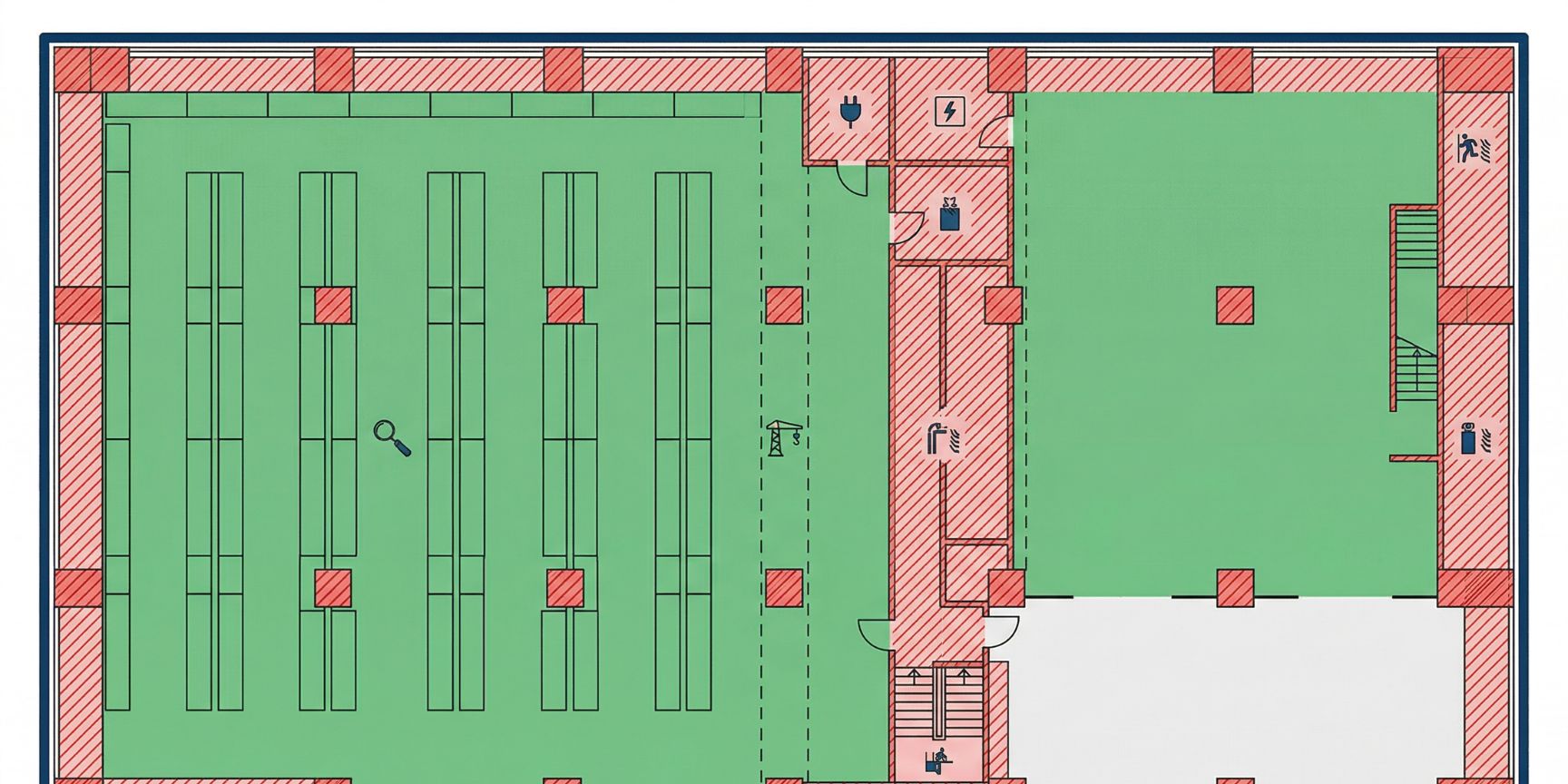
In general building construction and real estate valuations, the gross storage area is closely linked to the gross floor area (GFA) as defined in DIN 277. It comprises the sum of the floor areas of all floor plan levels of a building.
Important for logistics companies: The gross storage area includes not only the pure shelf or picking areas, but also:
- The constructive enclosures (outer walls).
- Interior walls and column grids.
- Traffic areas (forklift aisles, escape routes).
- Functional areas (technical rooms, heating).
In the practice of logistics real estate, the gross storage area is often defined as the area that lies within the clear dimensions of the outer walls, whereby the structural supports within the hall are included "gross".
The "net shock": Why gross is not the same as usable area
For a contract logistics company, the difference between gross and net area is decisive for the margin calculation. While the gross storage area forms the basis for the rent payment (often as a "triple net" contract), the net storage area or usable area is the area where goods can actually be stored or processed.
A decisive factor is the degree of land use:
In modern logistics centers, this value is ideally between 85% and 92%. If the value falls below 80%, for example due to unfavorable column grids or oversized traffic areas, the process costs per stored unit increase massively.
The logistics property: Column grid and clear height
From the point of view of real estate development, the gross area is determined by the column grid. A standard measurement in modern "Grade A" halls is often meters.
Why is this important for the gross storage area?
- Column loss: Each concrete column takes up approximately 0.16 m² to 1 m² of gross area per column that cannot be used for shelving systems.
- Flexibility: The fewer supports interrupt the gross area, the more freely the layout (block storage vs. narrow aisle) can be designed.
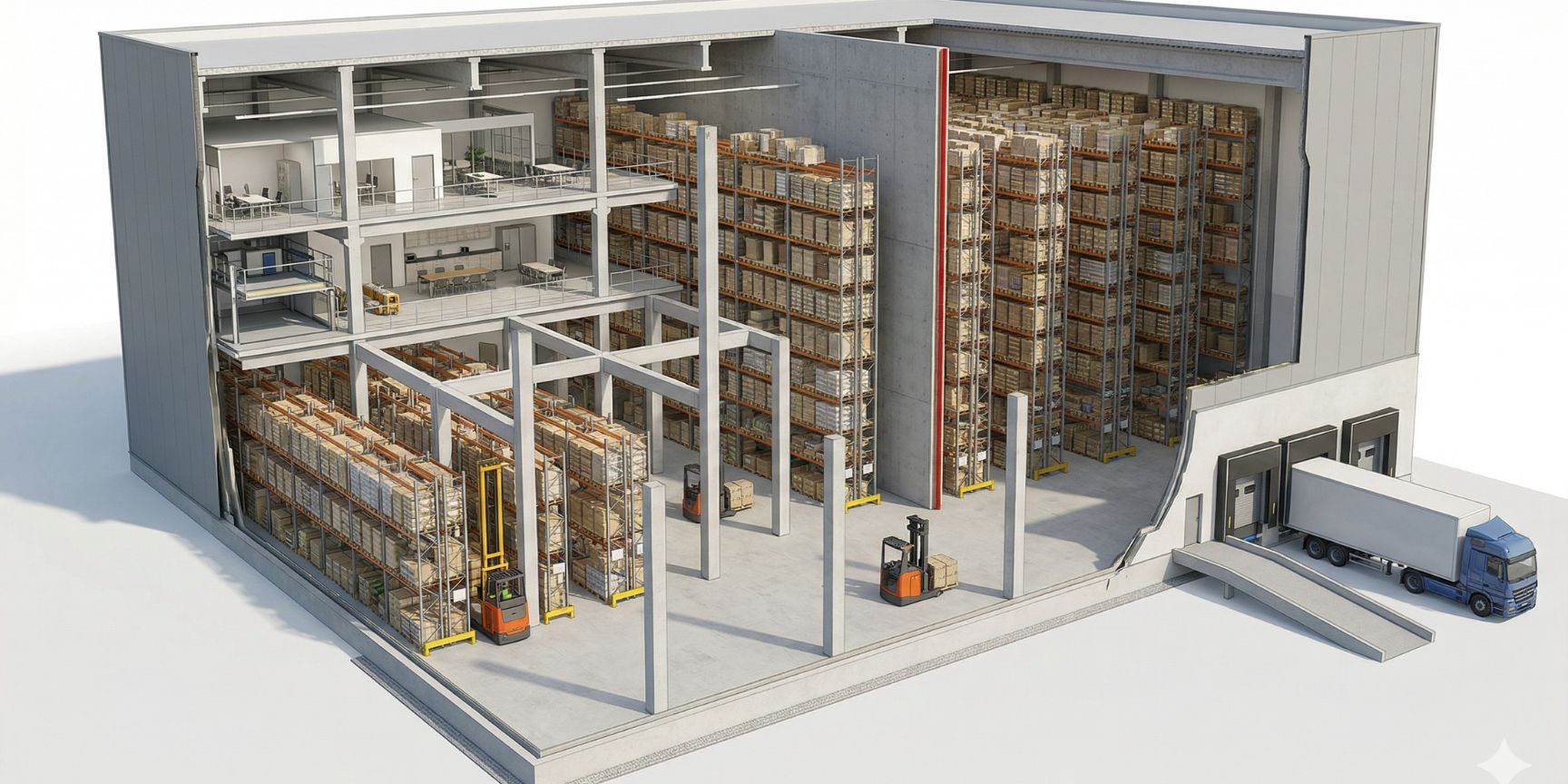
- Clear height: The gross area is two-dimensional, but logistics thinks three-dimensionally. Only the combination of the gross area and the clear height (UKB – lower edge of the truss) of usually 10.50 m to 12.20 m defines the true storage potential.
Contract logistics: The gross area as a basis for calculation
In contract logistics (3PL), an "all-in" rate per slot is often calculated. The logistics service provider rents the gross area from the investor. His challenge: He has to accommodate ancillary areas (offices, social rooms, battery charging stations) on this gross area that do not generate direct warehouse sales.
Practical tip: When renting, make sure that the mezzanine areas (intermediate levels) are fully included in the gross storage area. Mezzanines often offer a cost-effective way to increase the gross usable area without increasing the floor area of the building.
Facts, figures, data: Key figures for land valuation
To evaluate the quality of a gross storage area, professionals use the following benchmarks:
| Key figure | Value (Best Practice) | Significance |
| Surface load | 5.0 – 7.5 t/m² | Load-bearing capacity of the floor slab on the gross area. |
| Hall share | > 90% | Ratio of storage space to office space in the property. |
| Manoeuvring area | 35 – 40 m depth | Necessary outdoor space in front of the gates (based on the length of the hall). |
| Efficiency Ratio | 0,90 | Target value for the ratio of usable area to rented gross area. |
FAQ – Frequently asked questions about gross storage space
Question: Do the outer walls count towards the gross storage area?
Answer: According to DIN 277, yes. For the gross floor area (GFA), the external dimensions including cladding are used. In commercial tenancy law for logistics, however, the "rental space according to GIF" (Gesellschaft für Immobilienwirtschaftliche Forschung) is often used, which differentiates in more detail between exclusive and communal areas.
Question: How does the Fire Protection Ordinance affect the gross area?
Answer: Massively. Fire protection walls divide large gross areas into fire compartments (often max. 10,000 m²). These walls not only consume floor space, but also dictate the positioning of the passageways and thus the traffic flow efficiency.
Question: Is the gross storage area identical to the land area?
Answer: No. The land area is the entire area. The ratio of gross floor area to land area is limited by the floor area number in the development plan.
Conclusion for practice
The gross warehouse area is the basis of return for investors and the cost basis for logistics companies. An in-depth analysis of the gross area before signing the contract is essential. In particular, the "hidden" space guzzlers such as technical centres, stairwells and unfavourable column positions must be identified. In times of rising rents in prime locations, maximizing net usable space within the rented gross area is the decisive lever for competitiveness.

Your Ideal Logistics Warehouse
Browse listings for warehouse space, logistics real estate, industrial land, and contract logistics solutions.
Browse Exposés
Maximize Exposure for Your Warehouse Space
Showcase your logistics properties and attract qualified inquiries.
Discover Products