




Fire protection systems in warehouses
Table of Contents
- Fire Protection Systems in Logistics: A Technical Deep Dive
- The three pillars of plant fire protection
- Specific risks: chimney effect and fire load in the hall
- Water extinguishing systems: sprinklers and ESFR technology
- Active fire prevention: oxygen reduction (oxyreduct)
- Detection at high altitudes: smoke aspiration systems (RAS)
- Questions and Answers (Q&A) on Fire Protection in Logistics
- Operator Responsibility and Maintenance
- Conclusion and cost-effectiveness
Fire Protection Systems in Logistics: A Technical Deep Dive
Fire protection in logistics properties, be it classic pallet warehouses, hazardous goods warehouses or highly automated shuttle warehouses, poses massive challenges for planners and operators. The combination of high fire load density (packaging material, plastics), enormous storage heights (chimney effect) and technical ignition sources requires highly specialised fire protection systems. This article sheds light on the technical subtleties of plant fire protection with a focus on warehouse logistics.
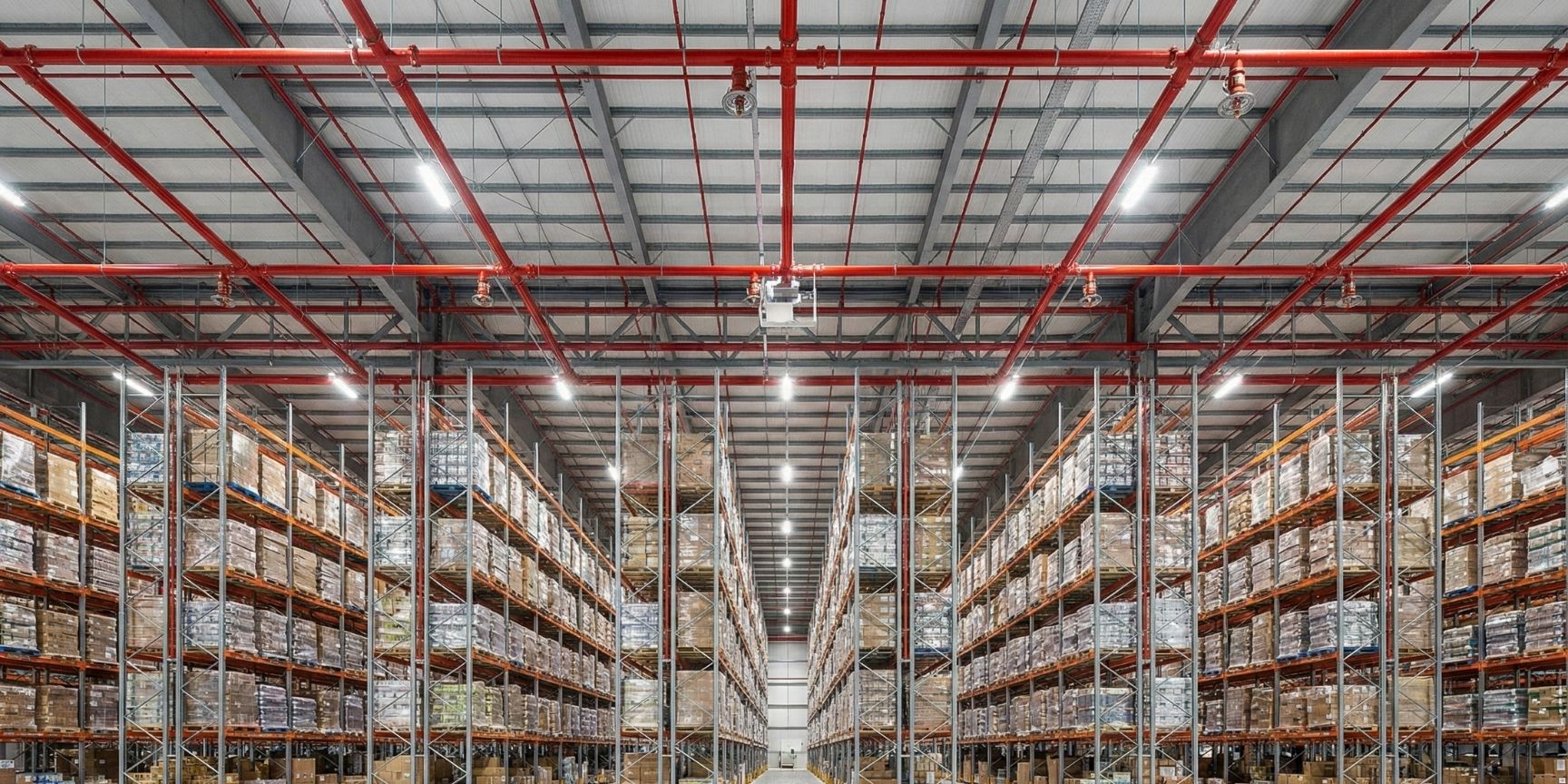
The Three Pillars of Plant Fire Protection
In principle, fire protection systems can be divided into three functional categories, which usually operate in a networked manner in a modern logistics property:
- Fire alarm systems (BMA): Used purely for detection and alerting (fire brigade and building evacuation).
- Extinguishing systems: Used to fight or suppress fires (e.g. sprinklers, gas, foam).
- Smoke and heat exhaust ventilation systems (SHEVs): Provide a smoke-free layer to protect the building's statics and enable extinguishing attacks.
In logistics, the interaction is crucial: An ESFR sprinkler system (Early Suppression Fast Response) is of little use if the SHEV "sucks" or swirls the spray mist by opening it too early. This is where complex matrix controls come into play.
Specific risks: chimney effect and fire load in the hall
Why is a logistics hall different from other commercial buildings? The main problem is the vertical spread of fire. In high-bay warehouses, the alleys act like chimneys. An incipient fire on the ground can race under the hall roof within seconds due to thermal buoyancy (chimney effect).
In addition, the energy density of the stored goods increases. Synthetic materials and packaging develop extremely high temperatures during combustion, which endanger steel beams (softening from approx. 500 °C) and concrete structures. Fire protection systems must therefore not only detect, but also cool and contain them immediately.
Water extinguishing systems: sprinklers and ESFR technology
The classic sprinkler system is still the standard in logistics (market share > 85%). But not all sprinklers are the same.
- Ceiling sprinklers vs. shelf sprinklers: In the past, in-rack sprinklers (in the shelf levels) were standard from certain heights. However, this increased the cost and risk of damage from forklifts.
- Early Suppression Fast Response (ESFR) Sprinklers: These ceiling sprinklers operate with large volumes of water and high pressure. They generate heavy water droplets that penetrate the thermal buoyancy of the fire (plume) and reach the source of the fire directly. They often make it possible to dispense with rack sprinklers up to storage heights of approx. 12-14 meters (depending on FM Global or VdS specifications).
Important for contract logistics companies: The design of the sprinkler system often limits the use of the hall. A system designed for "non-combustible parts in cartons" fails if car tires or plastics are suddenly to be stored.
Active fire prevention: oxygen reduction (oxyreduct)
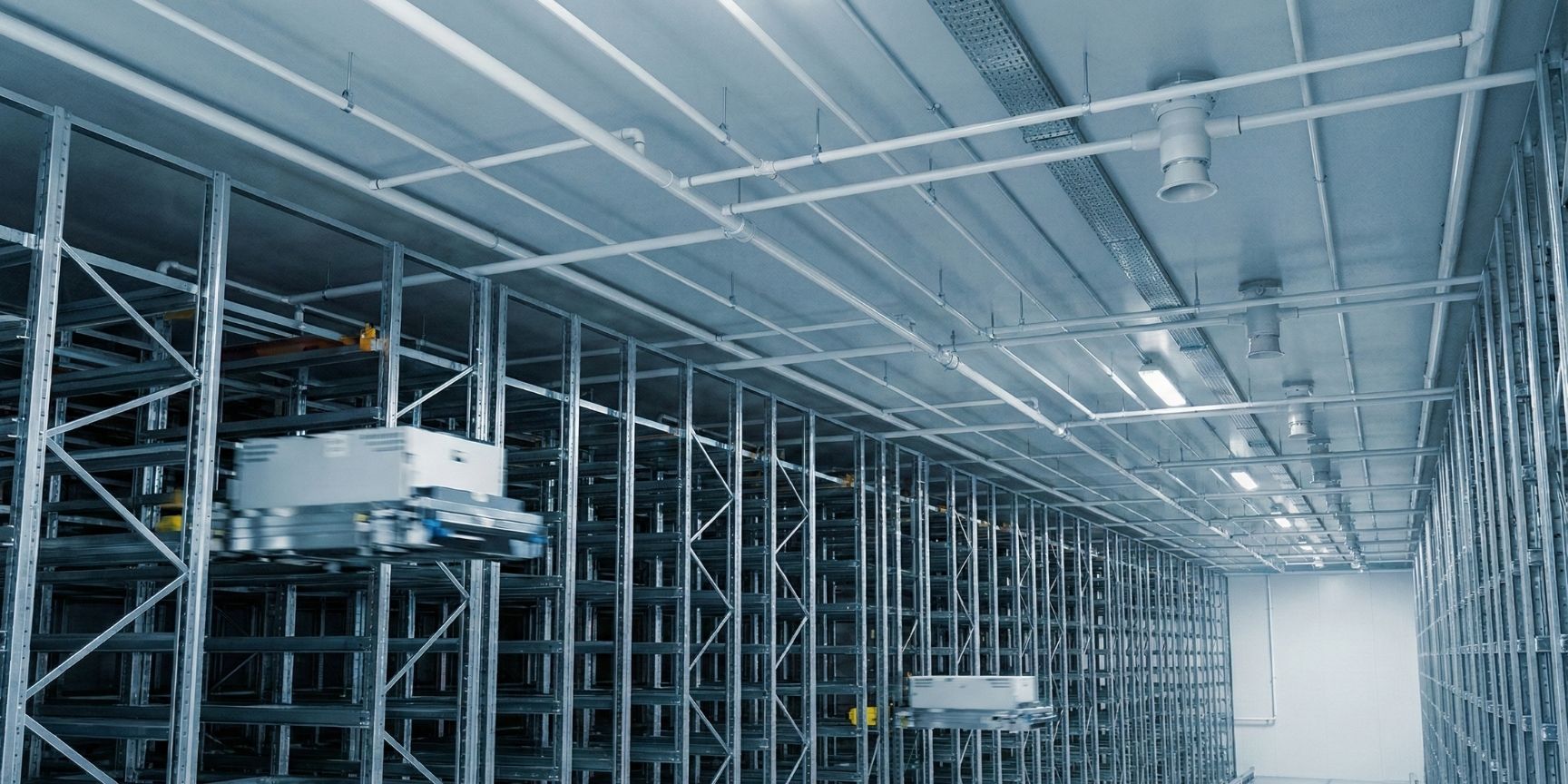
In fully automated high-bay warehouses (HRL), where there are no people on a regular basis, oxygen reduction is becoming increasingly prevalent.
The principle: By introducing nitrogen, the oxygen content in the hall is reduced from 20.9% to a level (usually 13.5% to 15%) at which an open fire is no longer physically possible.
- Advantage: There is no fire, so no smoke damage and no water damage. The ability to deliver remains 100%.
- Disadvantage: High operating costs (energy for nitrogen generators) and the hall must be built extremely tightly (envelope tightness) to minimise gas losses.
Detection at high altitudes: smoke aspiration systems (RAS)
Conventional point-shaped smoke detectors are often ineffective or require a lot of maintenance in 15 or 40-metre-high halls. The smoke dilutes too much on the way up (stratification).
This is where smoke aspiration systems (RAS) are used. A pipe system on the ceiling or on the shelves permanently sucks in air samples and analyzes them in a central evaluation unit. These systems are up to 100 times more sensitive than point detectors and detect smoldering fires (e.g. due to overheated motors on conveyor belts) long before an open flame occurs.
Questions and Answers (Q&A) on Fire Protection in Logistics
Question: What is the difference between VdS and FM Global Standards?
Answer: VdS (Association of Non-Life Insurers) is the German/European set of rules (e.g. VdS CEA 4001). FM Global is a U.S. industrial insurer with its own, often stricter standards (FM Data Sheets). For international corporations or investors, FM certification of the system ("FM Approved") is often mandatory in order to obtain globally uniform insurance policies. This may require, for example, stronger pumps or tighter sprinkler spacing.
Question: How do I deal with lithium-ion batteries in the warehouse?
Answer: Lithium-ion batteries represent a new class of fire (thermal runaway). Traditional sprinklers often can't extinguish the battery itself, but they can cool the environment and prevent it from spreading. Currently, experts often recommend a combination of separate fire compartments, close-meshed shelf sprinkling (possibly with extinguishing agent additives) and special monitoring (thermal imaging cameras).
Question: When is a gas extinguishing system instead of water worthwhile?
Answer: Gas (e.g. CO2, Novec 1230, inert gases) is almost exclusively used in smaller, enclosed areas, such as in the server room of the logistics control system or in special hazardous materials containers. For an entire warehouse, the required gas volume is usually technically and economically unfeasible.
Operator Responsibility and Maintenance
A fire protection system is only as good as its state of maintenance. Strict obligations apply to logistics managers:
- Weekly checks: Visual inspection of sprinkler heads, pressure gauges and pumps.
- Maintenance: Annual maintenance by specialist companies.
- Overhaul: Every 12.5 years (dry systems) or 25 years (wet systems), the sprinkler system must undergo an extensive inspection, which often means replacing pipes or sprinkler heads.
Practical tip: When storing, pay close attention to the distance between the top edge of the goods and the sprinkler head (usually at least 50 cm, with ESFR often 1 m). If this distance is not reached, the spray pattern is disturbed and the insurance cover is jeopardized.
Conclusion and cost-effectiveness
Investments in high-quality fire protection systems pay for themselves not only in the event of damage. An investment certified according to VdS or FM Global significantly reduces insurance premiums. In addition, it often enables a denser use of space in the first place (smaller fire compartments would be necessary without sprinklers, which requires walls and gates and slows down processes).
For the logistics property of the future, which is increasingly automated and dense, the trend is shifting from pure firefighting (sprinklers) to fire prevention (oxygen reduction) and early detection (RAS) in order to reliably rule out "total loss".

Your Ideal Logistics Warehouse
Browse listings for warehouse space, logistics real estate, industrial land, and contract logistics solutions.
Browse Exposés
Maximize Exposure for Your Warehouse Space
Showcase your logistics properties and attract qualified inquiries.
Discover Products