




Farshoring in warehouse logistics
Table of Contents
- Farshoring: The Global Backbone of the Efficient Supply Chain
- Farshoring vs. Offshoring: What's the Subtle Difference?
- The Role of Contract Logistics in the Farshoring Model
- Impact on the Logistics Property: From the Hall to the Hub
- Facts & Figures: Why Farshoring Remains Relevant Despite Crises
- FAQ: Frequently Asked Questions from Practice
- Risk management: Illuminating the Downsides
- Conclusion: Farshoring as Part of a Hybrid Ecosystem
Farshoring: The Global Backbone of the Efficient Supply Chain
Farshoring is much more than just a buzzword in business administration. It describes the relocation of corporate activities – especially production or logistics services – to geographically distant countries, usually to other continents. While nearshoring relies on proximity (e.g. Eastern Europe for Germany), farshoring uses the enormous economies of scale and labor cost advantages of regions such as Southeast Asia or parts of South America.
For the modern logistics world, farshoring means a complex balancing act between extremely low cost prices and the management of long, disruptive supply chains.
Farshoring vs. Offshoring: What's the Subtle Difference?
The terms are often used synonymously, but the Lexicon of Logistics differentiates more precisely here. Offshoring is the generic term for any form of foreign relocation. Farshoring specifies the spatial distance.
- Distance: Usually across several time zones (e.g. Germany – Vietnam).
- Transport routes: Primarily sea freight or air freight, rarely rail.
- Goal: Maximum reduction of variable costs and development of new sales markets locally.
The Role of Contract Logistics in the Farshoring Model
In contract logistics, farshoring is a double-edged sword. On the one hand, brand manufacturers are relocating their production far away, which increases the need for complex value-added services (VAS) directly in the country of origin.
In the farshoring context, contract logistics specialists take on tasks such as:
- Quality control before shipment (Pre-Shipment Inspection).
- Customizing and labelling for various target markets directly in the distant warehouse.
- Consolidation of very small quantities into full container loads (FCL) to optimize freight rates.
The challenge for the logistics service provider lies in IT integration. Without real-time interfaces (API) between the remote warehouse location and the headquarters in Europe, "black boxes" are created in the supply chain that jeopardize inventory management.
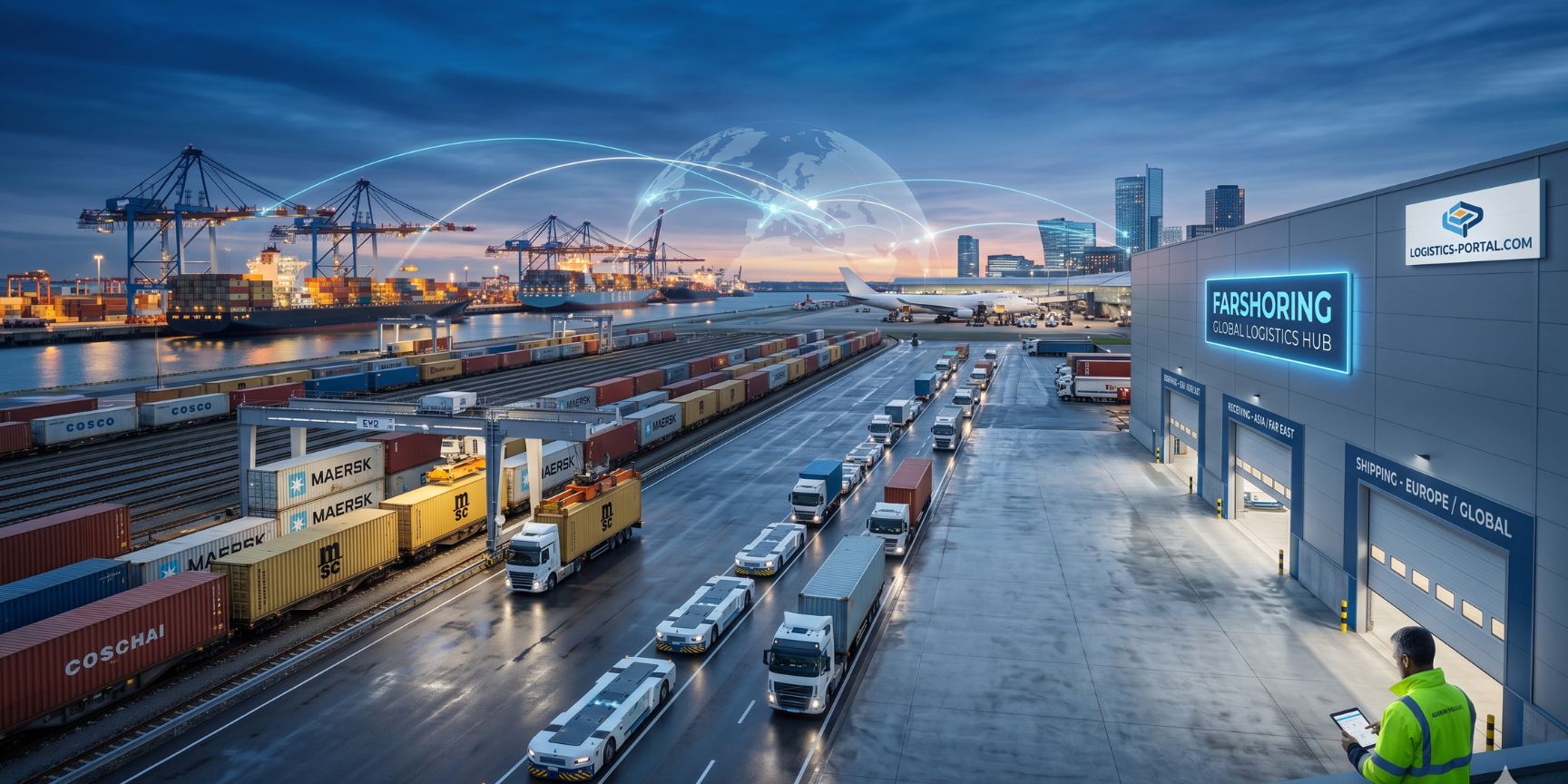
Impact on the Logistics Property: From the Hall to the Hub
Farshoring is changing the demands on the hardware of logistics – the real estate. If goods are at sea for 6 to 8 weeks, the buffer strategy changes.
- In the country of origin: Huge export hubs are being created here. These halls must be designed for high throughput (cross-docking) and often for specific requirements (e.g. textile logistics or electronic ESD protection).
- In the destination country (Germany/Europe): As the cycles are longer, the need for safety stocks increases. This is leading to a demand for larger storage space to offset volatilities in the arrival of the container ships. "Just-in-time" logistics are often replaced by "just-in-case" strategies, which stabilizes the utilization of German warehouse space.
Facts & Figures: Why Farshoring Remains Relevant Despite Crises
Despite trends towards "reshoring", the figures speak for themselves.
- Cost savings: Labor costs in classic farshoring countries such as India or Vietnam are often only 15–25% of the Western European level.
- Scalability: In the Far East, warehouse logistics capacities can often be doubled within a few weeks – a pace that is hardly conceivable due to the shortage of skilled workers and approval procedures in Europe.
- Transportation cost ratio: For products with high value per volume (e.g., microchips), transportation costs often account for less than 1% of the value of the goods, making farshoring economically unbeatable.
FAQ: Frequently Asked Questions from Practice
Question: Is farshoring still worthwhile with rising CO2 prices?
Answer: It will be more difficult. The CO2 levy on sea transport (EU ETS) increases logistics costs. Today, farshoring only makes sense for products whose production advantage clearly outweighs the rising ecological and logistical costs.
Question: How secure are the holdings in distant logistics properties?
Answer: That depends on the standard of the hall. Modern logistics parks in Asia today often offer higher levels of automation than existing European properties. Certification (e.g. TAPA for theft protection) is crucial.
Question: Does farshoring have an influence on the construction of halls in Europe?
Answer: Yes. Since farshoring often goes hand in hand with container logistics, European halls must be optimized for efficient unloading of containers (many ramps, large yard areas).
Risk management: Illuminating the Downsides
Anyone who practices farshoring buys risks. The lead time is the critical element. A strike in the port of Singapore or a blockade of the Suez Canal can shut down the assembly lines in Europe.
Practical tip for logistics managers: Use a dual-sourcing strategy. Cover 70% of demand with cost-effective farshoring and secure the critical 30% with nearshoring. In this way, your logistics property at home remains productive even in the event of global upheavals.
Conclusion: Farshoring as Part of a Hybrid Ecosystem
Farshoring is no longer an all-or-nothing concept in 2026. It has become a precise tool within a hybrid logistics strategy. For contract logistics professionals, this means being able to manage global networks. For investors in logistics real estate, this means that locations with excellent connections to the major seaports (such as Hamburg, Antwerp or Rotterdam) remain indispensable due to the constant flow of farshoring sources.
The future of the hall is global – no matter how far away the origin of the goods may be.