




Just-in-Case in Warehouse Logistics
Table of Contents
- Just-in-Case: The Renaissance of Stockpiling in Modern Logistics
- Definition and Differentiation: JIC vs. JIT
- JIC in Warehouse Logistics: Inventory Management in Detail
- Contract Logistics: New Roles for Service Providers
- The logistics property: From conveyor to capacity storage
- Questions and Answers (Q&A) on the topic of Just-in-Case
- Facts, figures, data: The economic dimension
- Practical checklist for decision-makers: Successfully implementing JIC
- Conclusion: It's all in the mix
Just-in-Case: The Renaissance of Stockpiling in Modern Logistics
For a long time, the warehouse was considered a "waste" in the sense of lean management. But global crises, blocked trade routes and unstable supply chains have forced a rethink. Just-in-case (JIC) is no longer just a contingency plan, but a strategic decision to ensure business continuity.
Definition and Differentiation: JIC vs. JIT
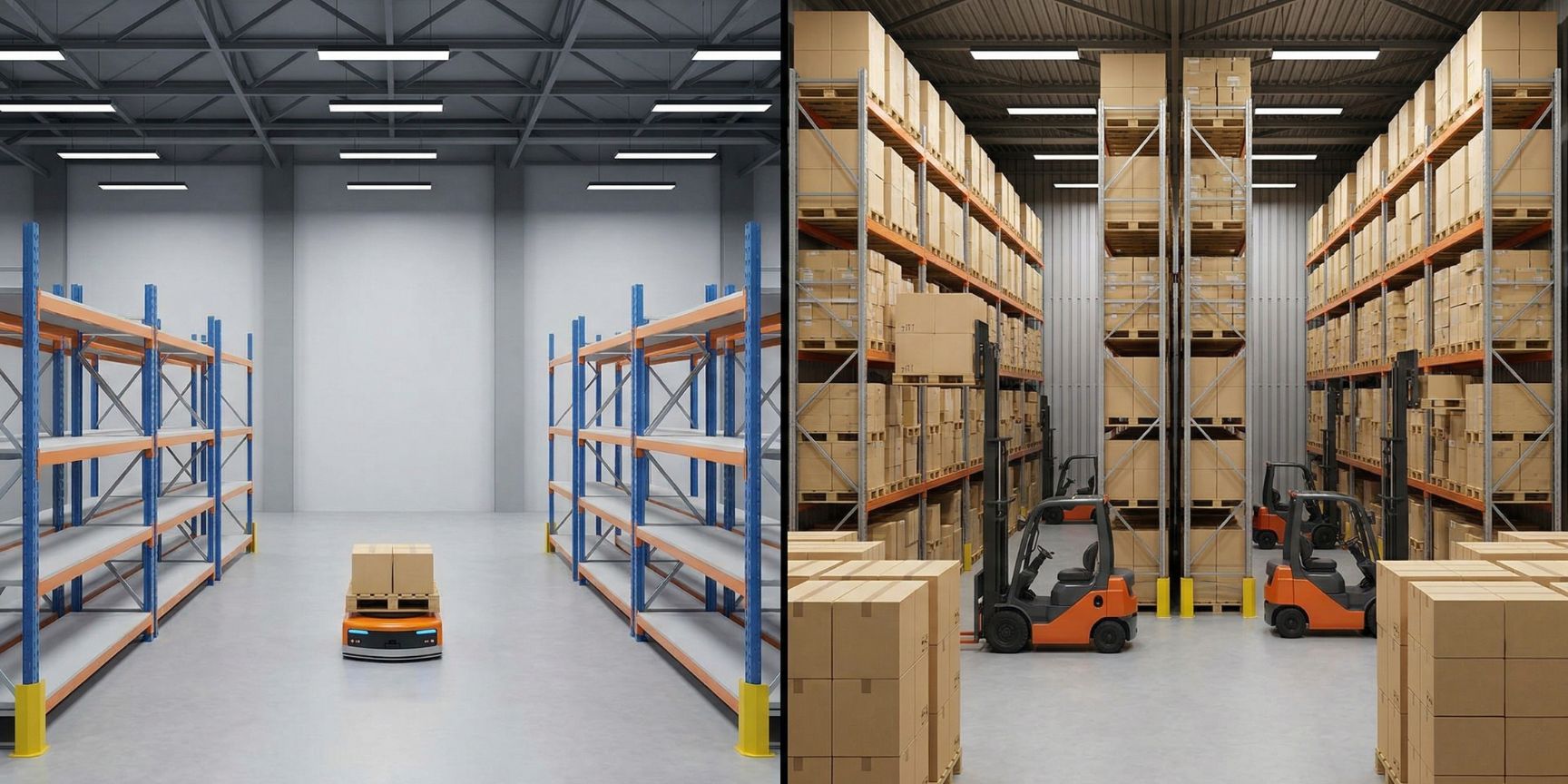
While Just-in-Time (JIT) aims to minimize inventories and deliver materials exactly when needed, Just-in-Case relies on deliberate redundancy. JIC describes a warehousing strategy in which large quantities of raw materials, components or finished goods are kept in stock "just in case".
The focus is shifting from capital efficiency to security of supply. In practice, this means higher safety stocks to cushion variability in lead time and fluctuations in demand.
JIC in Warehouse Logistics: Inventory Management in Detail
In warehouse logistics, JIC requires precise mathematical derivation of inventory levels. It is not about indiscriminately "stuffing" the halls, but about buffering critical A-components.
- Safety stock calculation: Companies increase the service level factor. A transition from a 95% to a 99% service level can often double the inventory you need.
- Decoupling points: JIC makes it possible to decouple production processes from unstable supplier markets. The bearing acts as a shock absorber.
- Obsolescence risk: In-depth JIC management must weigh the risk of "dead stock" against the costs of a "stock-out".
Contract Logistics: New Roles for Service Providers
For contract logistics companies, the trend towards Just-in-Case means a shift in the business model. Whereas in the past it was primarily throughput speeds (cross-docking) that were optimized, inventory management and value-added services (VAS) are now coming to the fore.
- Longer contract terms: Since JIC strategies are designed for the long term, the partnerships between shippers and service providers stabilize.
- Risk management: Contract logistics companies are increasingly monitoring the global supply chain in order to proactively activate JIC capacities.
- Transparency: Without real-time data (visibility), JIC leads to massive inefficiencies. Investments in WMS (Warehouse Management Systems) are essential here.
The Logistics Property: From Conveyor to Capacity Storage
The real estate industry is feeling the JIC wave most acutely. The demand for hall space has remained high in recent years despite economic dips, as companies have massively expanded their storage capacities.
- Shortage of space: The vacancy rates in top logistics regions (e.g. Hamburg, Ruhr area, Frankfurt) are often below 2%. JIC intensifies this pressure.
- Requirements for the hall: * Third-party usability: Since inventories vary, halls must be flexible in use.
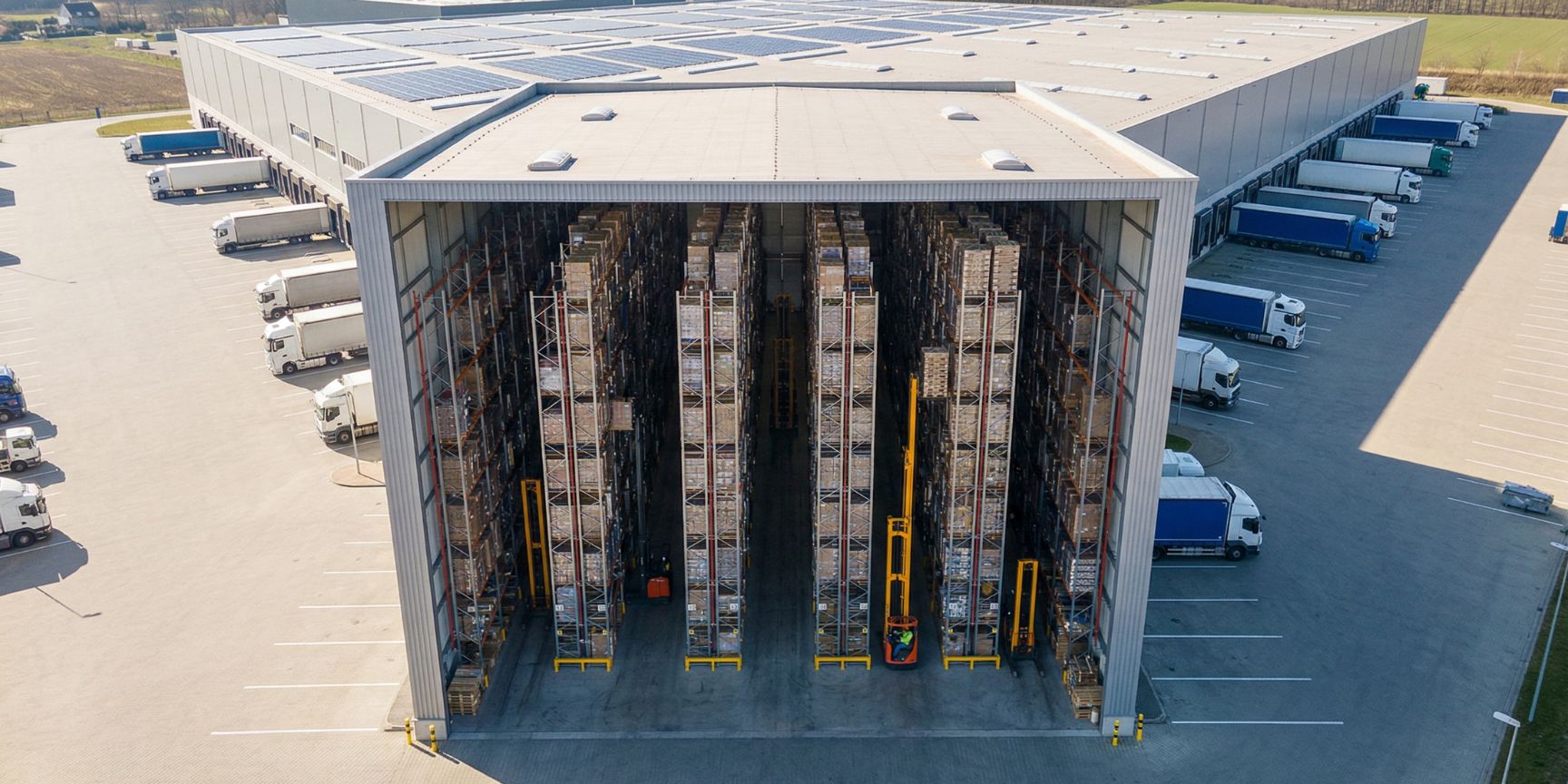
- Height counts: In order to map JIC economically, vertical compaction (high-bay warehouses) is becoming more important. Hall heights of 12m UKB (lower edge truss) are standard, 15m and more are becoming more attractive for JIC centres.
- Soil load capacity: Higher stands mean higher point loads, often >7.5 t/m².
Questions and Answers (Q&A) on the Topic of Just-in-Case
Question: Isn't just-in-case uneconomical due to the high level of capital commitment?
Answer: In the short term, JIC is increasing working capital. However, the costs of a production standstill (penalties, loss of profit, loss of reputation) must be offset in a full cost accounting. Often, JIC is the cheaper insurance policy against supply chain shocks.
Question: What role does the logistics property play in the JIC cost analysis?
Answer: Rental costs are often the smallest part of logistics costs (approx. 10-15%), while personnel costs and interest costs for the goods dominate. Nevertheless, the availability of space is the bottleneck. Those who do not secure JIC areas lose their operational capacity.
Question: How does JIC affect sustainability (ESG)?
Answer: This is a critical point. More inventory means more surface sealing and potentially more waste from obsolete products. A modern JIC strategy therefore uses AI-powered forecasting tools to form "smart buffers" and avoid overstocking.
Facts, Figures, Data: The Economic Dimension
The switch to JIC can be expressed in key figures:
| Key figure | Just-in-Time (JIT) | Just-in-Case (JIC) | Impact |
| Inventory turnover frequency | High (> 20 p.a.) | Low (4 - 8 p.a.) | Slower capital turnover time |
| Safety stock | Minimum (hours/days) | High (weeks/months) | Buffer against supply stops |
| Space requirements | Low (Cross-Dock) | High (Warehousing) | Increasing demand for big boxes |
| Transport costs | High (many small shipments) | Lower (Full Truck Loads) | Consolidation effects possible |
Recent studies show that after the crisis years 2020-2023, companies have permanently increased their safety stocks by an average of 15% to 25%. This correlates with a predicted additional demand for logistics space of several million square meters throughout Europe.
Practical Checklist for Decision-makers: Successfully Implementing JIC
If you are thinking about switching to JIC, the following points should be considered:
- ABC-XYZ analysis: Identify critical components (A-goods with high supply variability). This is the only place where JIC is worthwhile.
- Location strategy: Locate properties near end markets or manufacturing facilities to minimize last-mile risks.
- Flexibility of the hall: Pay attention to the multi-user capability of the property in case the portfolio strategy changes again in 5 years.
- Financing of working capital: Clarify with your bank the financing of the increased value of goods.
Conclusion: It's all in the Mix
Full just-in-case is just as risky as extreme just-in-time. The trend is towards the "hybrid model". Companies use JIT for non-critical, locally available goods and JIC for strategic components from overseas. For the logistics real estate industry, this means that the demand for modern, third-party warehouse space will remain structurally high, as the warehouse will once again be seen as a strategic asset and no longer as a pure cost factor.