




Fire protection doors in warehouses
Table of Contents
- Fire protection doors in logistics: focus on safety, technology and efficiency
- Fire Resistance Classes: What T30, T90 and T120 Really Mean
- Comparison of construction methods: The right door for every hall
- Focus on warehouse logistics: When speed meets safety
- The hold-open system: The brain of the fire protection door
- Special case of intralogistics: Conveyor system closures
- Maintenance and testing: The operator's obligations
- Planning tip: Fire protection as a return on investment factor
- FAQ – Frequently asked questions about fire doors
- Conclusion for practice
Fire protection doors in logistics: Focus on safety, technology and efficiency
In the world of warehouse logistics and contract logistics, halls are often huge, contiguous areas. But what is efficient from a process point of view poses enormous challenges for fire protection. This is where fire protection doors come in. They are used to divide buildings into so-called fire compartments to prevent the uncontrolled spread of fire and smoke. For operators of logistics properties, choosing the right door system is not just a question of compliance, but a decision about operational safety and insurability.
Fire Resistance Classes: What T30, T90 and T120 Really Mean
The most important characteristic value of a fire protection door is its fire resistance period. In Germany and Europe, this is given in minutes:
- T30 (Fire Retardant): Withstands fire for at least 30 minutes.
- T90 (Fire Resistant): Provides at least 90 minutes of protection.
- T120 (High Fire Resistant): Required in special high-risk areas.
In modern logistics properties, T90 is the standard for walls that separate fire compartments. Since the introduction of the DIN EN 16034 product standard, fire doors must also have a CE marking, which simplifies cross-border use in the EU and guarantees uniform safety standards.
Comparison of construction methods: The right door for every hall
Depending on the space available and frequency in the hall, different systems are used:
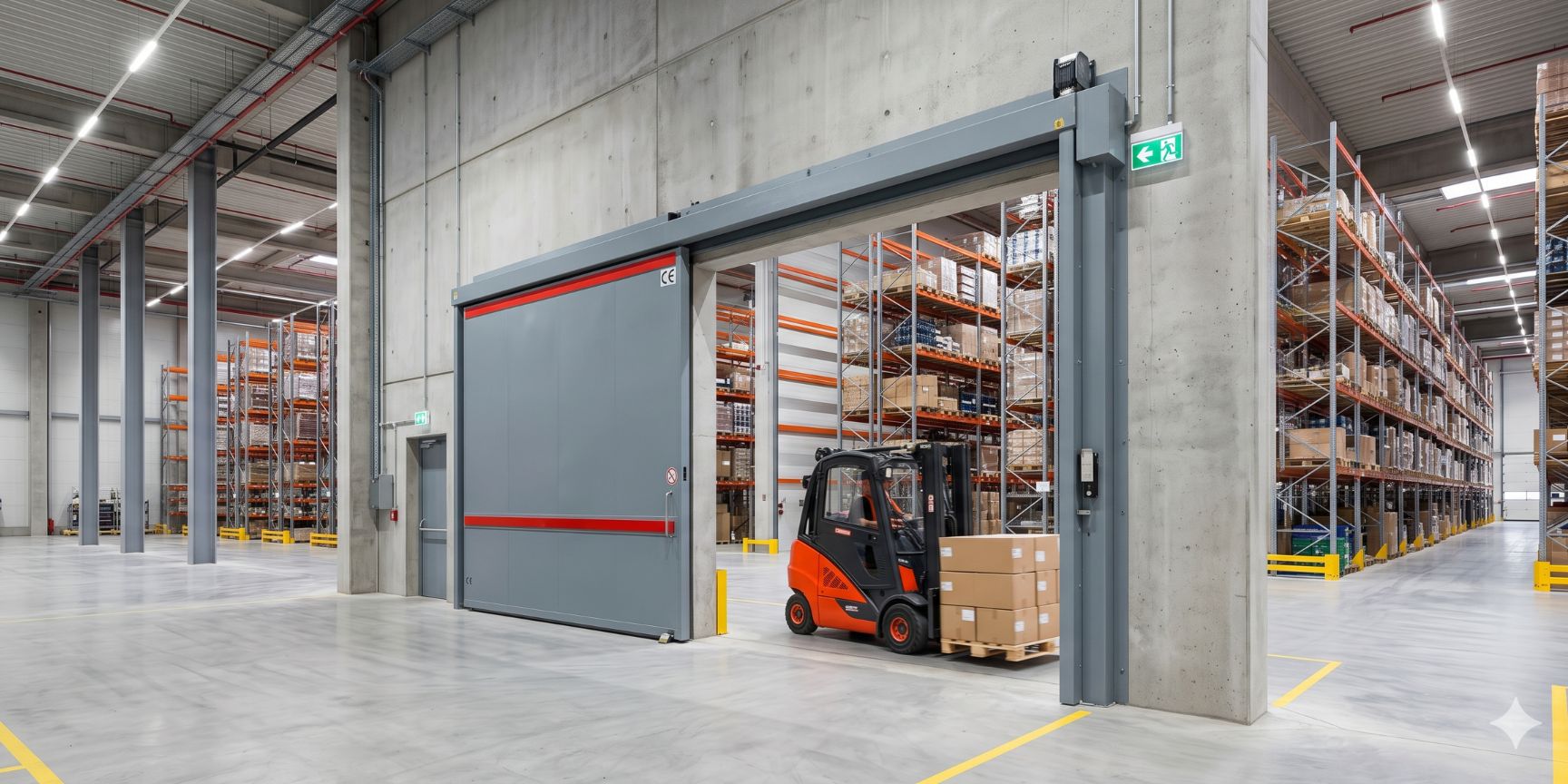
- Fire protection sliding doors: The classic for large wall openings. They require lateral space ("return area"), but are extremely robust and reliable.
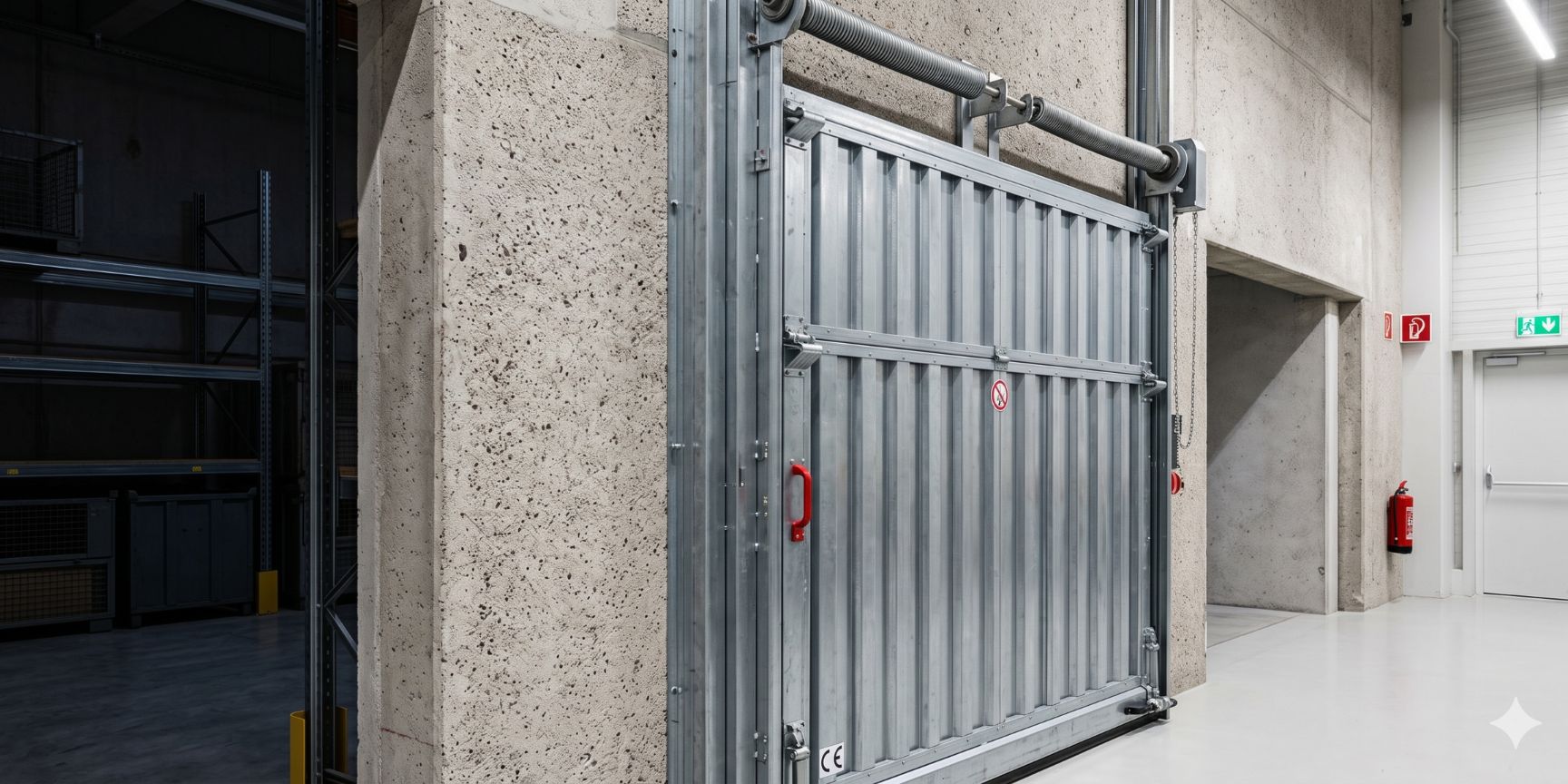
- Fire protection sectional doors: Ideal when there is no space on the side. They open upwards. They are particularly popular in contract logistics, as they hardly obstruct the flow of traffic.
- Fire protection roller and lift doors: These are often used where ceiling heights are limited or very compact solutions are sought.
- Fire protection curtains (textile systems): A modern alternative. When at rest, they are concealed almost invisibly in a cassette above the opening – perfect for architecturally sophisticated logistics buildings or conveyor systems.
Focus on warehouse logistics: When speed meets safety
A high-bay warehouse or a cross-docking terminal is very busy. A fire protection door must not slow down the workflow.
The problem: Classic fire protection doors are heavy and close slowly (approx. 10–15 cm per second).
The solution: Combination doors. Here, a fast industrial door for daily operation is combined with a fire door that only closes in the event of an alarm. Today, modern multifunctional doors often combine burglary protection, sound insulation and fire protection in one system, which reduces the complexity in the logistics property.
The hold-open system: The brain of the fire protection door
In order for a fire protection door to be open in everyday life (to give forklifts free passage), it needs a hold-open system approved by the building authorities. This consists of:
- Fire detectors: Optical smoke switches or thermal switches.
- Locking device: Magnets that keep the door open.
- Central/Control: The logic unit that gives the command to close.
- Manual release button: For manual closing (mandatory).
If the power fails or a detector detects smoke, the hold-open system interrupts the holding current and the door closes by dead weight or spring force (the so-called "gravity fail-safe" principle).
Special case of intralogistics: Conveyor system closures
In automated warehouses, conveyor belts often break through fire walls. This is where conveyor system closures are used. These special doors must communicate with the control system of the conveyor system: In the event of an alarm, the section must be cleared (keyword: "clearance") before the door can close. If this is not possible, separators are used, which can also close through the conveyed material.
Maintenance and testing: The operator's obligations
A fire door is a safety device and is subject to strict test cycles:
- Monthly inspection: By the operator (functional test by triggering).
- Annual inspection: By a qualified person (expert). Mechanics, closing speed and the hold-open system are tested in detail.
- Documentation: All inspections must be noted in the inspection book. Missing documentation can lead to the loss of insurance cover in the event of a claim.
Planning tip: Fire protection as a return on investment factor
For investors in logistics real estate, third-party usability is crucial. A building with flexible fire compartments and high-quality door systems can be more easily adapted to different tenants from contract logistics. Large door openings (e.g. 4x4 metres) should be standard in order to be prepared for future generations of forklifts or special loads.
FAQ – Frequently asked questions about fire doors
Question: Can I keep fire doors open with wedges?
Answer: Definitely not! Blocking fire doors is a criminal offence and overrides insurance cover. Only approved hold-open systems are permitted.
Question: How much does a T90 sliding gate cost for a warehouse?
Answer: Prices vary greatly depending on size and equipment. For a standard sliding gate (approx. 4x4m) including installation and hold-open system, you should calculate between €8,000 and €15,000.
Question: How long does a fire door last in a highly frequented logistics hall?
Answer: With good maintenance and proper use (protective buffer against collision damage!), the service life is 15 to 20 years. The electronics of the hold-open system often have to be modernized after 8-10 years.
Question: Is smoke protection sufficient or does it have to be T90?
Answer: That depends on the fire protection concept. Smoke protection doors only prevent the spread of smoke gases, but do not offer resistance to heat and flames. T90 is almost always required in fire walls.
Conclusion for practice
Fire protection doors are much more than "steel doors". They are highly complex security systems that must be precisely coordinated with the processes of warehouse logistics. Those who rely on quality, certified hold-open systems and a reliable maintenance partner during planning not only protect lives, but also ensure the long-term operability of their logistics property.
Your Ideal Logistics Warehouse
Browse listings for warehouse space, logistics real estate, industrial land, and contract logistics solutions.
Browse Exposés
Maximize Exposure for Your Warehouse Space
Showcase your logistics properties and attract qualified inquiries.
Discover Products