




Focus on the warehouse clerk
Table of Contents
- Definition and Evolution: From Packer to Process Manager
- Core processes of warehouse logistics
- The Warehouse Operator in Contract Logistics: Value Added Services
- The logistics property: working environment and technical limits
- Technology and industrial trucks (FFZ)
- KPIs and key performance indicators
- Safety and fire protection in the hall
- Future Outlook: Human-Machine Collaboration
- Conclusion
Focus on the warehouse clerk: Interface between goods, real estate and process
Definition and Evolution: From Packer to Process Manager
The term "warehouse clerk" is often used colloquially as a generic term, but it differs greatly in the technical context. Today, we primarily distinguish between the warehouse clerk (2-year training) and the warehouse logistics specialist (3-year training). While physical strength used to be the main focus, today the job description requires a high level of IT affinity and an understanding of complex flows of goods.
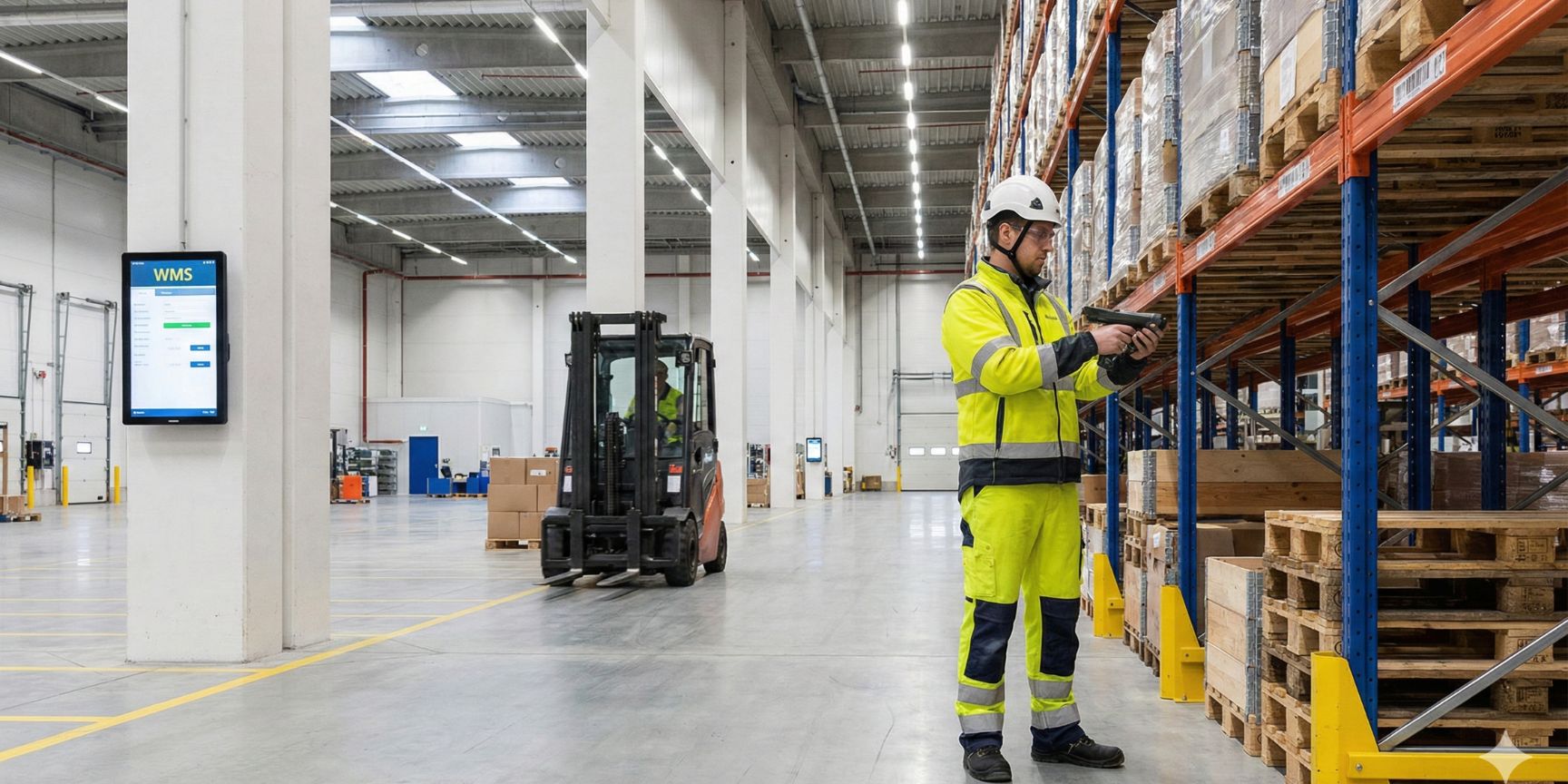
In modern logistics real estate, the warehouse clerk is the decisive factor that connects the static conditions of the hall (shelving systems, route layout) with the dynamics of the orders. It not only operates industrial trucks (FFZ), but also permanently interacts with warehouse management systems (WMS) via handhelds, forklift terminals or pick-by-voice technologies.
Core processes of warehouse logistics
The activity is classically divided into four main phases, which, however, vary depending on the type of hall and the degree of automation:
- Inbound goods: unloading, visual and systemic control, receipt in the WMS.
- Putaway: Physical transport to the storage location (fixed location system vs. chaotic warehousing).
- Picking: Compilation of orders. Here, the strategy (e.g. multi-order picking) determines efficiency.
- Outbound goods: packaging, loading, load securing.
Question: Why is "chaotic warehousing" often more efficient for the warehouse clerk?
Answer: In chaotic (dynamic) warehousing, the WMS assigns any free space to the goods. This optimises the use of space in the property and often shortens the distances for the warehouse clerk, as items are stored where there is space or where they make strategic sense due to their turnover frequency (ABC analysis).
The Warehouse Operator in Contract Logistics: Value Added Services
In contract logistics, a service provider takes on logistical and logistics-related tasks for manufacturers or retailers. For the warehouse clerk, this means an expansion of the field of activity away from pure "storage" to value-added services (VAS).
Here, the logistics hall becomes an extended workbench. Typical activities are:
- Kitting: The pre-assembly of assemblies.
- Display construction: Equipping sales displays for the retail trade.
- Returns management: Quality inspection and preparation of returns (refurbishment).
This places special demands on the hall infrastructure. Mezzanine levels are needed for VAS activities, which require adequate lighting (at least 200-300 lux in work areas compared to 150 lux in pure storage aisles) and comfortable temperatures, which in turn has an impact on the property's heating and ventilation systems.
The logistics property: working environment and technical limits
For specialist staff, understanding the property is essential. A warehouse clerk must know the load limits of the hall in order to avoid damage and accidents.
- Floor load capacity: Standard logistics halls have a surface load of 50 kN/m² (approx. 5 tonnes). In the case of block storage (stacking pallets on top of each other without a rack), the warehouse operator must know how high it can be stacked without damaging the hall floor or the lowest pallet (point load vs. surface load).
- Flatness tolerances: In narrow-aisle warehouses where high-rack forklifts (man-up devices) are used, the floor must be extremely flat (DIN 18202, line 4 or VDMA guideline). Unevenness leads to dangerous fluctuations of the mast at lifting heights of 10 to 12 meters.
- Column grid: A wide column grid (e.g. 12 x 24 meters) makes it easier for the warehouse clerk to maneuver and enables more flexible rack row planning.
Technology and industrial trucks (FFZ)
The warehouse clerk's work tool defines his daily efficiency. The spectrum ranges from simple hand pallet trucks ("ant") to forklifts and complex reach trucks.
Question: What influence does battery technology have on everyday work?
Answer: The trend is massively towards lithium-ion batteries. For the warehouse clerk, there is no need for time-consuming battery replacement or water refilling (as with lead-acid). Instead, "opportunity charging" is carried out during the breaks. However, this requires strategically placed charging points in the hall to minimise travel times.
KPIs and key performance indicators
A professional warehouse clerk today is measured by data. In a modern distribution center, the following key performance indicators are common:
- Picks per hour: In manual warehouses, often between 60 and 150 picks/h, in highly automated areas or with pick-by-light significantly higher.
- Error rate: Number of picking errors per 1,000 items.
- Replenishment time: Time from reporting a stock shortage to availability at the picking station.
This data is not only used for control, but also for process optimization. A warehouse clerk who understands the connections can proactively report bottlenecks (e.g. "fast-moving goods are too far behind").
Safety and fire protection in the hall
Security is non-negotiable in the logistics property. The warehouse operator operates in an environment with heavy loads and traffic.
- Sprinkler systems: ESFR (Early Suppression Fast Response) sprinklers are installed in most modern halls (from approx. 7.5m storage height). The warehouse operator must ensure that the minimum distances between the upper edge of the stored goods and the sprinkler head (usually 0.5 m to 1.0 m) are maintained so that the spray cone is not obstructed in the event of a fire.
- Rack inspection: According to DIN EN 15635, racks must be inspected regularly. The warehouse clerk is often the first instance ("qualified person") who reports collision damage to shelf supports and immediately closes areas.
Future Outlook: Human-Machine Collaboration
Will the warehouse clerk be replaced? No, but his role is changing into a surgeon. Autonomous mobile robots (AMRs) and automated guided vehicles (AGVs) are increasingly taking over the pure transport routes ("low value tasks"). Humans focus on complex grips, problem solving, and monitoring systems. In modern "dark warehouses" (fully automated), the warehouse clerk works primarily in maintenance ("clearing") or at ergonomically optimized high-performance workstations on the periphery of the warehouse.
Conclusion
The warehouse clerk is the operational anchor of the supply chain. His expertise in WMS processes, the physical limits of the logistics property (floor load, fire protection) and the requirements of contract logistics (VAS) determines whether a theoretically planned margin is also realized in practice. He is not just an exporter, but a qualified skilled worker in a high-tech environment.