



Packaging in warehouse logistics
Table of Contents
- Definition and levels: From product to load unit
- Packaging in warehouse logistics: space, density and automation
- The role in contract logistics: Value Added Services (VAS)
- Packaging and the logistics property: fire loads and sprinklers
- Load securing and stability
- Legal framework and disposal
- Loading aids: The substructure of the packaging
- Conclusion and outlook: Smart packaginge
Definition and levels: From product to load unit
In logistics, the term "packaging" is often used vaguely. In terms of technical precision, a distinction must be made between three levels, which place different demands on warehousing.
- Primary packaging (sales packaging): The sleeve that directly encloses the actual product (e.g. the PET bottle).
- Secondary packaging (outer packaging): Combines several primary packages into one trading unit (e.g. the 6-carrier or a carton).
- Tertiary packaging (transport packaging): Used to secure transport and often forms the load unit (e.g. stretch film on a Euro pallet).
Important for warehouse logistics: the modular capability. Packaging should be sized to fit flush with the standard dimensions of ISO pallets (1200 x 800 mm or 1200 x 1000 mm). An overhang leads to malfunctions in automatic warehouses, a shelter to instability and waste of space.
Packaging in warehouse logistics: space, density and automation
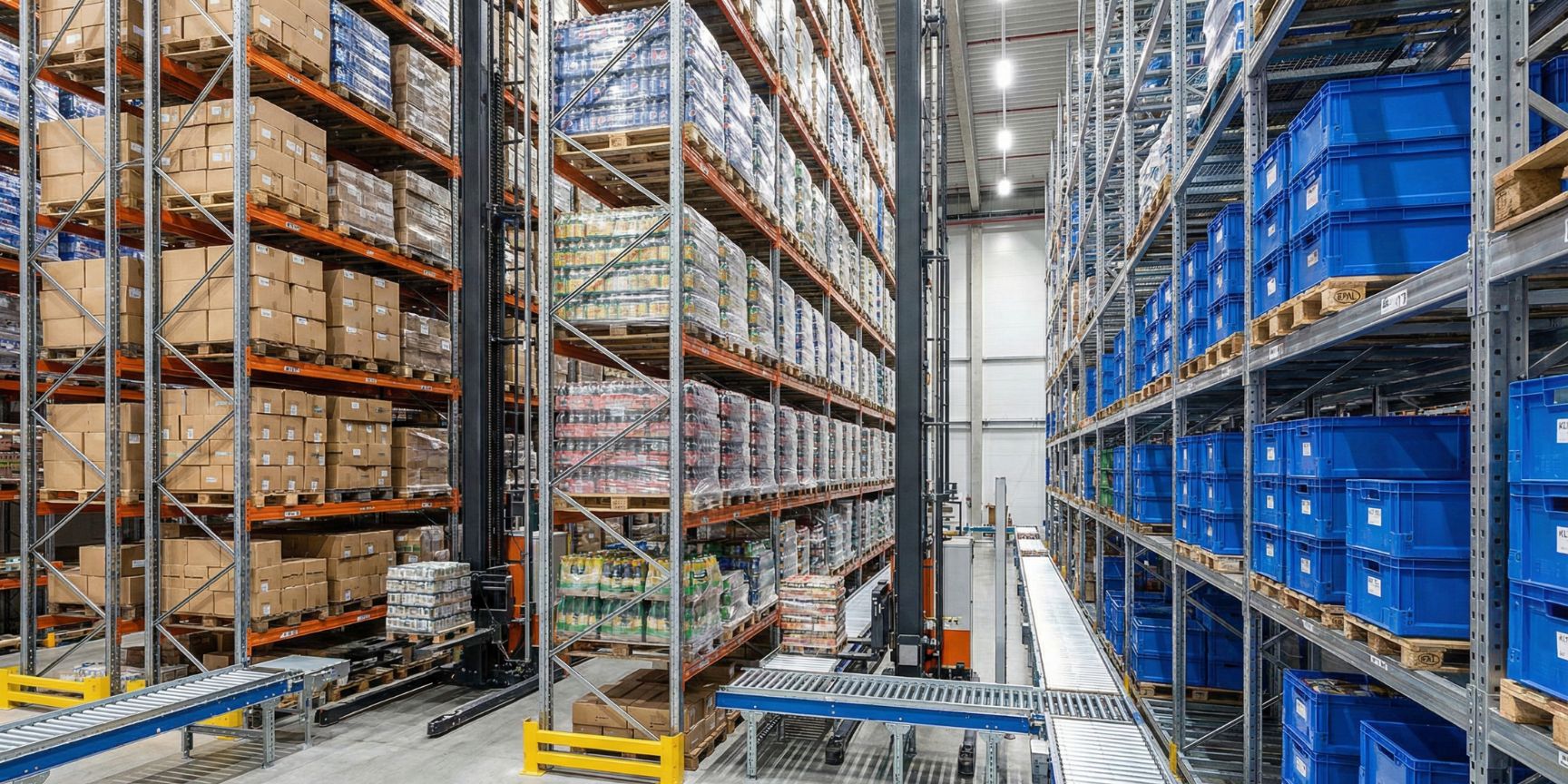
The efficiency of a warehouse stands and falls with the packaging. It directly influences the filling level and the choice of conveyor technology.
In automated small parts warehouses (AS/RS) or shuttle systems, goods often have to be repacked into standardised containers (small load carriers) if the original packaging (cardboard packaging) is not eligible for funding (soil that is too soft, unstable).
Numbers, data, facts: The use of volume is the critical KPI. If you transport "air", the costs increase. The ratio of gross weight to dimensional weight is decisive here. Modern 3D volume scanners capture packaging dimensions in incoming goods with millimetre precision in order to allocate the optimal storage space in the high rack (storage space optimisation).
Question & Answer: How does packaging affect conveyor technology?
Question: Why does some packaging fail on automated systems?
Answer: Automatic conveyor belts and light barriers require defined edges and stable floors. Foil-wrapped textiles (soft bags) or cartons with loose adhesive tape ("flags") can irritate sensors or get caught in roller conveyors. Therefore, such goods often have to be made "trayable", i.e. placed on a tray, which causes process costs.
The role in contract logistics: Value Added Services (VAS)
For contract logistics companies, packaging is often the core business in the field of value-added services. This is where the line between logistics and production becomes blurred.
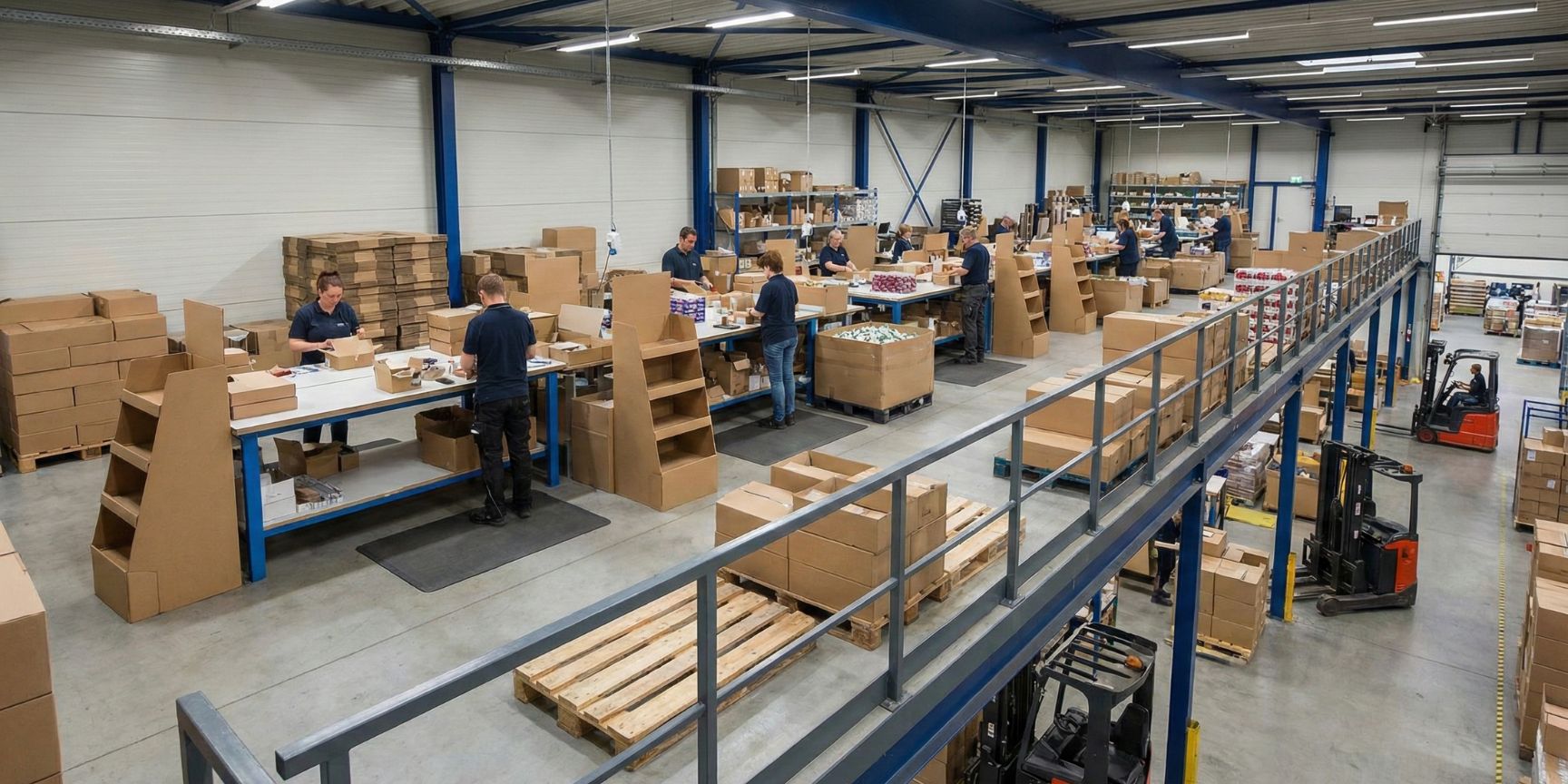
Co-packing and display construction: Many goods arrive at the warehouse in neutral industrial packaging and need to be finished for the point of sale (PoS) or e-commerce.
- Seasonal promotions: The assembly of displays for retail.
- Kitting: The compilation of gift sets from different individual items.
The logistics space must be flexible. Action areas are needed on which a lot of personnel and material (empty cardboard boxes, filling material) can be moved at short notice. This places demands on the mezzanine levels in halls, as these activities are often located there (pay attention to the load capacity!).
Packaging and the logistics property: fire loads and sprinklers
An aspect that is often underestimated is the influence of packaging materials on the property itself, especially on fire protection.
Logistics properties are divided into fire hazard classes. The type of packaging is decisive for the fire load.
- Cardboard/paper: Burns well, but can usually be extinguished well with standard sprinkler systems (ESFR – Early Suppression Fast Response) because water penetrates the material.
- Plastics (KLTs, foils, polystyrene): These develop extremely high temperatures during fires and liquefy (pool fire). Water often rolls off.
Practical implication: If plastic containers are suddenly stored in a hall instead of cartons, this can lead to the existing sprinkler system no longer being sufficient. An expensive "upgrade" of the extinguishing technology (e.g. in-rack sprinkling in the shelf levels) becomes necessary. Tenants and owners must communicate closely here.
Load securing and stability
The tertiary packaging must absorb physical forces (acceleration, braking, centrifugal forces).
- Form-fitting: Seamless stowage in the truck.
- Adhesion: tie-down lashings.
In practice, damage is often caused by inadequate wrapping of pallets. A stretch film that is too loose will cause the bond of pallet and goods to break. Modern stretch wrappers work with pre-stretch of up to 300%, which saves film material and increases stability (retention force).
Question & Answer: Sustainability vs. Security?
Question: Does it always make sense to do without film for sustainability reasons?
Answer: Not across the board. If a pallet with a value of €5,000 is damaged during transport and has to be destroyed by dispensing with 200 grams of film, the ecological balance (due to the new production of the goods) is catastrophic. The trend is towards thinner high-performance films or reusable securing systems (e.g. tension belts for pallets).
Legal framework and disposal
The Packaging Act (VerpackG) in Germany obliges distributors (including online retailers) to participate in a dual system.
For warehouse logistics, this means:
- Waste separation: Tons of film and cardboard packaging accumulate in large logistics centers.
- Compaction: Balers are used to reduce disposal costs and save space. A bale of pressed cardboard is a recyclable material, loose cardboard is waste.
Loading aids: The substructure of the packaging
You can't look at packaging without the load carrier.
- Euro pallet (EPAL): Exchangeable, standardized. Costs approx. 10–15 € (depending on the market).
- One-way pallet: Often for export, no exchange obligation, lower load capacity.
- Chemical pallet (CP): Special dimensions for the chemical industry.
- Düsseldorf pallet: Half pallet, often used for trade and display construction.
The management of these load carriers (pallet management) is a complex accounting process in contract logistics. Pallet debts are hard cash.
Conclusion and outlook: Smart packaging
The future of packaging in logistics is digital. "Smart Packaging" integrates RFID chips or sensors that monitor temperature, vibration and location. For logistics properties, this means that comprehensive Wi-Fi or 5G campus networks must be part of the basic equipment in order to read out this data in real time.
Packaging is changing from a pure waste product to an integrated part of the digital value chain.