




Pick Pack in warehouse logistics
Table of Contents
- Pick-and-Pack: The Backbone of Efficient Logistics – An Expert Guide
- Definition: What is meant by pick-and-pack?
- The process in detail: How modern fulfillment works
- Pick-and-Pack from the Perspective of the Logistics Property: Requirements for the Hall
- The Role of Contract Logistics: Outsourcing as a Strategy
- Figures, data, facts: Making efficiency measurable
- FAQ: Frequently asked questions about the pick-and-pack procedure
- Technology Trends: Pick-and-Pack 4.0
- Practical utility: tips for optimising your pick-and-pack
- Conclusion: A process with leverage
Pick-and-Pack: The Backbone of Efficient Logistics – An Expert Guide
In a world in which "same-day delivery" is advancing from luxury to standard, one process in particular is moving into the focus of intralogistics: the pick-and-pack process. It's much more than just grabbing goods from the shelf. It is a finely tuned choreography of people, technology and real estate structure that decides whether a logistics location is profitable or sinks into chaos.
Definition: What is meant by pick-and-pack?
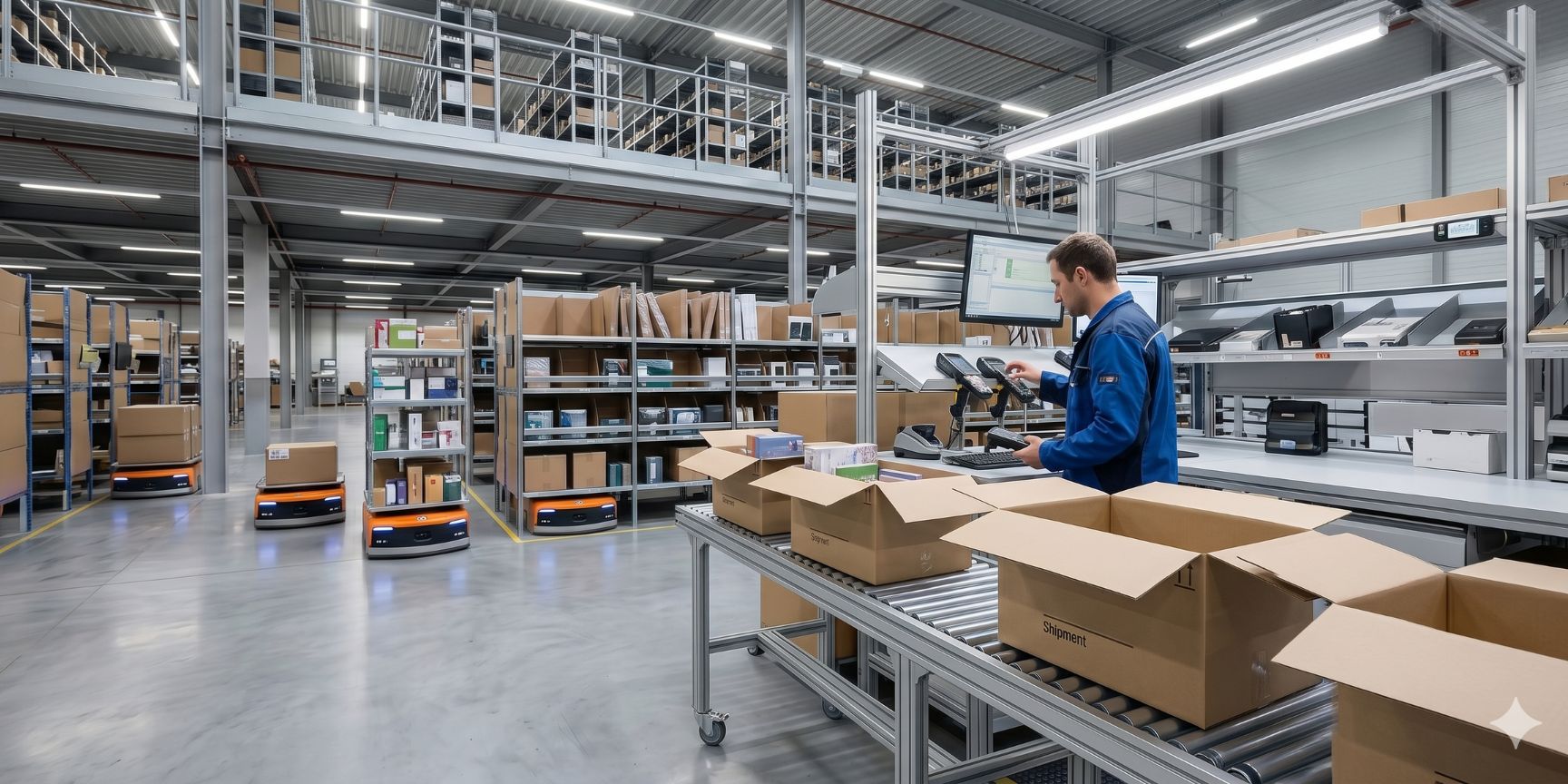
Pick-and-pack describes a process in warehouse logistics in which items for an order are taken directly from the storage locations (pick) and placed directly in the shipping carton (pack).
In contrast to traditional processes, in which goods are first collected, transported to a central packing station and repacked there, pick-and-pack saves time and reduces the number of touchpoints per article. This is particularly important in B2C e-commerce and contract logistics , where small batch sizes and high shipment volumes dominate.
The process in detail: How modern fulfillment works
The pick-and-pack process is classically divided into three phases:
- Order Receipt & Routing: The Warehouse Management System (WMS) creates an optimized pick list.
- Picking: The employee (or a robot) heads for the storage locations. Technologies such as pick-to-light, voice picking or mobile handheld scanners are used here.
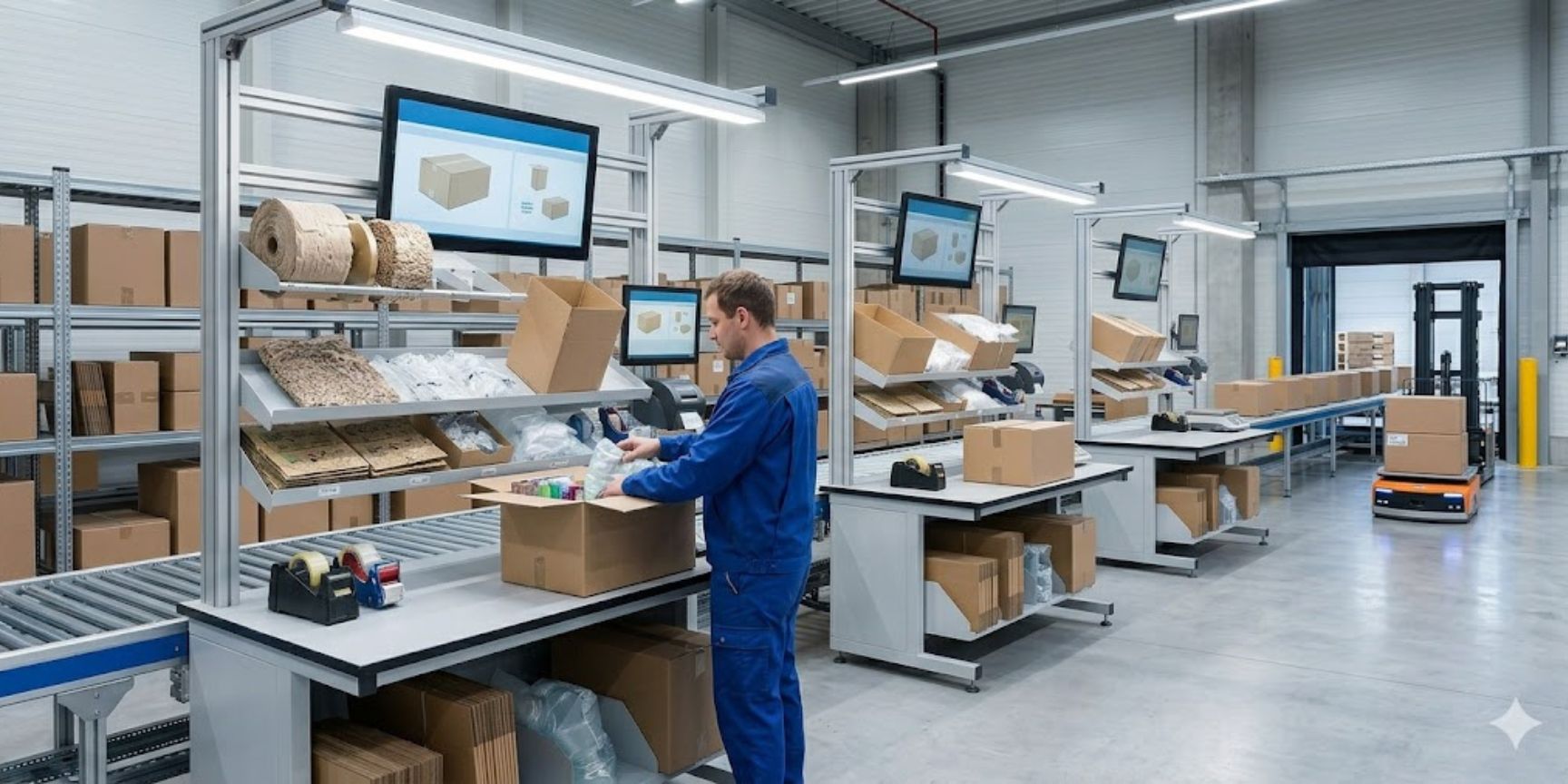
- Consolidation & packing: The goods are prepared for dispatch directly at the pick trolley or at a specialised station. This is often where delivery notes or advertising materials are also attached.
Pick-and-Pack from the Perspective of the Logistics Property: Requirements for the Hall
An efficient pick-and-pack strategy cannot be implemented in just any property. The architecture of the hall must support the process:
- Zoning: Clearly defined picking zones (fast-moving areas) and sufficient space for the packing stations and the provision of dispatch are required.
- Floor conditions: Heavy-duty, flat industrial floors are a prerequisite for the use of order pickers or autonomous mobile robots (AMR).
- Lighting & Ergonomics: Since picking is an error-prone manual activity, bright (LED-based) and ergonomically designed workstations are essential for picking quality.
- Mezzanine levels: In order to make optimal use of the floor space, modern logistics properties often rely on shelving systems over several levels (pick towers), which massively increases the pick density.
The Role of Contract Logistics: Outsourcing as a Strategy
Many companies outsource the pick-and-pack to contract logistics companies (3PL). Why? Because these service providers have the specialized know-how and the necessary scalability.
In contract logistics, pick-and-pack is often combined with value-added services (VAS). This means that products are additionally refined during the packaging process, for example through gift packaging, labelling or set-building (combining several products into a new unit). The logistics location will thus become an extended workbench for retailers.
Figures, data, facts: Making efficiency measurable
To evaluate the success of a pick-and-pack system, the industry uses specific key performance indicators (KPIs):
| KPI | Description | Benchmark (Top Performer) |
| Pick Rate | Picks per employee/hour | 120 - 200 (depending on the product) |
| Order Cycle Time | Time from order to shipment | < 4 hours |
| Pick Accuracy | Percentage of error-free shipments | > 99.8% |
| Packaging costs | Cost per shipment unit | Dependent on material & automation |
FAQ: Frequently asked questions about the pick-and-pack procedure
Question: For which industries is pick-and-pack best suited?
Answer: Primarily for online retail (fashion, electronics, FMCG) as well as for spare parts logistics, where individual orders have to be reacted to quickly.
Question: What is the biggest advantage over batch picking?
Answer: The speed. Since the intermediate step of subsequent sorting is no longer necessary, the goods can leave the warehouse much faster ("speed-to-market").
Question: What role does AI play in this process?
Answer: AI algorithms optimize the routes of employees in real time and calculate the optimal placement of goods in the warehouse (slotting) based on historical data.
Technology Trends: Pick-and-Pack 4.0
The future belongs to automation. We are seeing a massive increase of:
- Cobots (Collaborative Robots): These support employees in carrying heavy loads or take over the picking completely in standardized environments.
- Wearables: Data glasses (augmented reality) show the picker directly in his field of vision which compartment he needs to head for (vision picking).
- Automated packaging machines: These scan the size of the goods and produce a tailor-made carton – this saves filling material and reduces transport volume.
Practical utility: tips for optimising your pick-and-pack
If you want to optimize your process, you should start with these three levers:
- Route optimization: 50% to 70% of the time spent picking is spent on locomotion. Use a WMS that minimizes journeys according to the "Traveling Salesman" principle.
- Consistently implement ABC analysis: Place fast-moving items (A-items) near the packing stations and at reach height.
- Error avoidance through technology: Rely on scanning processes for every pick. The investment in handheld scanners quickly pays for itself by reducing return costs due to incorrect deliveries.
Conclusion: A process with leverage
Pick-and-pack is much more than an operational necessity. In the modern logistics landscape, it is a strategic tool. Whether in your own hall or through a partner in contract logistics – those who master the processes reduce their costs per order and increase customer satisfaction in the long term. The logistics property of tomorrow must act as a flexible framework that optimally networks man and machine.
Your Ideal Logistics Warehouse
Browse listings for warehouse space, logistics real estate, industrial land, and contract logistics solutions.
Browse Exposés
Maximize Exposure for Your Warehouse Space
Showcase your logistics properties and attract qualified inquiries.
Discover Products