




Pick-by-Scan in the warehouse
Inhaltsverzeichnis
- Pick-by-Scan: The Foundation of Digital Warehouse Logistics
- The technical functionality and hardware evolution
- Process flow: Error minimization through scan logic
- Pick-by-Scan in Contract Logistics: Flexibility as a trump card
- Requirements for the logistics property and hall
- Facts and figures: Focus on profitability
- Glossary / FAQ: Frequently asked questions from practice
- Conclusion and outlook
Pick-by-Scan: The Foundation of Digital Warehouse Logistics
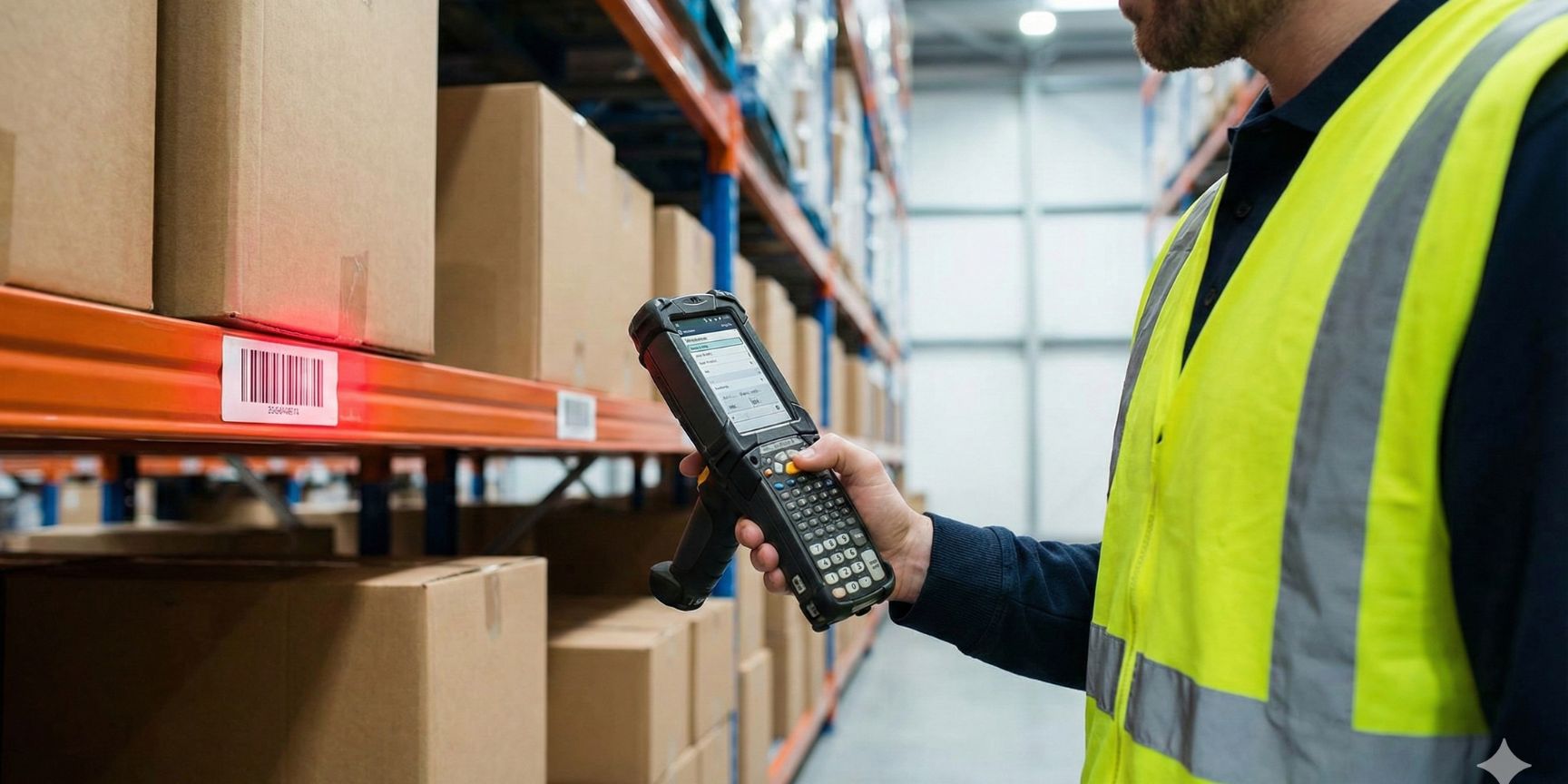
Pick-by-scan is probably the most widely used method of paperless picking. Instead of classic paper lists, warehouse employees use mobile data collection devices (MDE) to identify items and storage locations using barcodes or QR codes. This process connects the physical flow of goods in real time with the digital flow of information from the warehouse management system (WMS).
In contrast to static systems, pick-by-scan offers a high degree of flexibility. It is not tied to fixed installations on the shelf (such as pick-by-light), but to the employee's mobile hardware. For specialist portals and decision-makers, however, it is not only the "what" but the "how" and "where" that are decisive – especially with regard to the property and the drafting of contracts in logistics.
The technical functionality and hardware evolution
The heart of the system is the communication between the MDA device and the avalanche transceiver. Data is usually transmitted via WLAN or, more rarely, via the mobile communications standard (4G/5G) in outdoor areas.
Technologically, the field has changed considerably:
- Classic Handhelds: Rugged devices with pistol grip and built-in display/keyboard.
- Wearables & ring scanners: To compensate for the disadvantage of the "occupied hand", modern warehouses rely on ring scanners on the finger in combination with smartwatches or terminals on the forearm. This brings ergonomics closer to pick-by-voice .
- Smart devices: Rugged smartphones with Android Enterprise are increasingly being used, which are controlled via app and offer intuitive touch interfaces.
Process flow: Error minimization through scan logic
A typical pick-by-scan operation follows a strict validation logic that drastically reduces error rates. While paper-based processes can have error rates of 0.3% to 1.0%, pick-by-scan often reduces these to less than 0.1%.
- Order display: The display shows storage location, item number and quantity.
- Place verification: The employee scans the barcode at the storage location. If this is not correct, the system (location control) blocks.
- Article verification: The article or the outer packaging (EAN/GTIN) is scanned (object inspection).
- Quantity confirmation: The withdrawal quantity is confirmed (manually or by scanning each individual part).
- Real-time posting: The stock is corrected immediately in the WMS. Shortages are noticed immediately, not only during inventory.
Pick-by-Scan in Contract Logistics: Flexibility as a trump card
In contract logistics, where service providers take over warehouse processes for third parties, pick-by-scan is often the means of choice. Why is that?
- Multi-client capability: An MDE can theoretically switch between clients every minute. The software mask adapts to different customer requirements without having to rebuild the physical infrastructure (as with Pick-by-Light).
- Quick induction: Seasonal peaks (e.g. Black Friday, Christmas business) require the use of temporary workers. Visual guidance on the display can be learned in just a few minutes – much faster than complex voice commands or memorizing storage locations.
- Documentation: For contract logistics specialists, proof of process quality is essential. Each scan generates a time stamp ("log file") that provides complete evidence of when which item was packed by whom in the event of complaints.
Requirements for the logistics property and hall
One aspect that is often underestimated in planning is the interaction between pick-by-scan and the physical hall. A "dumb hall" (only shell) does not work for digital picking.
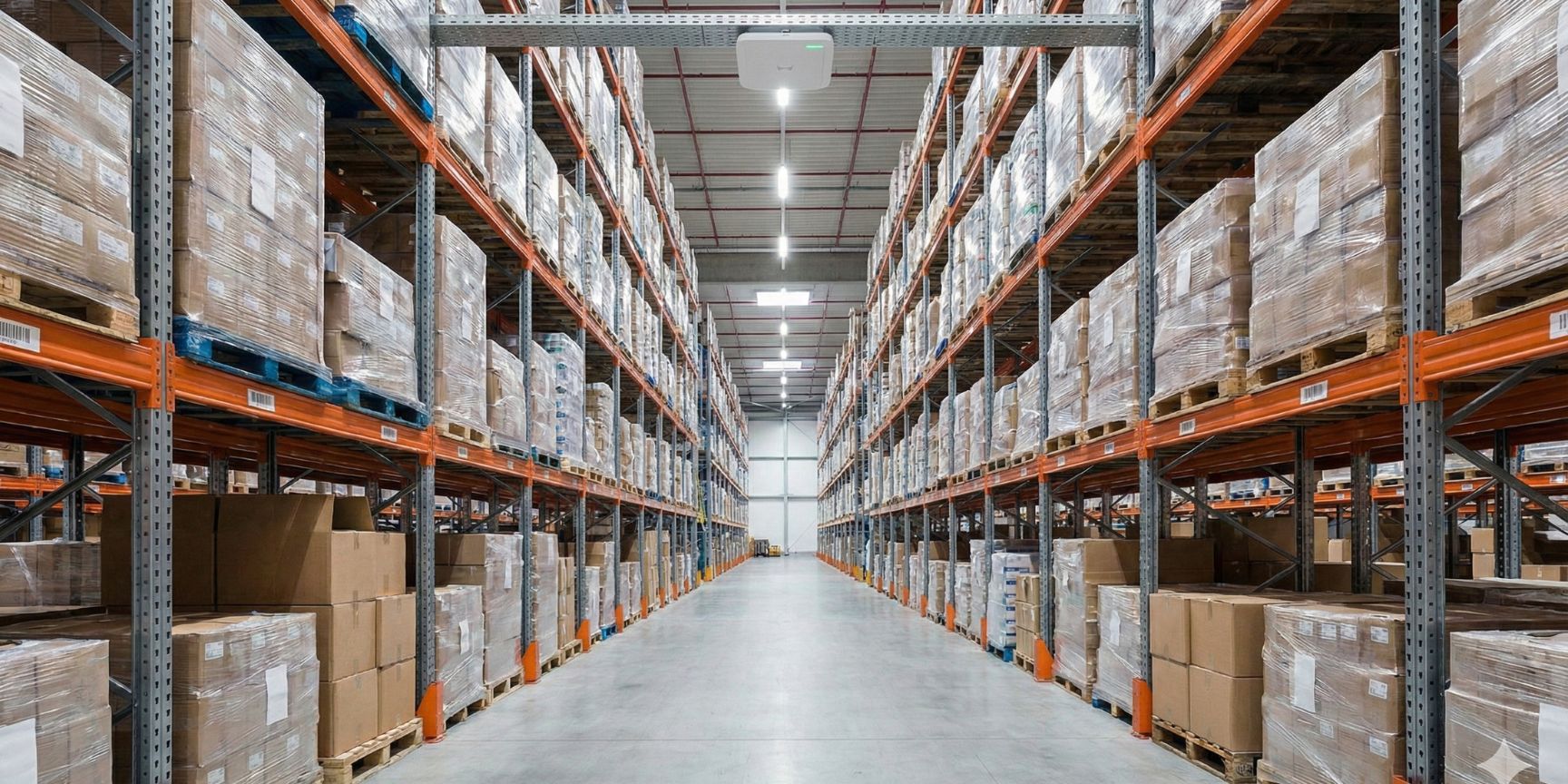
- Wi-Fi illumination and shadowing The best hardware is of no use without connectivity. Steel shelves, mezzanine levels and liquid-containing goods (beverages, paints) massively absorb or reflect radio signals.
- Planning: A professional WLAN simulation measurement (heat map) is required before occupancy.
- Access points: The positioning of the access points must take into account the shelf geometry. In narrow-aisle warehouses, antennas often have to radiate directly into the alleys ("tunnel effect").
- Power supply and charging management The use of MDEs requires dedicated charging stations (Battery Charging Cabinets). In real estate planning, areas suitable for fire protection (due to Li-ion batteries) must be planned with sufficient electrical protection, ideally centrally near the break rooms or the control center offices.
- Lighting and readability Although the displays are illuminated, fast scanning of barcodes on different shelf levels (up to 2m height for manual picking) requires homogeneous hall lighting (at least 200 lux in the aisle) to avoid reflections on films and speed up scanning.
Facts and figures: Focus on profitability
When is the investment worthwhile?
- Investment: A robust industrial terminal costs between €800 and €1,500. In addition, there are costs for WLAN infrastructure and avalanche transceiver licenses.
- ROI (Return on Investment): By eliminating data entry times (no manual typing of pick lists on a PC) and reducing returns due to incorrect deliveries, systems often pay for themselves within 12 to 18 months.
- Inventory: Permanent inventory is only possible efficiently through pick-by-scan. Zero-crossing scans (confirmation that the tray is empty) keep inventory clean.
Glossary / FAQ: Frequently asked questions from practice
Question: Is pick-by-scan slower than pick-by-voice? Answer: In environments where both hands are needed to lift heavy loads, pick-by-voice or the use of wearable scanners (ring scanners) is more efficient. For complex items that require visual inspection (e.g. serial number comparison) or image display, pick-by-scan is superior.
Question: What barcode standards are necessary? Answer: The system must be able to read common 1D codes (EAN-128, Code 39) and increasingly 2D codes (Datamatrix, QR code). 2D codes are more robust against damage and can store more data in a smaller area.
Question: What about ergonomics? Answer: A common point of criticism is the weight of the devices. However, modern "Android Industrial" devices often weigh only 250-300 grams. Ergonomic pistol grips reduce wrist strain ("RSI syndrome").
Conclusion and outlook
Pick-by-scan will remain the standard in warehouse logistics for the foreseeable future, especially in e-commerce and spare parts logistics. The future lies in the fusion of technologies: Augmented reality (pick-by-vision) combines scanning technology with data glasses, and camera systems on forklifts will scan pallets as they pass by.
For operators and owners of logistics properties, this means that the hall is no longer just storage space, but a large-scale IT server room. High-quality data cabling and flexible power supply are as important as the industrial door itself.