




Pallet space – What is it?
Table of contents
- Definition: What is a pallet space?
- Calculating a pallet space: More than just the floor space
- Types of pallet spaces: From the floor to the high rack
- The role of pallet storage in modern warehouse logistics
- The pallet space as a factor in the logistics property
- Practical tips for optimising pallet spaces
Definition: What is a pallet space?
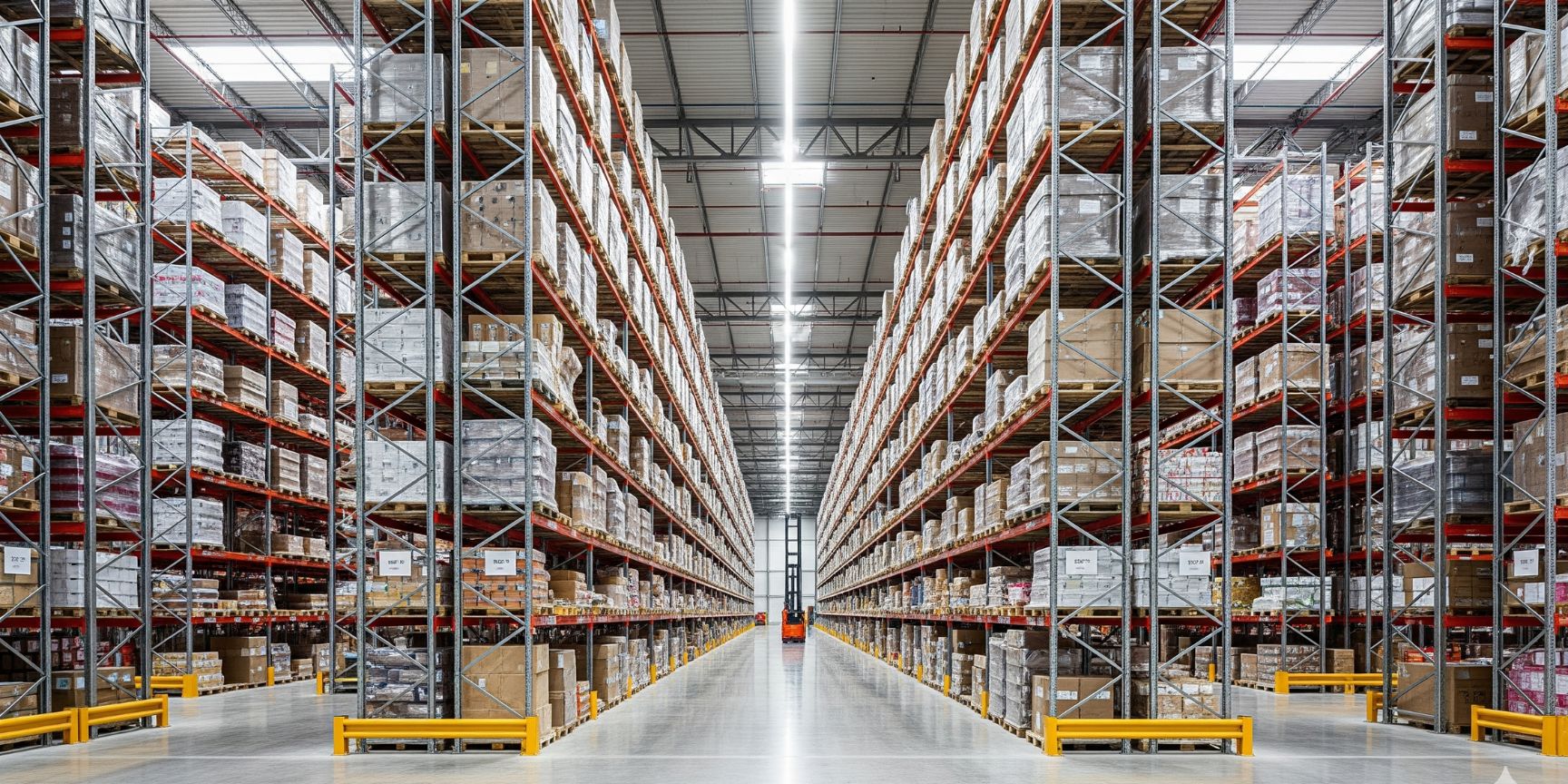
A pallet space is a defined, three-dimensional spatial unit within a warehouse that is intended for the storage of a single pallet. It is the smallest planning and commercial unit in warehouse logistics. Although the standardised Euro pallet (dimensions: 1200 mm x 800 mm) is often used as the basis, the actual space and space requirements of a parking space include much more than just this floor space. It necessarily includes the proportionate areas for handling, traffic routes and safety distances. In practice, the pallet space acts as the "currency" of the warehouse: capacities are measured in storage spaces, services (storage fees) are billed per storage space and the efficiency of a logistics hall is assessed on the basis of the maximum possible number of parking spaces.
Calculating a pallet space: More than just the floor space
The correct calculation of a pallet space is crucial for warehouse planning and cost calculation. A superficial view (1.20 m * 0.80 m = 0.96 m²) is misleading and wrong in practice. The professional calculation takes into account the total infrastructure area required for operation.
A common formula for determining the space required for a shelf location is:
- Area per storage space = pallet depth × (pallet width + proportionate aisle width)
Practical example: Suppose Euro pallets are stored transversely in a pallet rack (depth 0.80 m, width 1.20 m). The traffic aisle required for the industrial truck (e.g. a reach truck) is 3.00 m wide. Since the aisle serves two opposite rows of shelves, half of the aisle width is allocated to each storage space.
- Shelf depth (incl. overhang): approx. 1.10 m (for a Euro pallet)
- Proportionate aisle width: 3.00 m / 2 = 1.50 m
- Required depth per parking space: 1.10 m + 1.50 m = 2.60 m
- Required width per parking space (incl. side supports and safety distances): approx. 1.35 m
Thus, the actual floor area is not 0.96 m², but can quickly add up to 3 to 4 m² per parking space. Other factors such as main traffic routes, fire protection sections, loading zones and social areas must also be taken into account in the overall calculation of the usable area. In addition to the area, the height (including pallet and goods) and the maximum weight are the decisive vertical dimensions of the parking space.
Types of pallet spaces: From the floor to the high rack
The type of pallet space is determined by the storage system and the requirements of the goods to be stored. The most common types are:
- Floor storage (block storage): The simplest and most cost-effective option. Pallets are stacked directly on the hall floor. This is suitable for large quantities of homogeneous, stackable goods. The disadvantage is the limited direct access (LIFO principle: last-in, first-out) and a lower use of space at height.
- Rack space in pallet racking: The standard in logistics. Each pallet has a fixed space on the rack, which allows direct and quick access to each individual pallet (FIFO principle: first-in, first-out). This maximizes the use of hall height and is flexible for different items.
- Storage space in special racks: Depending on the requirements, specialized systems are used:
- Drive-in or drive-in racks: Significantly increase storage density by eliminating aisles. Suitable for large quantities of the same item (similar to block storage, but in height).
- Flow racks (Live Storage): The pallets roll on inclined paths from the loading to the unloading side. This guarantees a strict FIFO order and is ideal for goods with a best-before date.
- Mobile racking: The racking rows are mounted on rails and can be moved electrically to open only a single aisle at a time. This maximizes storage density but slows down access.
The role of pallet storage in modern warehouse logistics
The pallet space is much more than just a physical place. It is a central control and key performance indicator (KPI) for the entire warehouse management. A modern warehouse management system (WMS) not only manages occupancy, but optimizes it dynamically. Based on criteria such as turnover frequency (ABC analysis), volume or access frequency, the system assigns the goods the optimal storage location. Fast-moving items are stored close to the ground and close to the shipping zone to shorten picking distances and increase efficiency. The utilization of the pallet spaces is a direct indicator of the profitability of the warehouse.
The pallet space as a factor in the logistics property
For developers, investors and tenants of logistics properties, the maximum number of pallet spaces is the decisive key figure for evaluating a hall. Three structural factors are decisive here:
- Hall height: The clear height is measured, ideally as the UKB (lower edge of the truss). A height of 10 m or 12 m UKB is now standard to enable 5 or 6 or more levels in the pallet rack.
- Column grid: A wide column grid (e.g. 12 m x 24 m) enables a flexible and efficient arrangement of the rack rows with minimal interference.
- Floor load capacity: The floor plate must be able to bear the high point loads of the rack supports, which can be several tons in a fully loaded high rack.
The rent for a logistics space is often apportioned per square meter, but the user's internal calculation is almost always based on the cost per pallet space per month.
Practical tips for optimising pallet spaces
Efficient use of the available storage space reduces storage costs and increases productivity. The following measures have proven themselves in practice:
- Systematic storage space analysis: Check the occupancy regularly. Empty or only partially occupied places should be consolidated.
- Use of narrow-aisle tapers: By reducing aisle widths, significantly more rows of racks and thus more storage spaces can be installed with the same space requirement.
- Dynamic Warehousing (Chaotic Warehousing): A WMS-controlled system in which goods are stored in the next best free place rather than in a fixed location. This significantly increases occupancy.
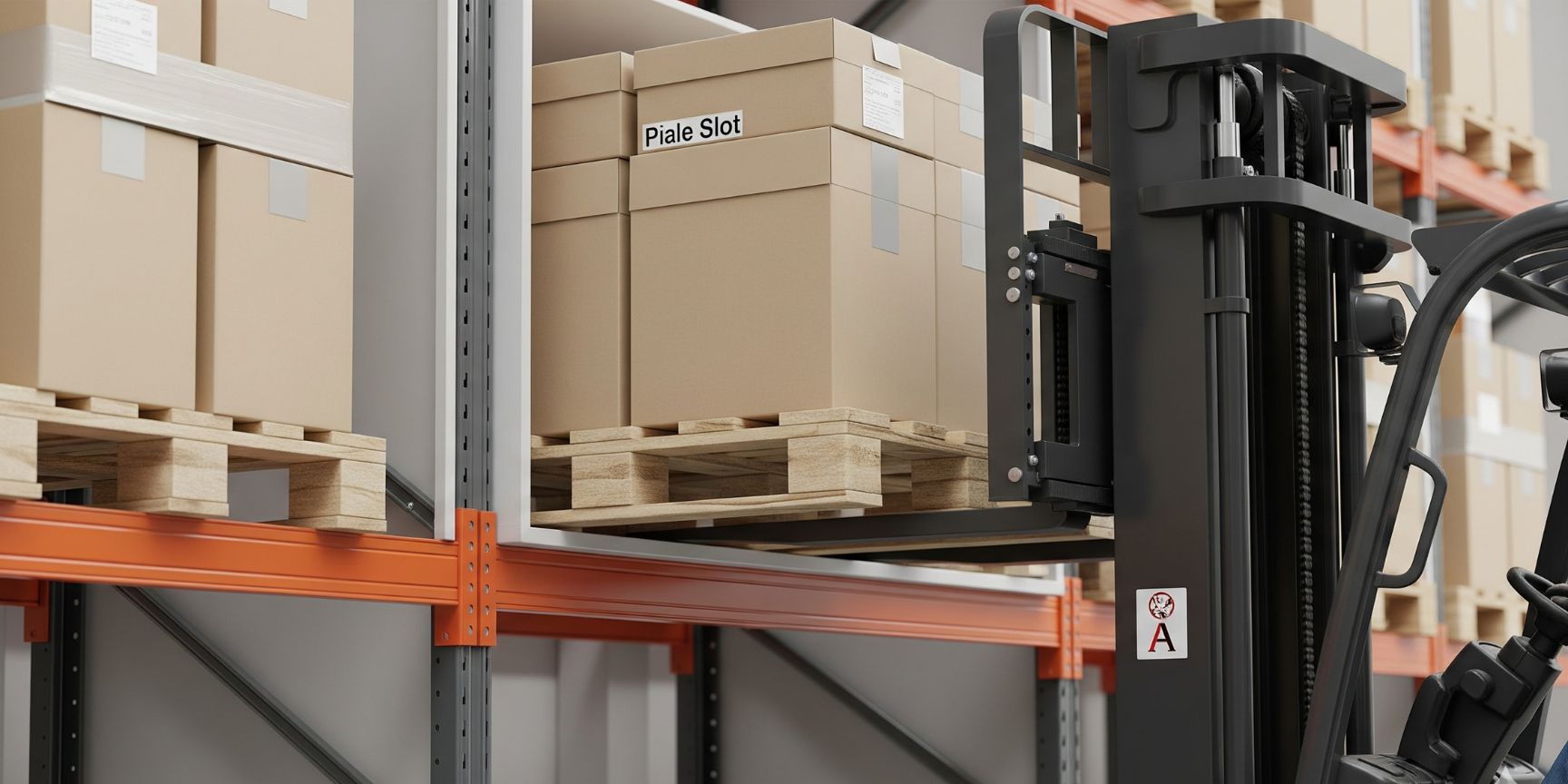
- Vertical picking: By using order pickers, where the driver moves up with the cab, the second or third shelf level can also be used for quick access, which increases efficiency.