




Column grid in logistics real estate
Table of contents
- The column grid: Strategic foundation of the logistics property
- What is meant by a column grid?
- The importance for warehouse and contract logistics
- The "Golden Mass": Why meters
- What role does the grid play in the floor slab?
- Flexibility vs. Construction Costs: An Economic Consideration
- FAQ: Frequently asked questions from practice
- Strategic recommendation for project developers
The column grid: Strategic foundation of the logistics property
In the world of logistics real estate, the column grid is much more than a static necessity. It is the unit of measurement that determines the storage density, the process speed and ultimately the third-party usability of a hall. Anyone who makes mistakes here in the planning phase will pay them back over decades through inefficient use of space.
What is meant by a column grid?
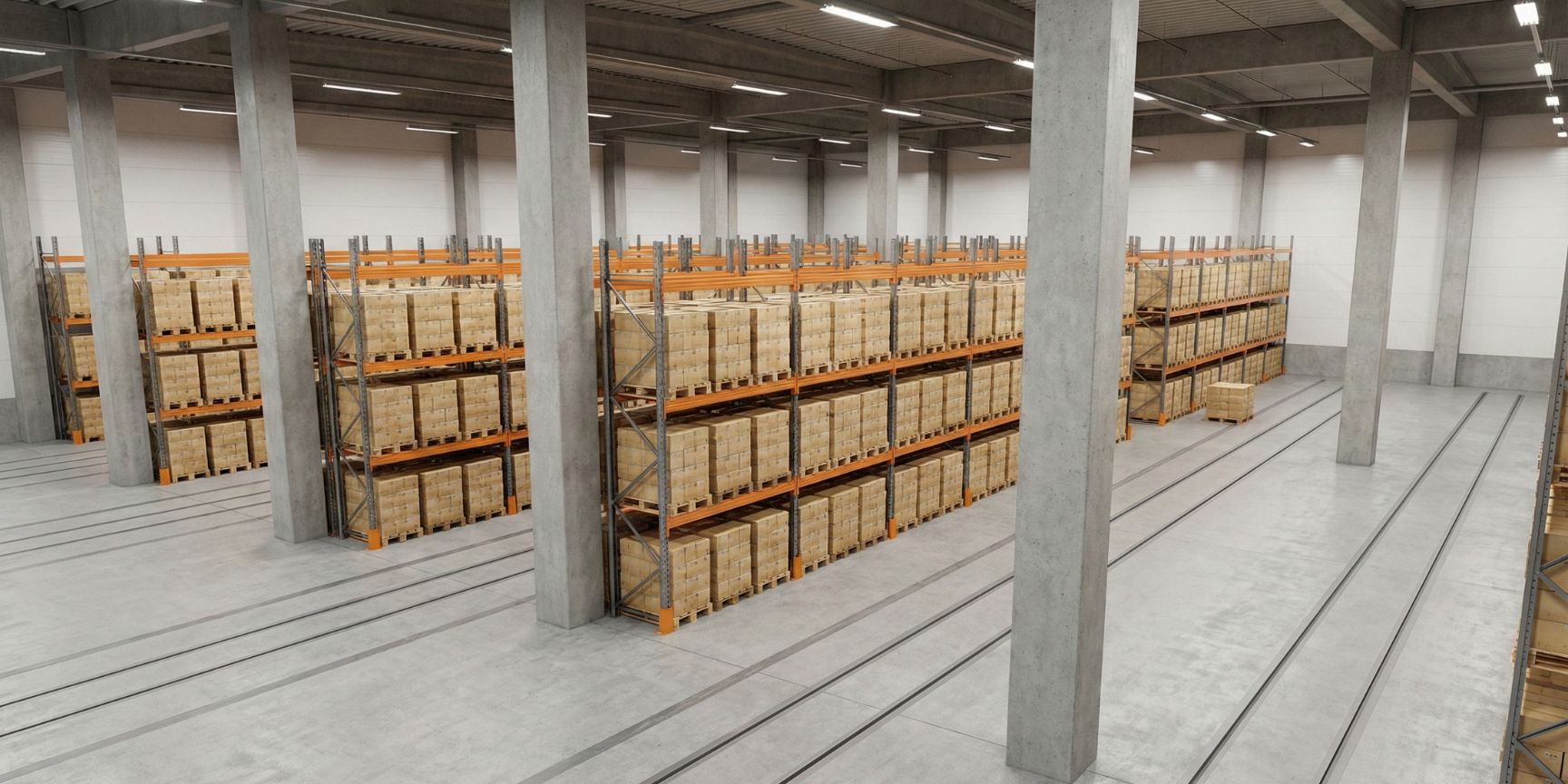
The column grid defines the distances between the load-bearing vertical components (columns) of a hall in the longitudinal and transverse directions. It is usually given in meters, for example m. While the first dimension often describes the distance between the columns within a row of trusses, the second dimension defines the span of the main trusses.
In modern logistics real estate, a standard dimension has been established that is optimized for the geometry of the Euro pallet (mm) and the working widths of industrial trucks.
The importance for warehouse and contract logistics
In contract logistics, where contract terms are often shorter than the lifespan of a property, flexibility is key. A narrow or unflattering grid forces the logistics specialist to compromise on the shelf layout.
- Lost space: If a support is in the driveway or blocks a shelf space, "dead corners" are created.
- Safety risk: Supports that are too close to manoeuvring paths increase the risk of collision and thus maintenance costs.
- Scalability: A wide grid makes it possible to switch from wide-aisle to narrow-aisle storage without touching the statics.
The "Golden Mass": Why meters?
In the industry, the grid of approx. m in depth and m in width (truss spacing) is often considered the standard. Why?
- Rack metrics: Three standard rack bays for Euro pallets, including the necessary tolerances and column sheathing, can be precisely fitted between two supports.
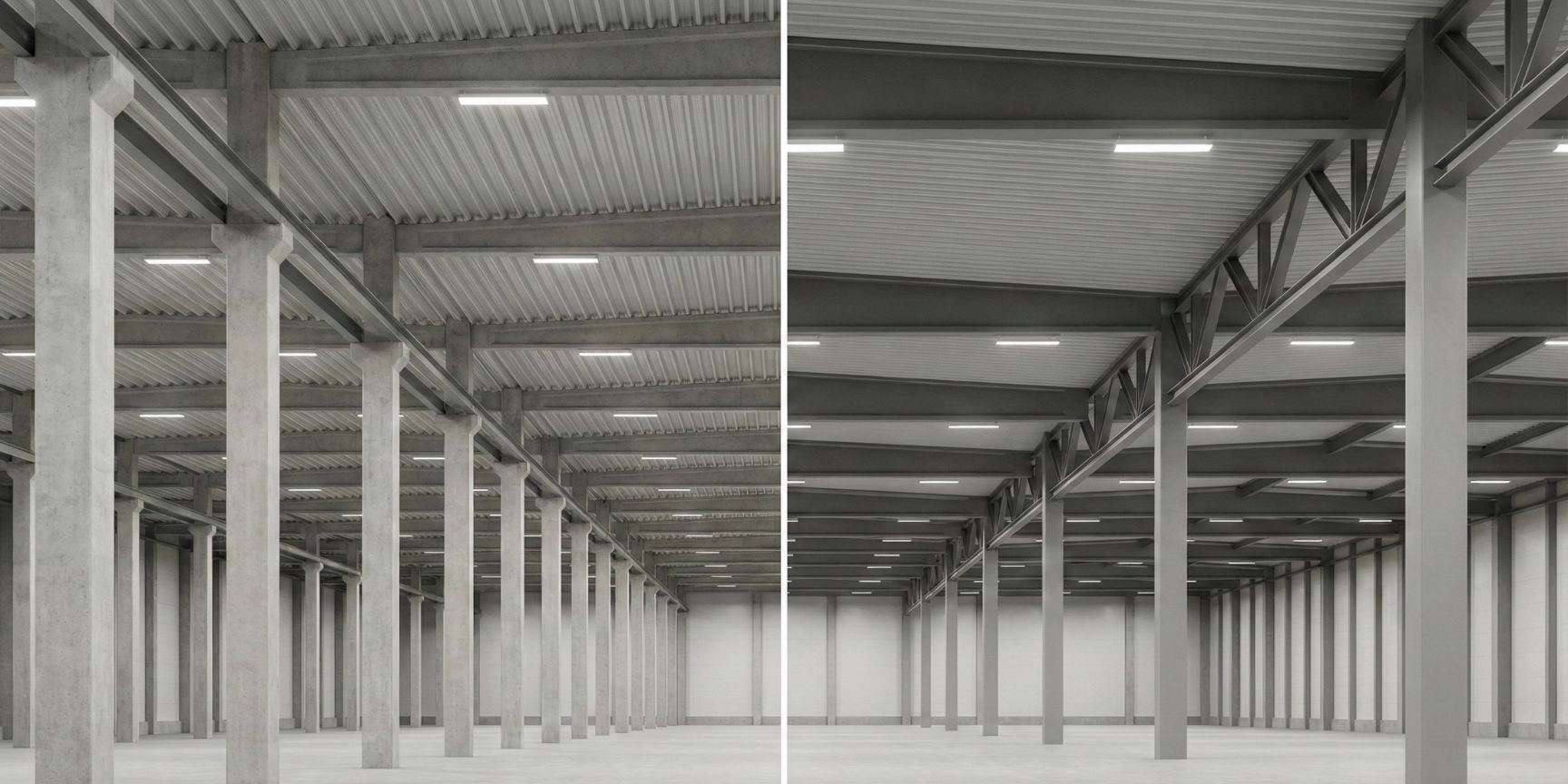
- Reinforced concrete economy: Distances of 12 to 15 meters can be bridged with economical precast concrete elements. If you go well beyond this (e.g. 30 meters school-free), the construction costs increase disproportionately, as the truss heights increase massively.
- Fire Protection: The grid often correlates with the sprinkler groups and the placement of smoke extraction systems.
What role does the grid play in the floor slab?
An often underestimated aspect is the interaction between the column load and the floor slab. With wide grids, an enormous point load is concentrated on the foundation under the column.
Practical tip: Make sure that the expansion joints of the floor slab harmonize with the column grid. Joints in the travel path of the forklifts lead to increased wear of the rollers and vibrations, which can endanger the load.
Flexibility vs. Construction Costs: An Economic Consideration
Halls without internal supports (cantilevered) are the dream of every logistics manager, but often the investor's nightmare.
| Grid Type | Pros | Cons |
| Tight (e.g. m) | Cost-effective to build, low truss height. | Limited layout, lots of obstacles. |
| Standard ( m) | Optimal price-performance ratio, standard on the market. | This is sometimes a hindrance for specialized automation. |
| Wide (e.g. m) | Maximum flexibility, ideal for cross-docking. | Very expensive, high attic due to massive trusses. |
FAQ: Frequently asked questions from practice
Question: Can I change an existing column grid at a later date?
Answer: Practically no. The columns carry the roof load and stiffen the building against wind loads. An intervention in the statics is extremely expensive and usually requires elaborate replacement constructions made of steel.
Question: How does the grid influence intralogistics automation?
Answer: To a large extent. Automated guided vehicles (AGVs) and automated small parts warehouses (AS/RS) often require millimetre precision. Each support is a disruptive factor for the sensor technology and path optimization. In fully automated warehouses, the "silo concept" is often chosen, in which the rack supports the roof structure and supports in the classic sense are omitted.
Question: What does "clear height" mean in the context of the grid?
Answer: The clear height (UKB – lower edge of truss) is the vertical distance. A wide grid requires higher trusses. If the maximum height of the development plan is limited, a grid that is too wide can lead to the loss of a shelf level in height.
Strategic recommendation for project developers
If you are building a logistics property for third-party use (multi-user hall), you should not skimp on the column grid. A grid of m is the minimum today. In contract logistics, space that can also be used for value-added services (VAS) is gaining in value – column-free zones are an advantage here for flexibly designing assembly workstations or pick zones.
In summary, it can be said that the column grid is the DNA of the hall. It determines the efficiency of logistics processes for decades. An additional investment in larger spans often pays for itself through the first change of tenant, as the hall is qualified for a wider range of logistics services.