




Chaotic warehousing in the warehouse
Table of Contents
- What exactly is "chaotic" warehousing?
- How does dynamic storage space allocation work in practice?
- What are the key advantages of this system?
- Chaotic warehousing from the perspective of contract logistics
- Requirements for the logistics property and hall
- Challenges and conclusion: For whom is the switch worthwhile?
What exactly is "chaotic" warehousing?
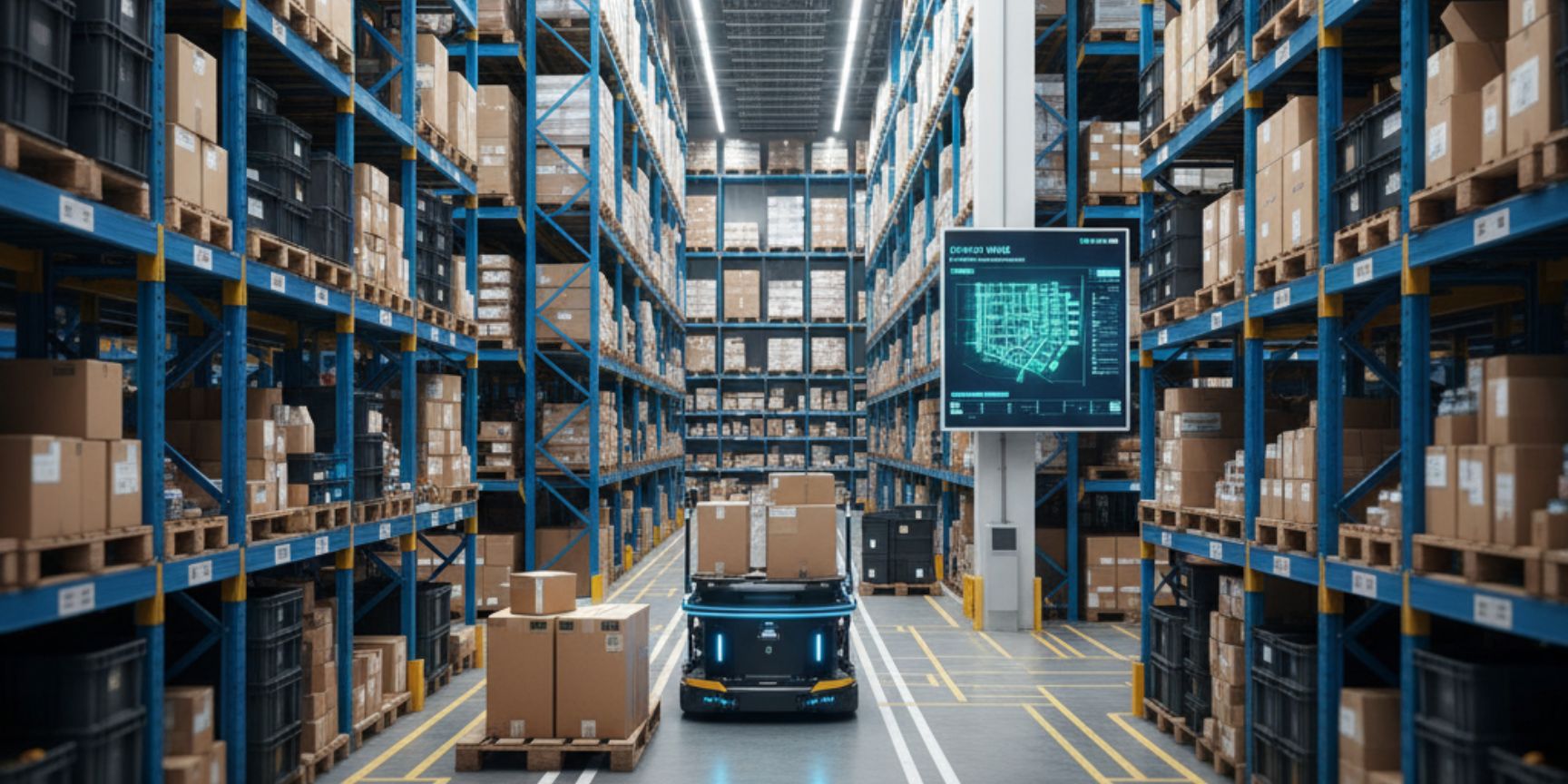
Chaotic storage (or dynamic location allocation) is a storage principle in which items do not have a fixed storage location. Instead, the goods are stored where a suitable and free space is available. The term "chaotic" is misleading, because the opposite is true: the system requires precise, software-supported control and is highly organized. The brain of the entire operation is the warehouse management system (WMS).
Question: So is the warehouse really chaotic?
Answer: No, not at all. For a person without access to the system, the arrangement of the goods may seem arbitrary – a ballpoint pen next to a car tire. For the avalanche transceiver, however, it is always known exactly which article is in which quantity at which storage location (coordinate). The organization is therefore not physically visible, but purely digitally mapped in the system.
How does dynamic storage space allocation work in practice?
The process is fully controlled by the WMS and relies on barcode or RFID scanning:
- Goods receipt: A new item arrives. It is recorded by the employee using a handheld scanner.
- Location allocation: The WMS identifies the item and checks the available storage locations. Based on criteria such as size, weight, turnover frequency (ABC analysis) and, if necessary, proximity to already existing identical articles, it allocates the optimal free space.
- Putaway: The warehouse employee is guided to the assigned location via his mobile data acquisition device (MDA). There he scans the storage location barcode and then the article barcode in order to "marry" the storage in the system.
- Picking: When an order is received, the WMS creates a route-optimized pick list. The employee is guided from seat to seat in order to efficiently pick the required items. The scan at the time of removal updates the inventory in real time.
What are the key advantages of this system?
Switching to dynamic warehousing is an investment, but it pays off in terms of significant efficiency gains.
- Maximum use of space and space: This is the biggest advantage. Studies and practical values show that the flexible use of free spaces can increase storage capacity by 20% to 50% compared to a fixed space system. White space is minimized.
- High flexibility: The system adapts effortlessly to changes in the product range, seasonal fluctuations or new products. There is no need to replan storage areas at great expense.
- Increased efficiency: The storage processes are accelerated, as it is not necessary to search for a specific space, but to head for the next free space. The WMS also optimizes the paths during picking, which increases picking performance.
- Reduced error rate: By consistently using scanners at every step of the process, human errors (e.g. wrong item or wrong place) are drastically reduced.
Chaotic warehousing from the perspective of contract logistics
For a contract logistics service provider (3PL), chaotic warehousing is often not a "nice-to-have", but an operational necessity. 3PLs usually manage goods for a wide variety of customers with completely different products and requirements in a single, large logistics center (multi-user hall).
Question: Why is the system so crucial for 3PLs?
Answer: A contract logistics company must ensure maximum flexibility. His customers' assortment changes, volumes fluctuate and new customers are added. A fixed-field system would be extremely inefficient here and would require constant, costly reorganizations. With a dynamic system, the 3PL can seamlessly and efficiently use the available space for all clients without them blocking each other. In addition, the WMS enables exact, client-specific billing of storage space and handling.
Requirements for the logistics property and hall
The decision for chaotic warehousing has a direct impact on the requirements for the logistics property. A hall is no longer just a shell, but an integral part of the system process.
- Floor conditions: For the use of high racks and automated vehicles (AGVs, AMRs), a heavy-duty and extremely flat industrial floor (e.g. according to DIN 18202) is essential to ensure trouble-free and safe operation.
- Hall layout and height: A hall structure that is as open as possible without many disturbing columns (large column grid) enables a flexible arrangement of the shelving systems. A sufficient hall height (often >10 metres UKB - lower edge truss) is crucial in order to scale the improved use of space vertically (space utilisation).
- IT infrastructure: Comprehensive, stable and powerful Wi-Fi coverage is the be-all and end-all. Every MDE scanner must have an uninterrupted connection to the WMS at all times. A redundant data and power supply is also recommended to avoid system failures.

Challenges and conclusion: For whom is the switch worthwhile?
Despite the many advantages, there are hurdles. The biggest is the dependence on technology. If the avalanche transceiver fails, the entire warehouse operation comes to a standstill. The initial investment in software, hardware (scanner, server, network) and employee training is also significant.
Bottom line: Chaotic warehousing is ideal for businesses with:
- A large and heterogeneous range of articles.
- Strongly fluctuating stocks (seasonal business, promotions).