




CHEP pallet in logistics
Table of contents
- The Blue Pallet phenomenon: what is the CHEP system really?
- Technical specifications and standards: Facts, figures, data
- The Role in Warehouse Logistics: Process Optimization through Standardization
- Influence on the logistics property and hall planning
- FAQ: Practice-relevant questions and answers
- Contract logistics: Sustainability as a competitive advantage
- Challenges and pitfalls in practice
The Blue Pallet phenomenon: What is the CHEP system really?
The CHEP (Commonwealth Handling Equipment Pool) pallet is the epitome of the pooling model in logistics. In contrast to the classic white Euro pallet, which is often traded in the exchange procedure (EPAL for Epal), CHEP is based on a rental model (circular economy). The distinctive blue colour not only signals the brand identity, but also a clear ownership relationship: CHEP pallets are never legally the property of the user, but are made available temporarily for a rental and use fee.
From the point of view of contract logistics, this offers a decisive advantage: the complexity of pallet management – including repair, quality inspection and return – is outsourced to the service provider.

Technical specifications and standards: Facts, figures, data
Exact dimensions are essential for the planning of warehouse layouts and shelving systems. The most common variant in Europe is the CHEP Euro pallet (B1208A).
| Feature | Detail |
| Dimensions | Length: 1,200 mm, Width: 800 mm, Height: 144 mm (standard height) |
| Load capacity (dynamic) | > 1,000 kg (often up to 1,500 kg in high racks) |
| Load capacity (static) | up to 4,000 kg when stacked on solid ground. (when stacked on solid ground) |
| Dead weight | approx. 20-25 kg (slightly heavier than standard EPAL due to hardwood content) |
| Material | High-quality, certified wood (PEFC/FSC) with reinforced elements |
The Role in Warehouse Logistics: Process Optimization through Standardization
In a high-bay warehouse, the quality of the load carriers is critical. While conventional exchange pallets often have quality defects (splinters, missing blocks), CHEP pooling guarantees consistent quality.
- Automation: Because CHEP pallets are inspected and repaired at service centres before each new issue, they minimise disruptions in automated conveyors and stacker cranes (SRMs).
- Sensor technology: One trend in "Logistics 4.0" is the integration of track & trace solutions directly into the pallet, which is much easier to implement with closed pooling systems than in the free exchange market.
Influence on the logistics property and hall planning
Anyone planning a logistics property must also think about load carrier management. The use of CHEP pallets has a direct impact on the use of space:
- No need for a pallet workshop: In a property for contract logistics, there is no need for space for sorting and repairing defective pallets.
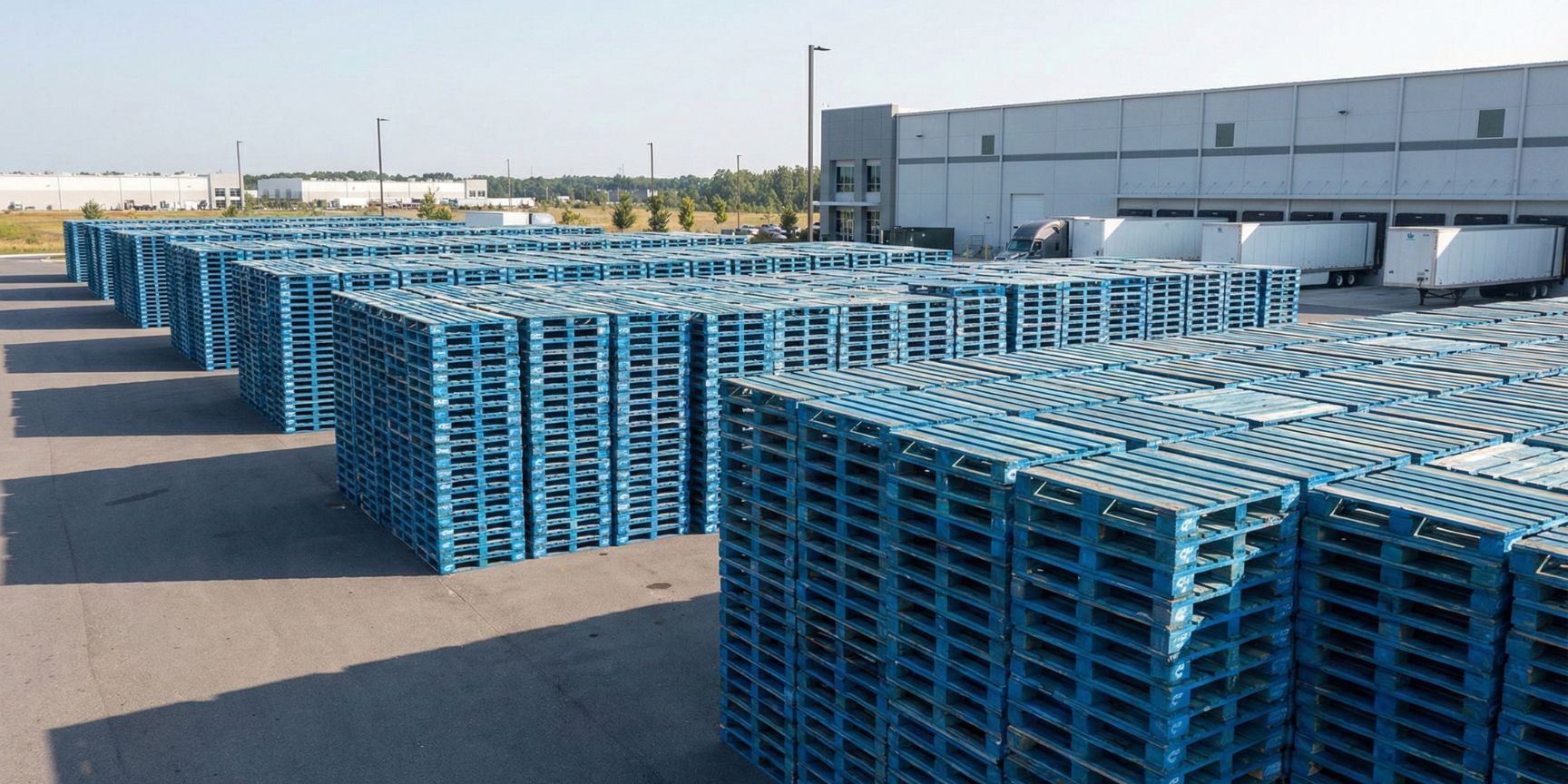
- Loading zone design: As CHEP pallets are collected and delivered in large quantities, the outdoor facilities (yard management) must provide sufficient storage space for stacking.
- Fire protection: The storage of large quantities of wooden pallets indoors affects the fire load calculation. Here, sprinkler systems (ESFR) must be calibrated accordingly.
FAQ: Practice-relevant questions and answers
Question: Why is the CHEP system often more expensive than buying pallets yourself?
Answer: The pure rental costs per day seem higher, but the "Total Cost of Ownership" (TCO) is often lower. There are no costs for procurement, managing pallet accounts, transporting empty pallets back and disposing of scrap.
Question: How does the transfer in the warehouse management system (WMS) work?
Answer: Modern avalanche transceivers map CHEP as a separate inventory type. Since each pallet must be reported electronically (via interfaces such as EDI) as it leaves the site, accurate accounting is essential to avoid "lost equipment" fees.
Question: Can a CHEP pallet be placed in any racking system?
Answer: Yes, it complies with DIN EN 13698-1. Nevertheless, due to the higher dead weight in the static calculation of racks (especially with very high loads), a precise examination of the shelf loads is advisable.
Contract logistics: Sustainability as a competitive advantage
In tenders (RFPs), the footprint is playing an increasingly important role. The CHEP system is based on the principle of the circular economy.
"By reusing and professionally recycling the blue pallets, companies can reduce their wood waste and emissions by up to 50% compared to the single-use system or the uncontrolled barter market."
For contract logistics companies, this is an important argument in reporting to the customer (Sustainability Report).
Challenges and pitfalls in practice
Despite the benefits, there are operational risks:
- Stock differences: If blue pallets are "lost" in the system, CHEP charges high compensation payments. Strict gate control management is mandatory.
Dependency: You tie yourself to a dominant market player. Changing the pallet system is often complex due to the deep integration into the physical processes.