



Cradle-to-Cradle Principle in Logistics
Table of contents
- What is behind the cradle-to-cradle principle?
- Question & Answer: Isn't C2C just better recycling?
- The logistics property as a raw material depot: C2C in hall construction
- Question & Answer: How does a logistics hall become a "material bank"?
- C2C in warehouse and contract logistics: More than just green walls
- What are the concrete advantages and challenges of C2C in logistics?
What is behind the cradle-to-cradle principle?
Cradle-to-Cradle (C2C German) is a design philosophy and quality concept developed by German chemist Michael Braungart and American architect William McDonough. In contrast to the traditional linear economic model ("cradle-to-grave"), which results in the production, use and subsequent disposal of products, C2C aims to design products and processes in such a way that all materials can circulate as nutrients in closed loops.
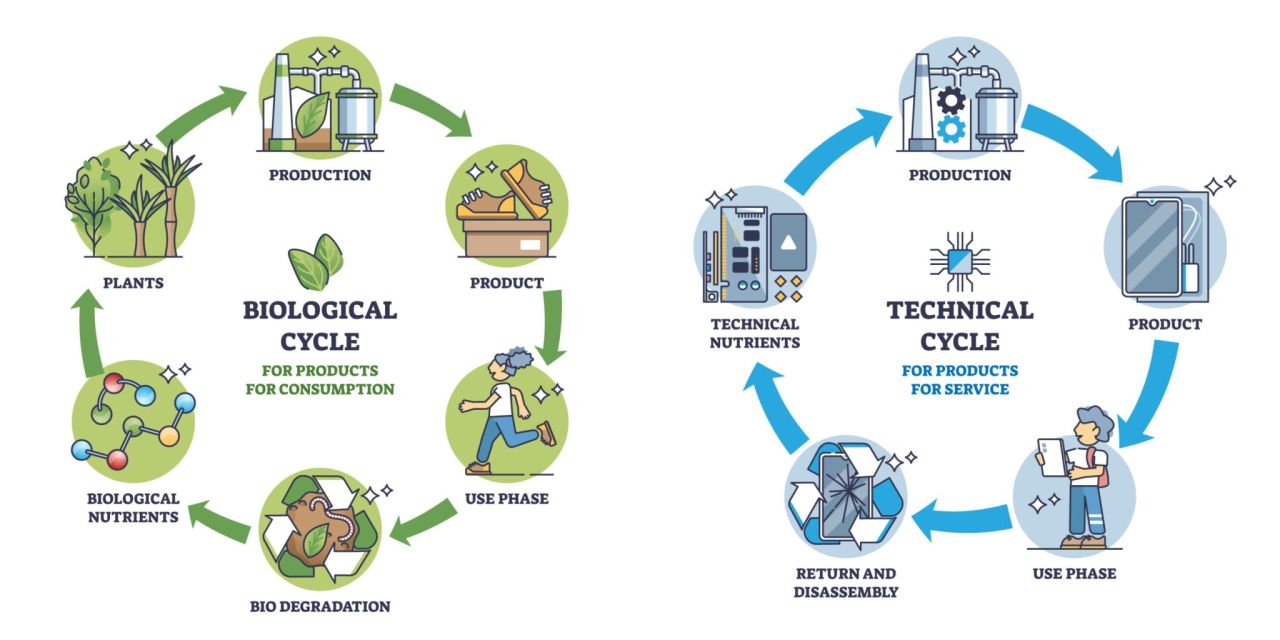
The principle distinguishes between two basic cycles:
- The biological cycle: Consumables (e.g. packaging made from natural fibres, cleaning products) are designed to be safely returned to the biosphere after use, where they serve as biological nutrients – they compost and become humus.
- The technical cycle: Consumer goods (e.g. machines, shelving systems, components of a hall) are designed in such a way that their materials can be separated by type after use and reused for new products in consistently high quality (upcycling). They circulate permanently as technical nutrients.
Question & Answer: Isn't C2C just better recycling?
No, the approach goes decisively further. Classic recycling is often a downcycling process. For example, a high-quality PET bottle is used to produce low-quality granules that may still be suitable for a park bench, but no longer suitable for a new bottle. The material quality decreases with each cycle until the raw material has to be disposed of as waste in the end.
C2C, on the other hand, promotes upcycling. This means that the quality of the raw materials is maintained or even improved over countless cycles of use. A central aspect of this is material health: from the outset, only materials that are free of toxic or harmful substances are used. This prevents pollutants from circulating and accumulating in the cycles.
The logistics property as a raw material depot: C2C in hall construction
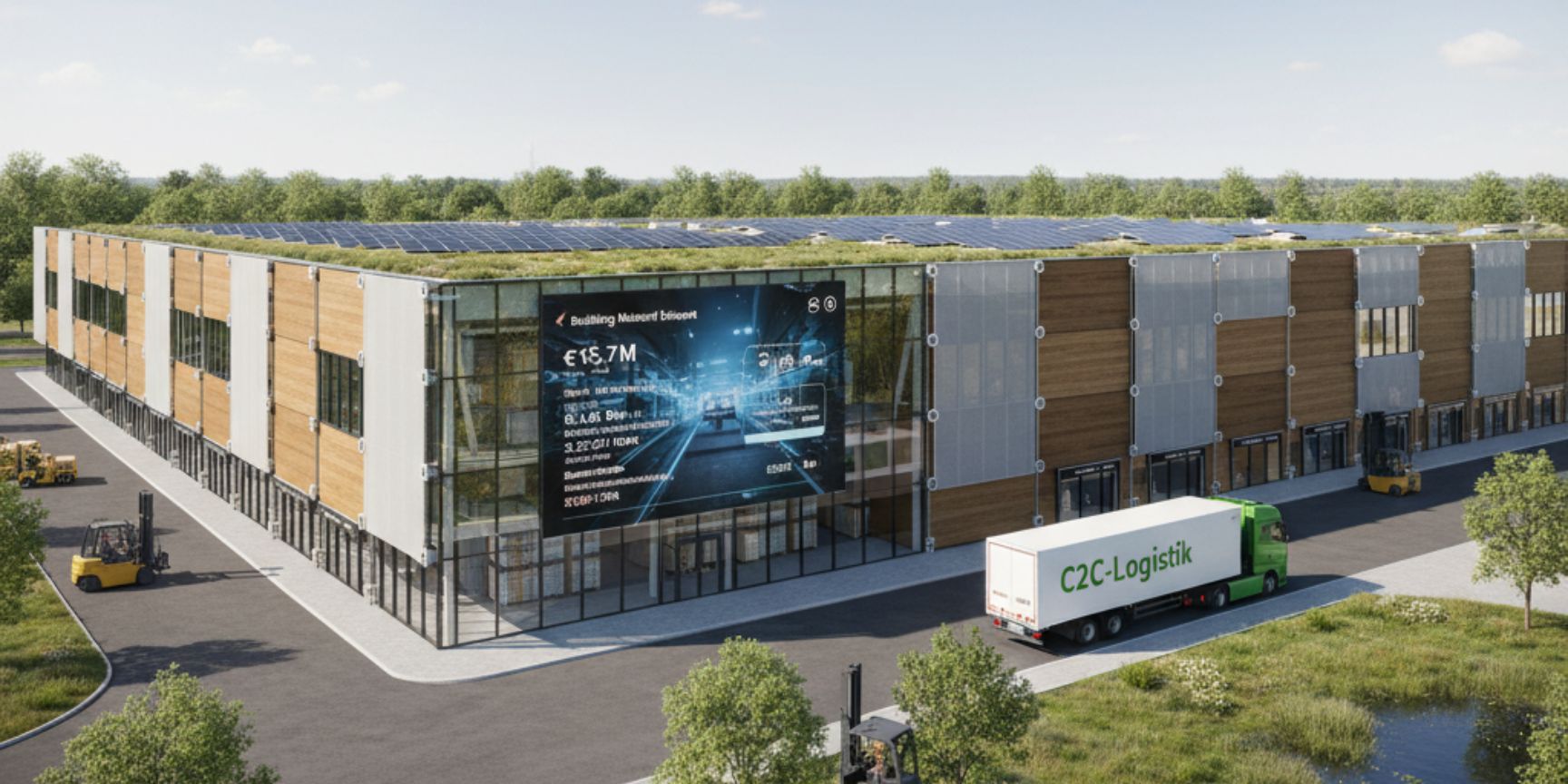
The application of C2C to logistics real estate is one of the most powerful levers for sustainability in the industry. A warehouse or transshipment hall planned according to C2C criteria is no longer seen as a cost factor that is demolished after 30 years, but as a valuable material depot.
Practical implementation:
- Design and choice of materials: Instead of composites, which are inseparably glued, removable connections (screws, clamps) are preferred. Healthy, recyclable materials are used, such as steel beams without harmful coatings, pure, untreated wood or insulation materials made from recycled and recyclable materials.
- Modularity: The hall is constructed from standardised, modular elements. Façade parts, roof elements or partition walls can be easily replaced, expanded or rebuilt at another location if necessary.
- Building Material Passport: Each material used is documented in detail in a digital passport – including its chemical composition, quantity and potential resale value. This makes the property a transparent commodity bank. In this way, the owner knows exactly how many tons of steel or aluminum are "stored" in his building.
A study by consulting firm EPEA found that the residual value of materials in a C2C building can be as high as 25% of the original construction costs after 50 years , while a conventional property often only has demolition costs.
Question & Answer: How does a logistics hall become a "material bank"?
By planning it from the outset as a temporary accumulation of valuable raw materials. The key is "Design for Disassembly" (DfD) – designing for disassembly. Instead of welding, screws are used. Instead of sticking, it is plugged in. Each component is designed in such a way that it can be removed easily, damage-free and sorted at the end of its service phase. The material passport then provides the "inventory list" for this bank. This turns demolition into a raw material harvest and the property retains a significant material value.
C2C in warehouse and contract logistics: More than just green walls
The C2C principles can also be transferred to the operational processes in warehouse and contract logistics. The aim here is to close the loops for goods, packaging and operating materials.
- Intelligent packaging solutions: The focus is on the development and use of reusable transport packaging (MTV) made of C2C-certified materials. A contract logistics provider can manage a pool system for pallets, boxes or containers for its customers, which are taken back, cleaned and returned to the cycle after use. At the end of their life cycle, they are not disposed of, but returned to the manufacturer, who uses them to produce new, equivalent packaging.
- Take-back systems: As a logistics service provider, you can play an active role in the take-back logistics of products. For a manufacturer of electronic devices, the contract logistics company could organize not only the distribution, but also the collection, sorting and return of old equipment to the producer, where the technical nutrients are recovered.
- Equipment: The C2C concept can also be applied to equipment such as forklifts or conveyor technology. Leasing or operator models, in which the manufacturer remains the owner, create an incentive to make the equipment durable, easy to repair and ultimately fully recyclable.
What are the concrete advantages and challenges of C2C in logistics?
Advantages:
- Cost-effectiveness: Long-term independence from volatile raw material markets and rising disposal costs. The value of the logistics property will be retained.
- Resilience: Supply chains are becoming more robust as people rely on circulating materials instead of finite resources.
- Marketing & Reputation: A demonstrably sustainable business model is increasingly becoming a decisive competitive advantage in the awarding of logistics contracts and in the recruitment of skilled workers.
- Future-proofing: C2C buildings and processes already meet future legal requirements (e.g. EU taxonomy) and secure the long-term value of assets.
Challenges:
- Initial investment: The planning and construction of a C2C logistics property can be more cost-intensive at first, even if this pays for itself over the life cycle.
- Availability: C2C-certified materials and components are not yet available nationwide and are available in all variants.
- Rethinking required: C2C requires close cooperation between all players along the value chain – from material manufacturers and architects to logistics service providers and their customers.