




Carousels in the warehouse
Table of Contents
- What is a carousel (paternoster)? A definition
- The functional principle: Vertical efficiency in practice
- The key benefits for logistics
- Critical Consideration: Disadvantages and Limitations of the System
- The use from the perspective of warehouse, contract logistics and logistics real estate
- FAQ: Answers to frequently asked questions from planning
What is a carousel (paternoster)? A definition
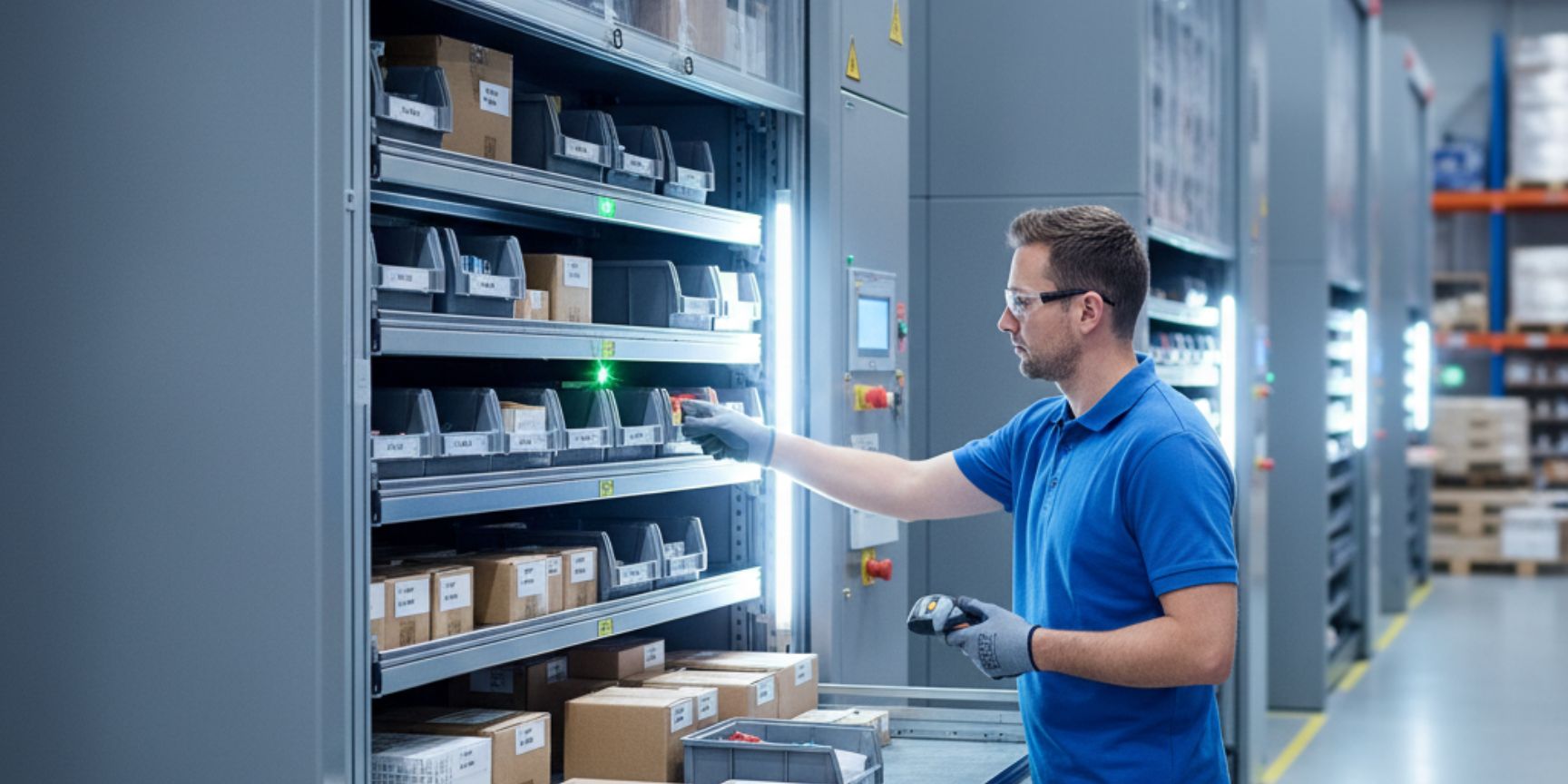
A carousel rack, colloquially known as a paternoster, is an automated, dynamic storage system for storing and picking small parts. The basic principle is similar to that of a Ferris wheel: several carrying sets (shelves or special product carriers) are attached to a vertically circumferential chain. At the request of an operator, the system rotates along the shortest path in order to transport the desired load set into an ergonomically favourable removal opening.
This system belongs to the family of dynamic storage systems and works according to the "goods-to-person" (WzP) principle. This is in contrast to static shelving systems, where the employee has to go to the goods ("person-to-goods"). The closed design protects the stored goods from dust, damage and unauthorized access.
The functional principle: Vertical efficiency in practice
The operation of a carousel rack is very simple. The employee enters the number of the desired item or storage location on a control unit (often a touchscreen or an interface linked to the warehouse management system). The internal logic of the paternoster calculates the shortest path – either forward or backward – and sets the drive chain in motion. Within seconds, the correct shelf appears in the operating opening. Modern systems can also support the picking process with light pointers (pick-by-light) that indicate exactly the compartment from which an article is to be removed.
Question from practice: How fast is such a system really?
Answer: The rotation speed is typically around 0.2 to 0.3 meters per second. With a common device height of 6 meters, it takes only 10 to 15 seconds in the worst case (half a turn) until the requested item is ready. However, the real time savings lie in the elimination of walking and searching routes for the employee.
The key benefits for logistics
Carousels offer a number of advantages that make them extremely attractive for specific applications:
- Maximum use of space: The most decisive advantage is the enormous space savings. By using the full height of the hall, the required floor space can be reduced by up to 80% compared to conventional shelving systems . A logistics property is thus optimally utilised in the third dimension – height.
- Increased picking performance: By eliminating running and search times, pick rates can be increased by two to four times. The employee can concentrate fully on the picking process.
- High ergonomics and occupational safety: The goods are always presented at an ideal working height (approx. 80-100 cm). bending, stretching or climbing ladders are completely eliminated. This reduces the physical strain and reduces the risk of accidents.
- Inventory security and control: The closed system protects the items from environmental influences and theft. In conjunction with a warehouse management system (WMS), almost error-free inventory management and picking is achieved.
Critical Consideration: Disadvantages and Limitations of the System
Despite the significant advantages, the carousel is not a one-size-fits-all solution. The following disadvantages must be taken into account when planning:
- High investment costs: The acquisition costs are significantly higher than with static shelving systems. The investment must pay for itself through efficiency gains and space savings.
- Low flexibility: Once installed, a carousel is a stationary system that can only be moved or reconfigured with great effort. Changes in the range of articles can be problematic.
- Throughput limitation: As a rule, only one person can work on a paternoster at a time. The system represents a potential bottleneck ("single point of failure"). If the device fails, access to all items stored in it is blocked.
- Weight and volume limitations: Carousels are designed for small parts. The maximum payload per load set is typically between 150 kg and 650 kg, depending on the model. Bulky or very heavy goods cannot be stored.
The use from the perspective of warehouse, contract logistics and logistics real estate
The valuation of a carousel changes depending on the logistical point of view:
- From a warehouse logistics perspective: The system is ideal for managing C-parts, tools, spare parts or other small-scale but varied assortments. It often serves as a highly efficient buffer or consolidation warehouse directly in the production or shipping area. The high picking accuracy significantly reduces error rates.
- From a contract logistics (3PL) perspective: For logistics service providers serving customers in industries such as e-commerce, pharmaceuticals or electronics, paternosters are extremely valuable. They enable multi-tenant storage of many different SKUs (Stock Keeping Units) in a confined space. Value-added services such as labeling, kitting or quality control can be carried out directly at the point of withdrawal.
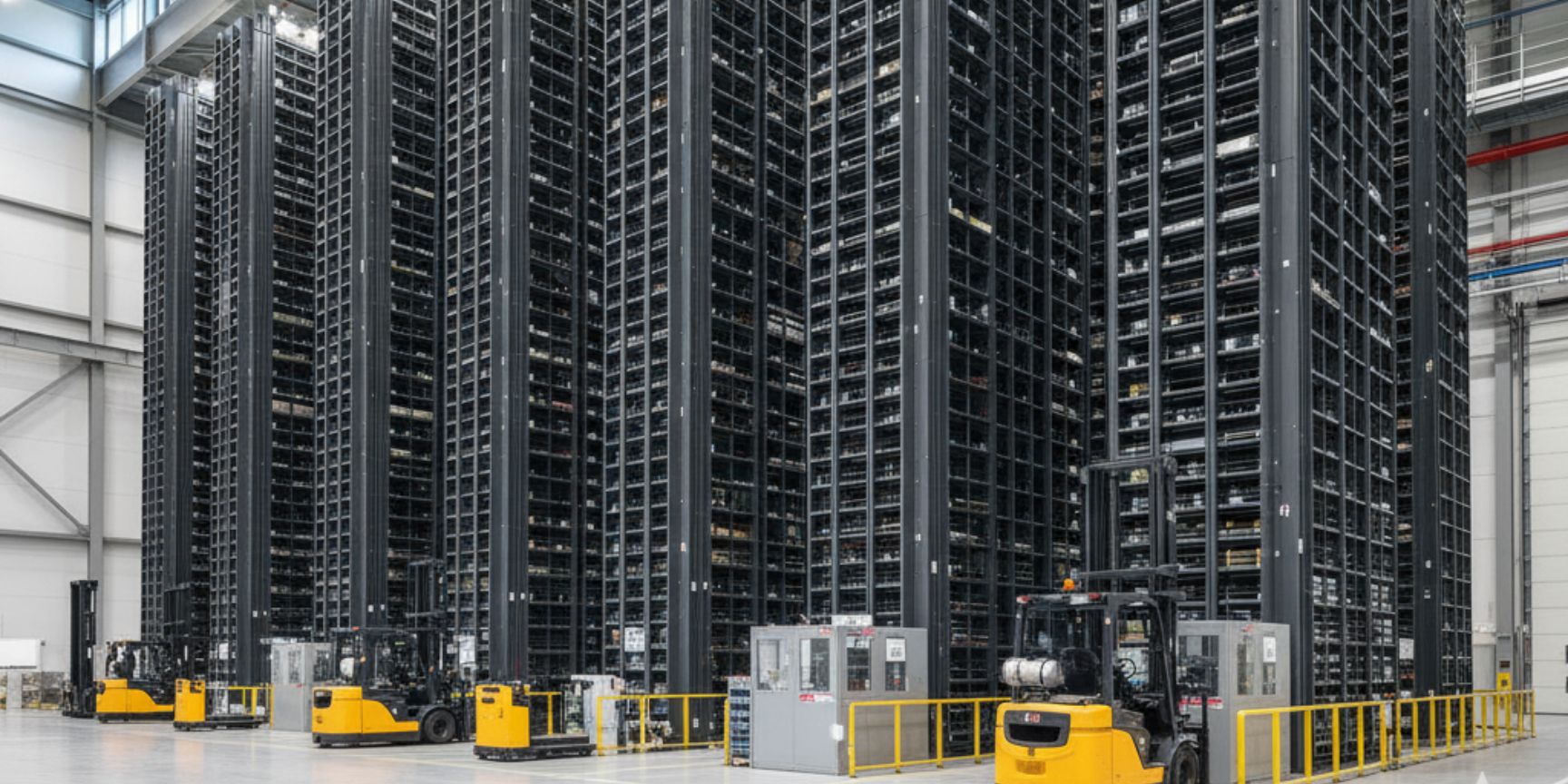
- From the perspective of logistics real estate: carousels change the criteria for a suitable hall. The sheer number of square metres takes a back seat, while the usable hall height becomes the decisive factor. A property with a clear height of 12 meters can achieve a storage density with paternosters that would otherwise require twice or three times the floor space. This maximizes the value per cubic meter and can provide the decisive competitive advantage in regions with high land prices. At the same time, the soil load capacity must be tested, as the weight of the system is very high in some places.
FAQ: Answers to frequently asked questions from planning
Question: When does it pay off to invest in a carousel rack?
Answer: Amortization is usually achieved when one or more of the following are true:
- High land or rental costs per square meter.
- Existing warehouse space is used to capacity and expansion is expensive or impossible.
- A high picking frequency and accuracy for small parts are process-critical.
- The focus is on ergonomic requirements and the reduction of stress for employees.
Question: How is a paternoster integrated into the existing IT infrastructure?
Answer: The connection is made via standardized interfaces. In the simplest case, the device works autonomously with its own, simple storage space management. However, full efficiency is achieved through the direct connection to a higher-level warehouse management (WMS) or ERP system. Picking orders are then transmitted directly to the device controller, which automates and optimizes the process.