



Climate neutrality in warehouse logistics
Table of contents
- Definition: What does climate neutrality mean in the logistics context?
- The logistics property: From energy consumer to green power plant
- Intralogistics and operational warehouse logistics: Efficiency in detail
- Contract logistics: The challenge of Scope 3 emissions
- Facts, figures, data: Where do we stand?
- Q&A – Practical questions on implementation
- Glossary: Important technical terms briefly explained
- Conclusion: The path to "net zero"
Definition: What does climate neutrality mean in the logistics context?
Climate neutrality describes a state in which the greenhouse gas emissions caused by an activity (e.g. the operation of a logistics centre) are zero through reduction or offsetting. Technically, a distinction must be made between "climate neutral" and "net-zero". While carbon neutrality is often achieved through offsetting (certificates), the Science Based Targets initiative's (SBTi) net-zero standard requires a physical reduction of emissions of at least 90% before the rest is offset.
For logistics, this means the decarbonization of the entire chain: from the heating of the hall to the electricity for the conveyor technology to packaging and upstream and downstream transport.
The logistics property: From energy consumer to green power plant
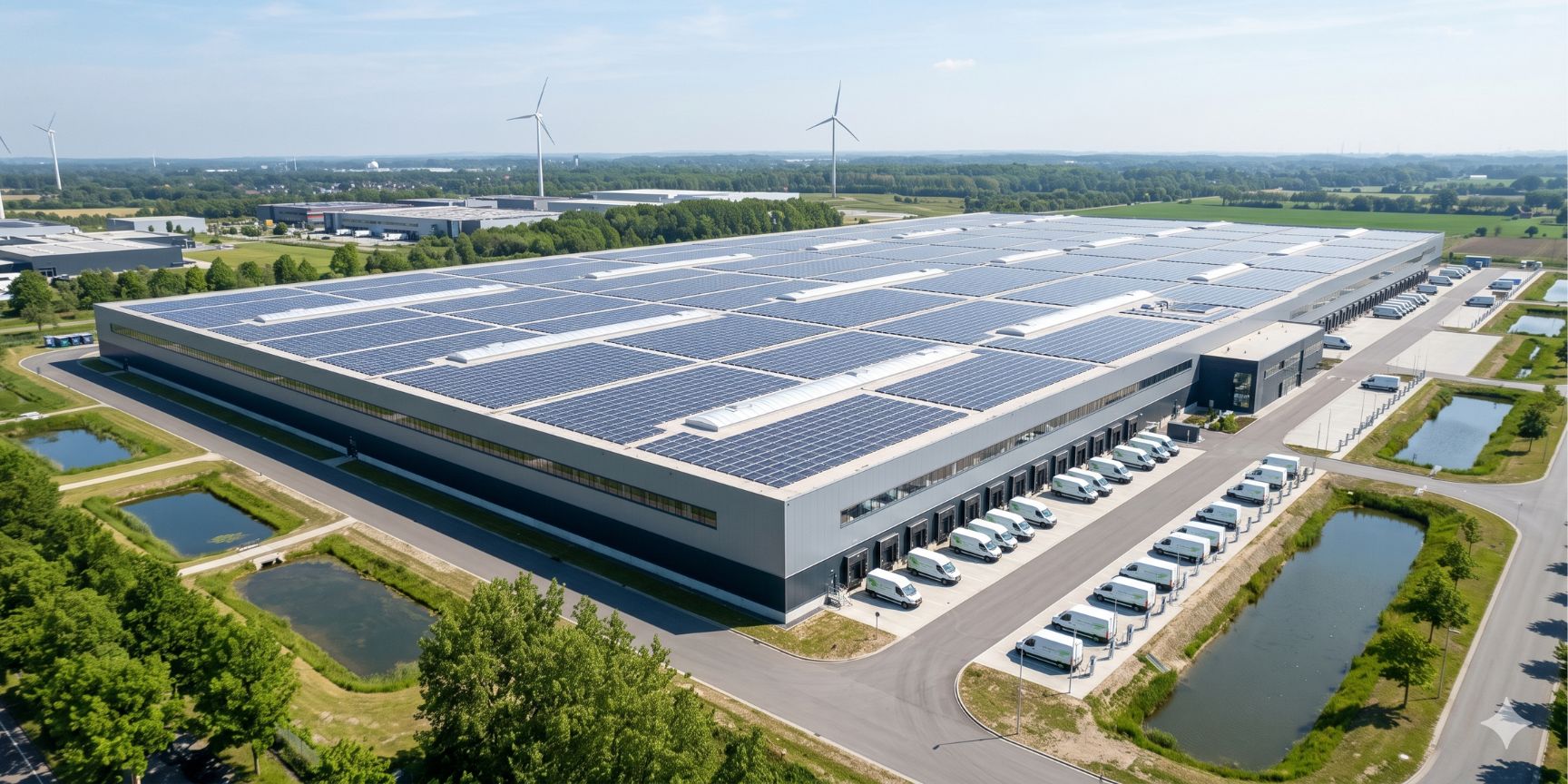
Logistics real estate plays a key role, as it often remains in the portfolio for decades. This is where the concept of "green buildings" comes into play.
- Energy-efficient building envelope: Modern halls aim for U-values (heat transfer coefficient) of less than 0.20 W/(m²K) for roofs and walls.
- Photovoltaics (PV): A standard logistics hall offers huge roof areas. A 10,000 m² hall can generate around 900,000 to 1,000,000 kWh of green electricity annually with a 1 MWp system – often more than is necessary for in-house operation (lighting, IT, forklifts).
- Heat pumps & radiant heaters: Avoiding fossil fuels (gas) is essential. Air-to-water heat pumps in combination with underfloor heating in the logistics zones are becoming standard.
Intralogistics and operational warehouse logistics: Efficiency in detail
In warehouse logistics, the levers for reducing emissions lie primarily in automation and fleet management.
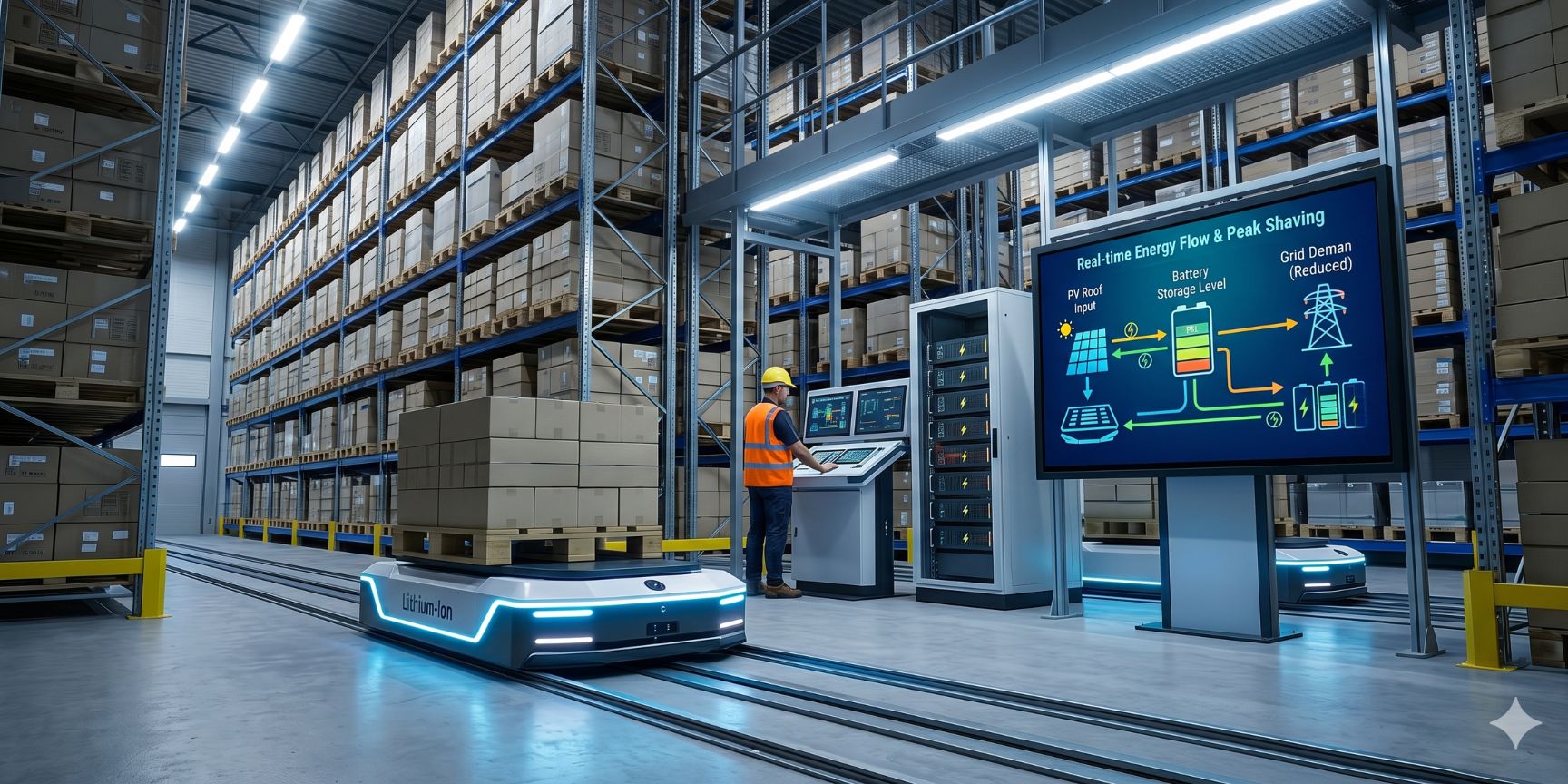
- Lithium-ion technology: Switching from lead-acid to Li-ion batteries improves efficiency by about 20-30% and enables efficient intermediate charging, ideally coupled with PV power peaks.
- Energy management systems (EMS): Intelligent software controls peak shaving. If 50 forklifts are charging at the same time, this puts a massive strain on the network; an EMS distributes the charging processes.
- Regenerative energy: Modern storage and retrieval machines (SRMs) in high-bay warehouses use the energy released during braking or lowering (recuperation) to feed it back into the internal grid.
Contract logistics: The challenge of Scope 3 emissions
In contract logistics, balancing becomes complex, as the service provider is often caught between the requirements of shippers (customers) and its own climate targets. This is where the GHG Protocol (Greenhouse Gas Protocol) comes into play:
- Scope 1: Direct emissions (own heating, own truck fleet).
- Scope 2: Indirect emissions from purchased energy (electricity, district heating).
- Scope 3: Indirect emissions in the value chain (purchased transport, waste, employee commuting).
For contract logistics companies, more than 70% of emissions are often attributable to Scope 3. Climate neutrality can only be achieved here through close cooperation with subcontractors and the optimization of packaging materials (circular economy).
Facts, figures, data: Where do we stand?
To illustrate the depth of the topic, it is worth taking a look at the key figures:
- CO2 equivalents (CO2e): Not only CO2 counts, but also methane or refrigerants from cold stores.
- Lighting: Switching from conventional light sources to LED with sensor control reduces electricity consumption in halls by up to 80%.
- Land sealing: Climate neutrality increasingly includes biodiversity. Compensation areas and green roofs are part of the ESG assessment of logistics properties.
- Certifications: DGNB (Gold/Platinum) or BREEAM are the currency in which the sustainability of a property is measured.
Q&A – Practical questions on implementation
Question: Is climate neutrality in logistics economically viable?
Answer: In the short term, the investment costs (capex) increase by about 10-15% (e.g. due to PV systems and heat pumps). In the long term, however, operating costs (opex) will be reduced by using our own electricity and being independent of CO2 taxes (BEHG). In addition, banks are increasingly demanding proof of taxonomy compliance for financing.
Question: Can an existing property become climate-neutral?
Answer: Yes, through "brownfield revitalization". This includes retrofitting LEDs, renovating the roof for PV, and replacing gas heaters with electrical systems. It is often more sustainable than a new building, as the "grey energy" (CO2 bound in the concrete) is retained.
Question: Is green electricity sufficient to be climate-neutral?
Answer: From a purely accounting point of view, yes for Scope 2. But for a real transformation, Scope 1 (heating/fleet) must also be decarbonized. Today, simply changing the electricity tariff is often considered greenwashing if efficiency measures are not implemented at the same time.
Glossary: Important technical terms briefly explained
- CSRD (Corporate Sustainability Reporting Directive): New EU directive that obliges logistics companies to report on sustainability in detail.
- Embodied energy: The amount of energy needed to build, transport, and demolish a building.
- Load management: Control of electricity consumption to avoid expensive and CO2-intensive grid peaks.
- Zero-emission warehouse: A warehouse that emits no greenhouse gases during operation (usually purely electrically operated).
Conclusion: The path to "net zero"
Climate neutrality in warehouse and contract logistics is a multi-stage process. It begins with avoidance (efficiency), continues with substitution (renewable energies) and ends with the compensation of unavoidable residues. For specialists in the field of logistics real estate, this means understanding the building as part of an overall energy system. Those who do not invest in the direction of climate neutrality today risk "stranded assets" – properties that become unrentable or unsaleable due to poor CO2 levels.