




Brownfield in warehouse construction
Table of Contents
- Definition: What is brownfield bearing construction?
- Driver: Why brownfield developments in logistics are on the rise
- The brownfield analysis: technical and legal due diligence
- Challenges and risks of revitalization
- Opportunities: The strategic advantages for warehouses and logistics properties
- Greenfield vs. Brownfield: Strategic Comparison (Logistics Focus)
- Questions and Answers (Q&A) on Brownfield Warehouse Construction
- Conclusion: The future of logistics real estate is (often) brown
Definition: What is brownfield bearing construction?
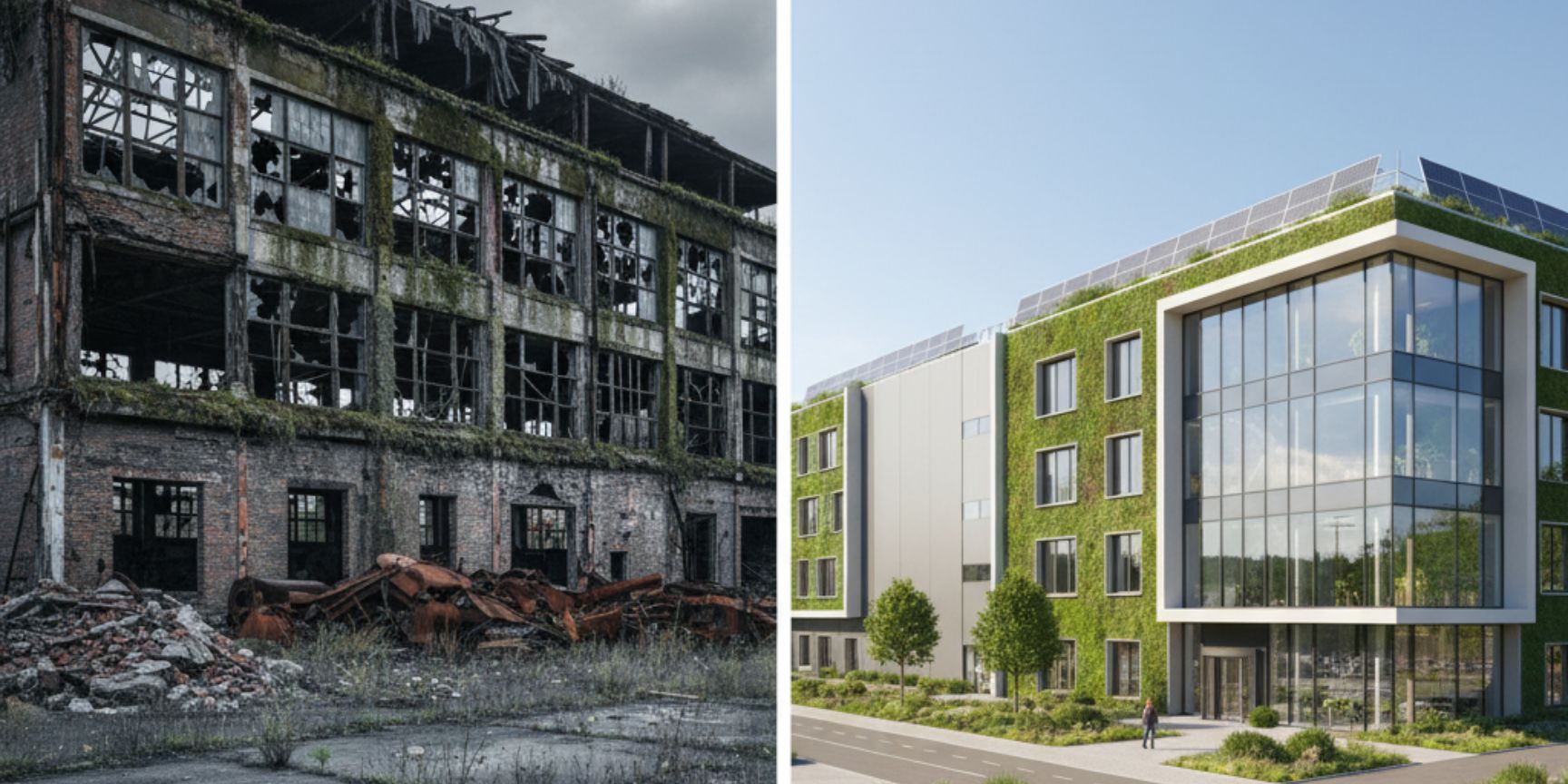
In the context of real estate development, the term brownfield (literally: "brown field") refers to land that has already served a previous use – usually of an industrial or commercial nature – and is now lying fallow. These areas are often affected by previous use, whether by existing buildings (building remains, foundations) or by contamination in the soil (contaminated sites).
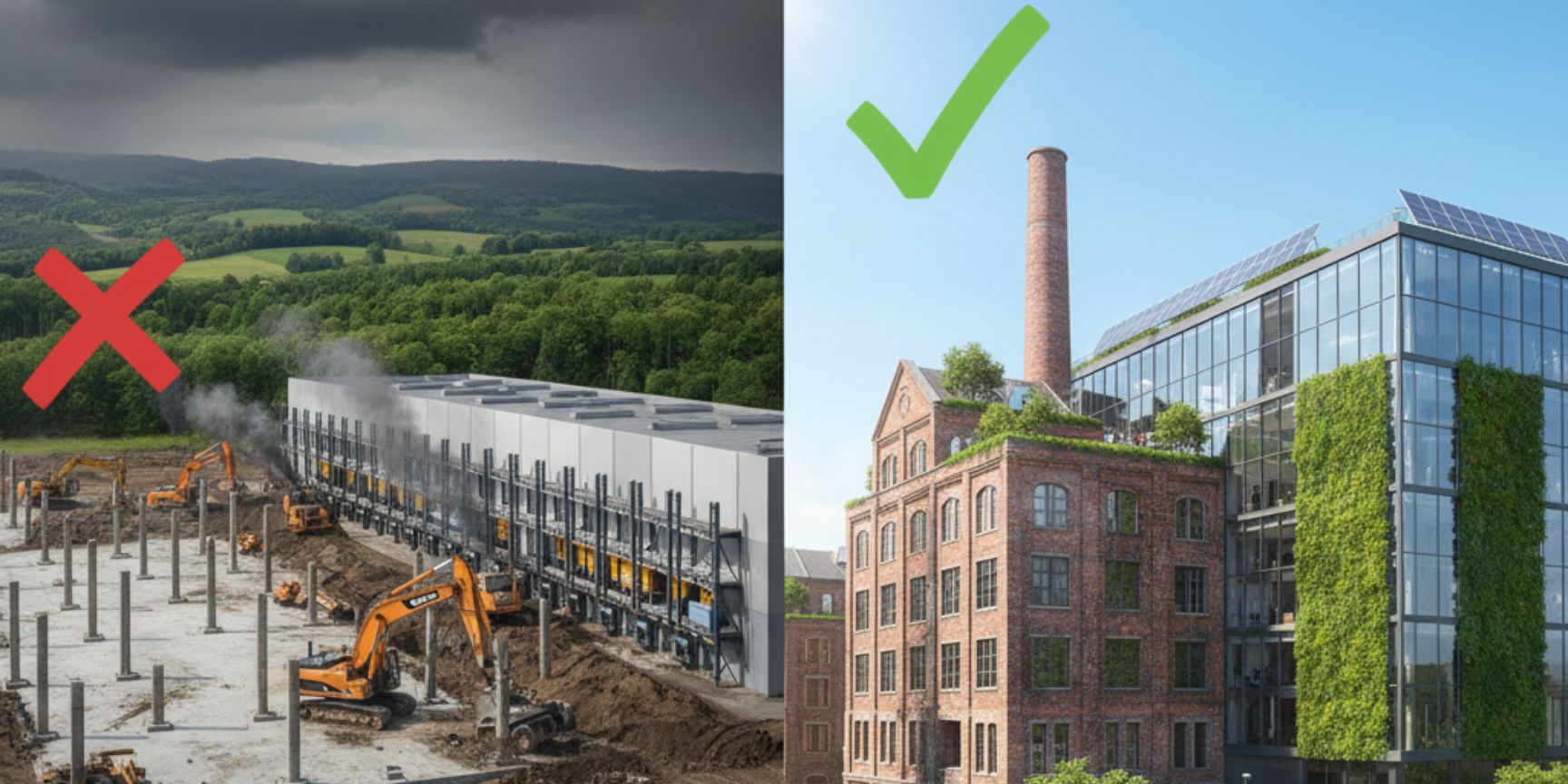
In contrast to this is greenfield , which describes completely undeveloped, often agriculturally used areas.
In warehouse construction and in the logistics real estate industry, brownfield development means in concrete terms:
- The demolition of old factory halls, freight yards, military barracks or utility plants.
- The subsequent remediation (decontamination) of the soil.
- The construction of a new modern logistics facility (warehouse, transshipment centre, distribution centre) on the revitalised site.
Driver: Why brownfield developments in logistics are on the rise
The trend towards brownfield use is not a fad, but an economic and ecological necessity, driven by several factors:
- Acute shortage of space: Especially in top logistical regions and conurbations, greenfield space is hardly available or extremely expensive. However, contract logistics and e-commerce providers need strategically well-located space for the "last mile" and fast distribution.
- ESG criteria: Investors, banks and, increasingly, tenants (contract logistics companies, retailers) are demanding compliance with sustainability standards (environmental, social, governance). The reactivation of a brownfield site instead of the sealing of a new green space ("net zero sealing") pays off massively on the "E" component.
- Political control: Municipalities and state governments are severely restricting the designation of new commercial areas on greenfield sites. They favor inner development and the removal of "eyesores" in the cityscape, which brownfields often are.
- Existing infrastructure: Brownfields often already have excellent connections to roads (near the highway), rails or even waterways – infrastructure that would often have to be created at great expense in greenfield projects.
The brownfield analysis: technical and legal due diligence
The purchase of a brownfield site is much more complex than that of a greenfield site. The success of the project stands and falls with meticulous due diligence (DD). The following checks are essential for logistics real estate developers:
- Technical DD (TDD): This is about the physical condition. How complex is the demolition (e.g. solid foundations, bunkers)? What building fabric is available (e.g. asbestos)?
- Environmental DD (EDD): This is often the most critical point. Historical research (What was produced here?) and soil surveys (grid sampling) must clarify the extent and type of contaminated sites . Is it heavy metals, mineral oil hydrocarbons (MKW) or volatile chlorinated hydrocarbons (HCCs)? Renovation procedures and costs depend on this.
- Legal DD (LDD): The development plan (B-Plan) is decisive. Does it allow the intended use of "logistics"? Old B-plans are often designed for "manufacturing" (GE) or "industry" (GI). 24/7 logistics use (three-shift operation) can lead to noise protection conflicts with nearby residential buildings and require a B-plan change, which costs time.
Challenges and risks of revitalization
Brownfield projects involve significant risks that must be taken into account in the project calculation for the new warehouse:
- Cost risk of contaminated sites: Remediation is the biggest factor of uncertainty. The cost of excavation, transport to specialty landfills, or in-situ remediation procedures (e.g., soil fume extraction) can explode if unexpected "hotspots" (highly contaminated areas) are found.
- Cost risk demolition: The dismantling of existing buildings, especially in the case of pollution (asbestos, PCBs), is expensive and time-consuming.
- Time delay: The remediation and the complex approval procedure (BImSchG – Federal Immission Control Act) often take longer than with greenfield projects. For a contract logistics company that has promised a customer a fixed "go-live" deadline for a new warehouse, this is critical.
- Building law hurdles: As mentioned, the conversion of an old industrial site into a modern logistics hub (with high truck traffic) can meet with resistance or require complex expert opinions (noise, traffic).
Opportunities: The strategic advantages for warehouses and logistics properties
Despite the risks, the opportunities that a revitalized space offers for warehouse logistics often outweigh the risks for specialized developers:
- Excellent locations: Brownfields often offer the "last available space" in prime locations (e.g. old freight yards near the city centre). This reduces transport costs and enables late cut-off times in contract logistics.
- Faster building law (potential): If the area is already designated as an industrial or commercial area (GI/GE) and the contaminated site problem is clearly defined, the approval procedure (according to BImSchG or building law) can paradoxically be faster than a lengthy B-plan preparation for a greenfield.
- Sustainability narrative: A remediated area is a strong selling point. The logistics property can be marketed as "ESG-compliant", which attracts institutional investors and ensures rentability to logistics service providers with strong credit ratings (often listed on the stock exchange).
- Acceptance: The removal of an industrial wasteland ("eyesore") often generates a positive response from municipalities and residents, which increases political support for the new logistics center.
Greenfield vs. Brownfield: Strategic Comparison (Logistics Focus)
| Criterion | Greenfield (Grüne Wiese) | Brownfield |
| Location quality | Often peripheral (B/C locations), far away from conurbations. | Often urban (A-location), close to consumers and workers. |
| Space costs (purchase) | High to very high (speculation, scarcity). | Often lower (due to the need for renovation), but increasing. |
| Development costs | High (roads, canal, electricity often have to be replaced). | Low (infrastructure usually available, may need to be upgraded). |
| Construction costs (preparation) | Low (topsoil removal only). | Very high (demolition, disposal, soil remediation). |
| Approval risk | High (environmental assessment, citizens' initiatives against land sealing). | Medium to High (depending on B-Plan and noise issue). |
| Contaminated site risk | Almost zero. | High to Very High (calculation risk). |
| Project duration (planning) | Often very long (B-plan procedure takes years). | Often shorter if B-plan law for logistics already exists. |
| ESG Profile | Weak (high surface sealing). | Strong (revitalization, no resealing). |
Questions and Answers (Q&A) on Brownfield Warehouse Construction
Question 1: Is a brownfield project always more expensive than a greenfield project at the end of the day?
Answer: Not necessarily. While the construction costs (demolition, renovation) are significantly higher in brownfields, the land costs can be lower. If you look at the total cost of ownership (TCO) including the subsequent operating costs (e.g. transport costs), a more expensive brownfield project in an A location can be more economical in the long run than a cheaper greenfield project in a C location due to the proximity to the customer and the reduction of transport routes.
Question 2: What is the difference between brownfield and greyfield?
Answer: The demarcation is fluid. Brownfields are primarily areas with suspected (or confirmed) environmental contamination that need to be remediated (e.g. old chemical plants, tank farms). Greyfield is the term used to describe "underused" existing properties without significant environmental pollution (e.g. vacant supermarkets, old furniture stores), which primarily require demolition or a far-reaching conversion (revitalisation), but no soil remediation.
Question 3: What role do logistics service providers (contract logistics providers) play in the development?
Answer: A decisive one. Project developers often develop "speculatively" (without a fixed tenant). With brownfields, however, the risk is high. Therefore, many brownfield warehouses are realized as a build-to-suit (BTS) solution. The developer only secures the property when a logistics service provider signs a long-term lease (often 10-15 years) for the hall specifically tailored to him. The tenant (logistics provider) benefits from the top location, the developer minimizes his rental risk.
Conclusion: The future of logistics real estate is (often) brown
In view of the political goals to reduce land sealing and the de facto shortage of A-location plots, brownfield development is no longer a niche topic, but a central building block for the growth of warehouse logistics in Germany and Europe. It requires a high level of specialist knowledge in the areas of renovation, construction law and project management. The ability to manage complex risks (especially contaminated sites) and to reactivate space in prime locations is becoming a decisive competitive advantage for developers of logistics properties.
Your Ideal Logistics Warehouse
Browse listings for warehouse space, logistics real estate, industrial land, and contract logistics solutions.
Browse Exposés
Maximize Exposure for Your Warehouse Space
Showcase your logistics properties and attract qualified inquiries.
Discover Products