




Building Mass Ratio (BMR) in logistics
Table of Contents
- Definition and building law basis of the Building Mass Ratio (BMR)
- BMR from the perspective of logistics real estate: volume instead of area
- Differentiation: GAR, FAR and BMR in comparison
- Practical relevance for high-bay warehouses and silo construction
- Calculation of the building mass according to DIN 277 vs. BauNVO
- Questions and Answers (Q&A) on BMR in Logistics
- Strategic importance for contract logistics and intralogistics
- Conclusion: BMR as a key indicator
Definition and building law basis of the Building Mass Ratio (BMR)
The Building Mass Ratio (BMR) or Cubic Capacity Ratio is a key figure for structural use that indicates how many cubic metres of building mass are permissible per square metre of land area. It is anchored in German building law, specifically in § 21 of the Building Use Ordinance (BauNVO).
While in residential construction the Floor Area Ratio (FAR) is often the measure of all things, in commercial and industrial construction – especially in logistics – the BMR is coming into focus. It is used if a limit on the height or the number of storeys alone is not sufficient or if, as is usual with logistics halls, no classic full storeys are formed.
The formula for the calculation is:
Building Mass Ratio (BMR) = Permissible building volume (in m3) / Size of the building plot (in m2)
An example: On a large logistics site with a fixed BMR of theoretically, enclosed space may be built.
 in der Logistik_1.jpg)
BMR from the perspective of logistics real estate: Volume instead of area
For developers of logistics properties, contract logistics companies and investors, the area (square meters) is important for handling, but the volume (cubic meters) is the currency for storage capacity.
In warehouse logistics, yield correlates directly with pallet space capacity. A hall with a floor area and a height of 6 metres (block warehouse) has a completely different utility value than a hall of the same floor area with a height of 12 metres (narrow-aisle warehouse) or even 40 metres high (automatic high-bay warehouse).
This is where the BMR becomes a limiting factor. In development plans (B-plans) for commercial areas (GE) or industrial areas (GI), the BMR often defines the upper limit of structural utilisation even before clearance areas or height limits take effect.
Differentiation: GAR, FAR and BMR in comparison
In order to fully understand the relevance of BMR, it must be distinguished from the other indicators:
- Ground Area Ratio (GAR): Indicates the percentage of the property that may be sealed/built over (e.g. GAR 0.8 = 80% overbuilding). Important for traffic areas and courtyard areas in logistics.
- Floor Area Ratio (FAR): Specifies the ratio of the total floor area to the property area. Since modern logistics halls often only have a huge ground floor, the FAR often comes to nothing or does not reflect reality.
- Building Mass Ratio (BMR): Records the volume. It is the most precise instrument for "hall buildings", as these usually do not have full storeys in the classic sense (except for possibly retracted mezzanine levels).
Important fact: According to § 17 BauNVO, upper limits apply to the determination of the extent of structural use. In commercial areas and industrial areas, the BMR upper limit is usually 10.0. However, exceptions are possible if the B-Plan explicitly justifies this (e.g. for high-bay warehouses at specific locations).
Practical relevance for high-bay warehouses and silo construction
BMR is particularly critical of the planning of high-bay warehouses. A high-bay warehouse in silo construction can reach heights of 30 to 45 meters.
Calculation example: A plot of land is large. The GAR is 0.8 (so it is allowed to build over). If a 30-metre-high high-bay warehouse is to be built here on the maximum floor area, this would result in a volume of:
16.000 m2 × 30 m = 480.000 m3
The BMR needed would be:
480.000 m3 / 20.000 m2 = 24
Since the standard upper limit according to the BauNVO is 10.0, this project would not be eligible for approval in a normal commercial area. A project-related development plan or designation as an industrial area with explicit exemptions is required to achieve such volume densities. For contract logistics companies, a BMR that is too low often means that they have to build in width (land grabbing) instead of upwards, which increases travel times and reduces process efficiency.
Calculation of the building mass ratio according to DIN 277 vs. BauNVO
Caution is advised for the exact determination of the BMR. It's not just the internal volume that counts.
According to § 21 para. 2 BauNVO, the building mass is calculated according to the external dimensions of the buildings from the floor of the lowest full floor to the ceiling of the top end.
- Not taken into account: components that are often not taken into account even in the Gross Floor Area (GFA) (e.g. subordinate components), as well as basements, unless they are recreation rooms or commercial use (although basements are rare in logistics).
- Roof shapes: For flat roofs (standard for logistics properties), the calculation is simple (length x width x height). In the case of sloping roofs, the volume is fully credited, which can be relevant for old existing properties.
Questions and Answers (Q&A) on BMR in Logistics
Question 1: Can the Building Mass Ratio be exceeded in a development plan?
Answer: Yes, exceedances are possible, but must be justified by urban planning (§ 17 BauNVO). Especially for logistics clusters ("logistics parks"), municipalities often designate higher BMZs in order to promote space-saving construction at heights. An exemption (§ 31 BauGB) in individual cases is difficult if the basic features of the planning are affected.
Question 2: What influence does BMR have on the price of land?
Answer: A massive one. A plot of land with a BMR of 9.0 is much more valuable for a logistics company than one with a BMR of 4.5, as he can realise twice the storage volume on the same soil. In standard land value maps, the value-relevant floor area number (WGFZ) is often replaced or supplemented by the BMR when it comes to commercial areas.
Question 3: Do mezzanine levels count as part of the building mass?
Answer: The building mass is an envelope volume. Whether you install one or three mezzanine levels (mezzanine floors for picking/VAS) within this envelope does not change the number of building masses, but it does change the floor area ratio (FAR). Since either FAR or BMR is often set in commercial areas (usually BMR for halls), the BMR is "mezzanine neutral".
Question 4: How does the BMR behave in the case of cold stores?
Answer: In cold stores, the wall thickness is significantly thicker due to the insulation. Since the BMR is calculated according to external dimensions, the insulation "eats" theoretically permissible internal volume. This must be taken into account in the tight calculation of storage capacity.
 in der Logistik_2.jpg)
Strategic importance for contract logistics and Intralogistics
In the tender for contract logistics services, a price is often calculated "per pallet" or "per pick". Real estate costs are a fixed block. A high BMR allows:
- Higher racks: Use of narrow-aisle forklifts or automatic systems.
- Lower land costs per cubic metre: Since land is scarce and expensive, high utilisation (high BMR) reduces the cost share of the individual storage space.
If a logistics property is to be considered "suitable for third-party use", a BMR of at least 8.0 to 10.0 is now standard in order to ensure a clear hall height of 10.5 m to 12.0 m (UKB - lower edge of truss) over the entire area that can be built on.
Conclusion: BMR as a key indicator
The number of building masses is much more than a bureaucratic hurdle in the building application. It is the indicator of the volume potential of a logistics location. For municipalities, it is a control instrument to regulate "blocks" in the landscape. For the logistics industry, it is the enabler of efficient, modern warehouse concepts. Anyone who evaluates, plans or operates logistics properties must not only know BMR, but also understand its interaction with plant technology (rack construction).
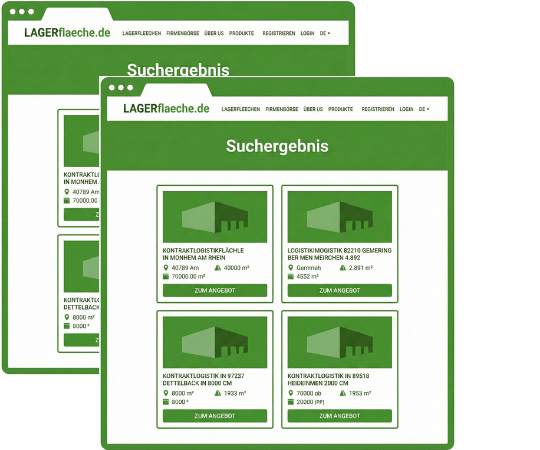
Your Ideal Logistics Warehouse
Browse listings for warehouse space, logistics real estate, industrial land, and contract logistics solutions.
Browse Exposés
Maximize Exposure for Your Warehouse Space
Showcase your logistics properties and attract qualified inquiries.
Discover Products