




Big Bag in Logistics
Table of Contents
- The Big Bag Phenomenon: More Than Just a "Big Bag"
- Design features and classifications (SF & SWL)
- Warehouse logistics: Requirements for the infrastructure and the logistics property
- Contract logistics: Outsourcing of filling and handling
- FAQ: Practice-relevant questions and answers
- Safety and dangerous goods (UN certification)
- Summary of key figures (fact check)
The Big Bag Phenomenon: More Than Just a "Big Bag"
By definition, a big bag, known as Flexible Intermediate Bulk Containers (FIBCs), is a flexible bulk container, usually made of robust polypropylene (PP) fabric. In the world of logistics real estate and industrial storage, it fills the gap between bagged goods (small containers) and silo transports (bulk).
A standard big bag carries loads from 500 kg to 2,000 kg with a dead weight of only a few kilograms. The ratio of dead weight to payload is unsurpassed, which makes it so attractive for contract logistics, where every gram of transport weight incurs costs.
Design features and classifications (SF & SWL)
To grasp the depth of the topic, one must understand the technical specifications. The Safety Factor (SF) and the Safe Working Load (SWL) are often discussed in specialist portals :
- SF 5:1 (disposable big bags): The container must withstand five times the weight of its load before it tears, but may only be filled once.
- SF 6:1 (reusable big bags): These are designed for several cycles.
- SF 8:1 (High Performance): Often required for the transport of dangerous goods (UN certification).
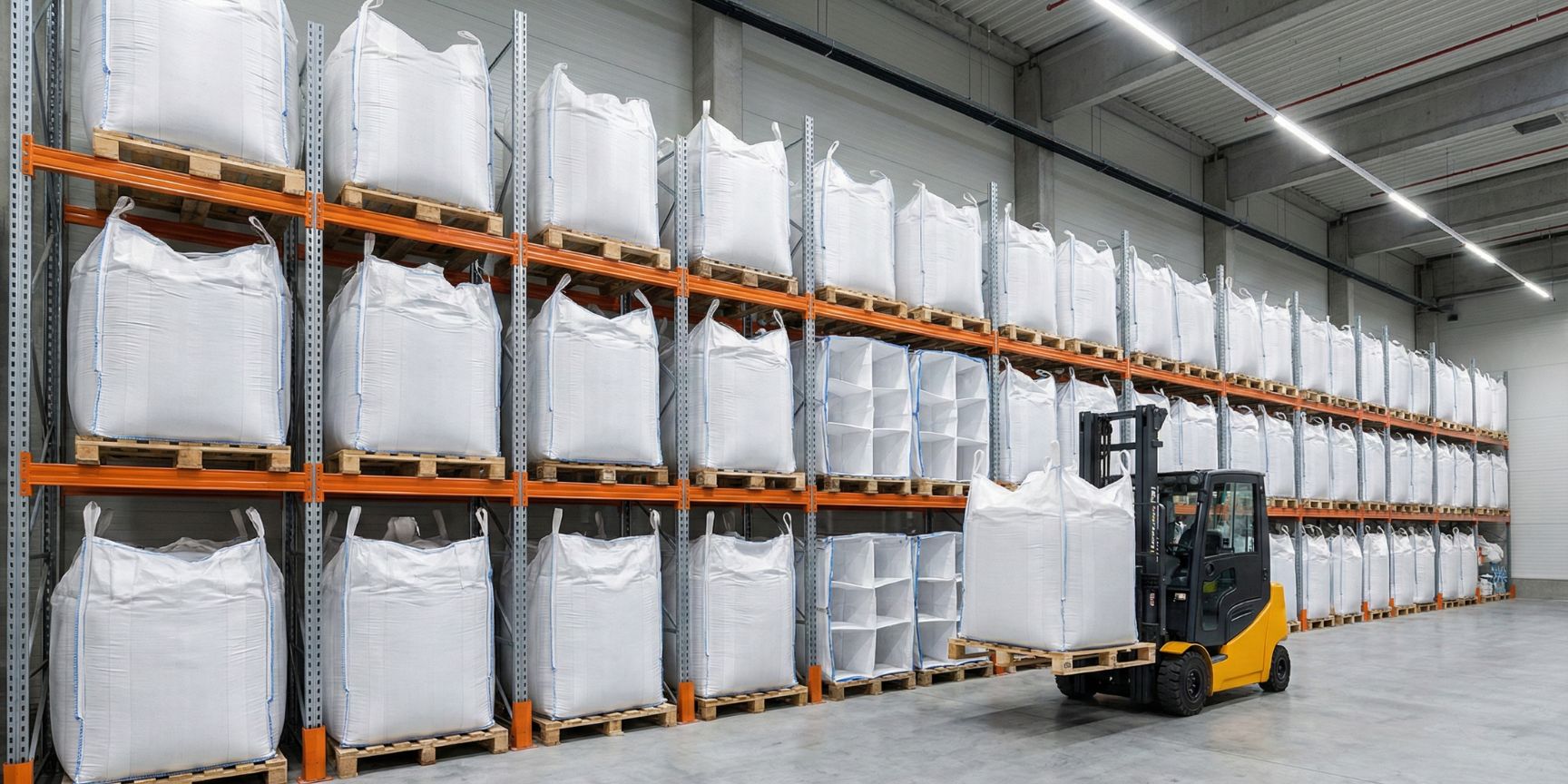
Dimensional stability is also crucial for warehouse logistics. So-called Q-Bags have internal struts (baffles) that prevent the bag from "bulging" after filling. This saves up to 25% storage space and ensures a clean stand image in the high rack.
Warehouse logistics: Requirements for the infrastructure and the logistics property
The storage of big bags places specific demands on the logistics property. Since big bags are a "soft" packaging, the floor load and the shelf construction must be critically examined.
- Ground conditions: Point loads under the feet of big bag racks or pallets can be enormous for 2,000 kg containers. An industrial floor according to DIN 18202 is standard.
- Fire load: Polypropylene is highly flammable. In a modern hall, sprinkler systems (ESFR sprinklers) must be designed for the increased fire load of plastics.
- Shelving systems: Big bags are ideally stored on pallets (CP3 or CP1 size). Without a pallet, storage in a mobile rack or flow rack is risky due to the instability.
Contract logistics: Outsourcing of filling and handling
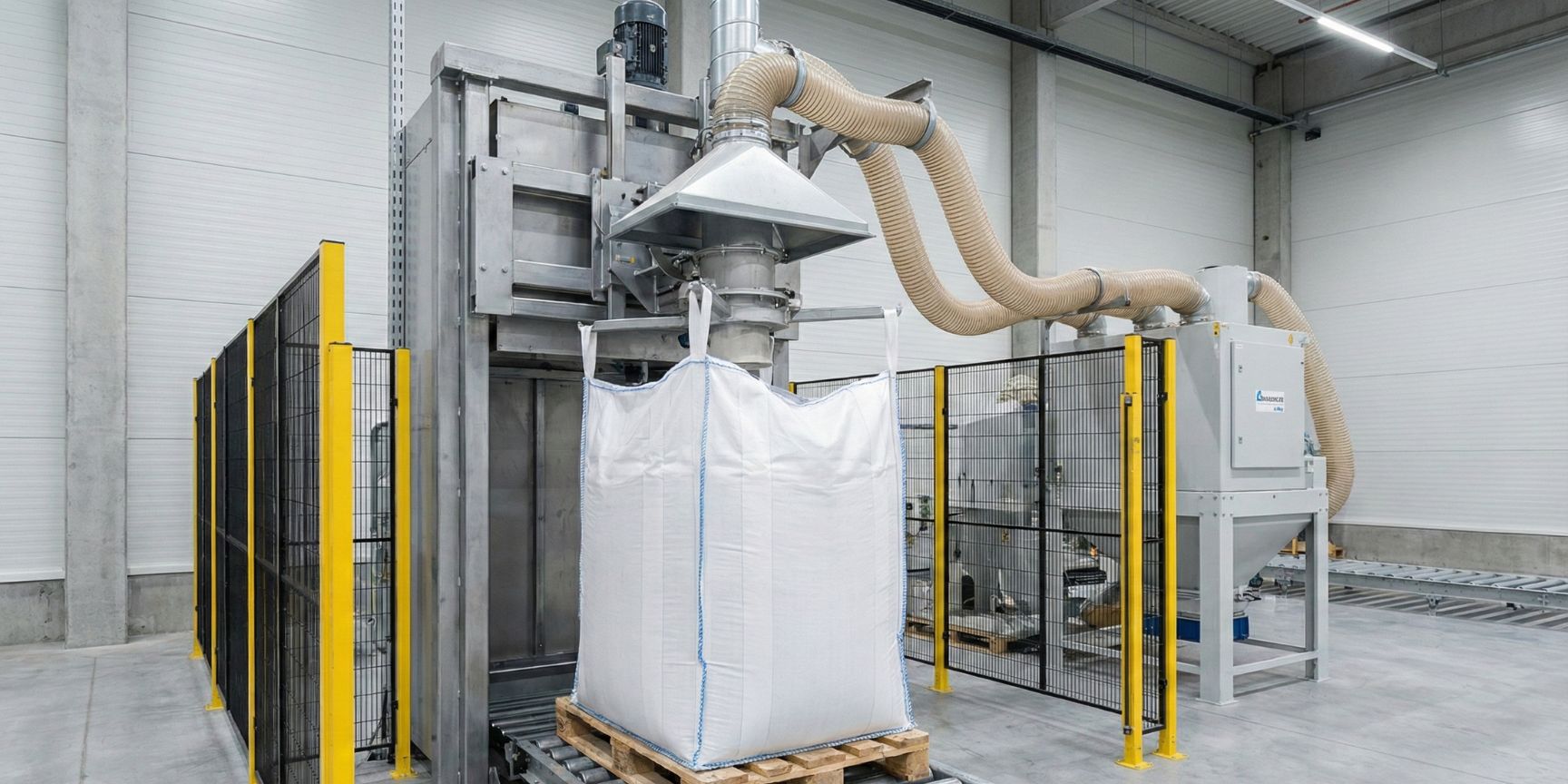
In contract logistics, the service provider often acts as an interface. It handles the transfer of silo trucks into big bags (silo transshipment) or the emptying of big bags to feed production plants. Dust protection and product protection play a role here. In food or chemical halls, clean room conditions or at least low-dust zones (inliner use) are often required. The use of inliners (PE film inside) protects the goods from moisture and prevents fine particles from escaping through the fabric.
FAQ: Practice-relevant questions and answers
Question: Can big bags be stored outdoors?
Answer: In principle, no, unless they are explicitly UV-stabilized. Untreated polypropylene becomes brittle under sunlight within a few weeks, which leads to a total loss of load-bearing capacity. Dark, cool storage is therefore standard in logistics properties.
Question: How many big bags fit in a standard truck?
Answer: With standard dimensions (cm) and palletizing, approx. 22 to 26 Big Bags (single-layer) or up to 52 (double-decker for stackable Q-Bags) can be transported.
Question: What needs to be considered when unloading in the hall?
Answer: Stacking ("block storage") is only permitted if the bags are dimensionally stable and have a safe surface. The employers' liability insurance association stipulates that the stacking height must not exceed three times the smallest side of the footprint unless stability is otherwise guaranteed.
Safety and dangerous goods (UN certification)
If big bags are used for hazardous substances, they must have UN approval. This classifies the bags according to substance groups (Y for medium danger, Z for low danger). Particularly important for the logistics hall: The marking must be visible at all times, and the staff must be trained in the handling of flexible containers, as pendulum movements during forklift transport can lead to accidents.
Summary of key figures (fact check)
| Feature | Detail |
| Material | 100% polypropylene (PP), recyclable |
| Payload (SWL) | Typically 500 kg to 2,000 kg |
| Volume | Mostly 0.5 to 2.0 |
| Safety Factor | 5-1 (Single-Trip), 6-1 (Multi-Trip) |
| Additional functions | Conductive (Type C/D), Dimensionally Stable (Q-Bag), UN-Tested |
Your Ideal Logistics Warehouse
Browse listings for warehouse space, logistics real estate, industrial land, and contract logistics solutions.
Browse Exposés
Maximize Exposure for Your Warehouse Space
Showcase your logistics properties and attract qualified inquiries.
Discover Products