




Buffer capacity in the warehouse
Table of Contents
- The Buffer Capacity in the Warehouse: The Invisible Engine of Logistics Performance
- What is buffer capacity? A definition
- The Golden 85 percent Rule: Why "Full" is Actually "Too Much"
- Buffer Capacity in Contract Logistics: Flexibility as a Commodity
- The Logistics Property: Structural Requirements for the Reserve
- Facts, Figures, Data: Calculating the Reserve
- FAQ: Frequently asked questions about Reserve Capacity
- Strategic Planning: Controlling the "Breath" of the Warehouse
- Conclusion: The Reserve Capacity as a Resilience Factor
The Buffer Capacity in the Warehouse: The Invisible Engine of Logistics Performance
Imagine a warehouse that is operating at 100% capacity. To the layman, this sounds like maximum efficiency. For the logistics expert, it is a nightmare. An overcrowded warehouse is at a standstill: processes are stalling, search times are exploding and the error rate is increasing. This is where the buffer capacity comes into play. It is the buffer that enables a logistics system to react to fluctuations without risking operational collapse.
What is Buffer Capacity? A Definition
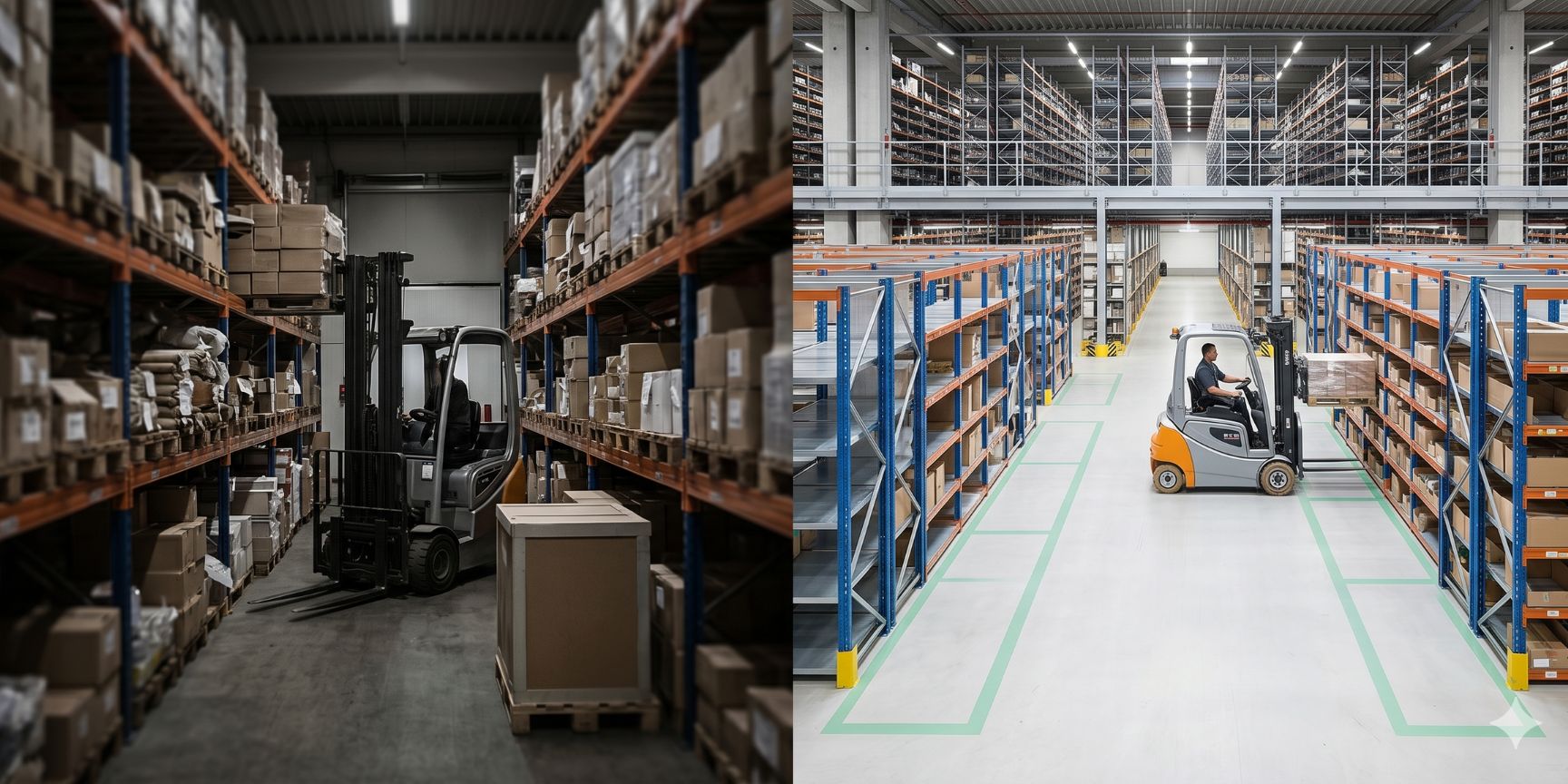
The buffer capacity (also known as reserve capacity) refers to the proportion of storage locations that is deliberately kept free to ensure operational flexibility. In warehouse logistics, it is the difference between the theoretical maximum capacity and the optimal work capacity. It acts as the "lung" of the bearing: it expands during peak times (e.g. seasonal business) and contracts during quieter phases.
The Golden 85 Percent Rule: Why "Full" is Actually "Too Much"
In warehouse logistics, a decisive guideline has been established: A warehouse is considered technically full from an occupancy of 80% to 85%.
Why is that?
- Relocation expenses: If there is no space for new goods, there must be constant reallocation ("rummaging expense").
- Throughput speed: Forklifts and order pickers need clear paths and transfer areas.
- Error prevention: In a fully grafted warehouse, the clarity decreases, which increases the error picking rate.
A buffer capacity of 15% to 20% is therefore not an empty space, but an investment in process speed.
Buffer Capacity in Contract Logistics: Flexibility as a Commodity
For contract logistics companies, the capacity reserve is a central component of service level agreements (SLAs). Service providers often have to guarantee that they remain able to deliver even in the event of unforeseeable volume jumps from their customers (e.g. due to marketing campaigns or supply chain delays).
In contract logistics, the reserve capacity is often contractually priced. A customer pays not only for the space occupied, but also for the provision of a capacity option. This is where the reserve becomes a strategic asset that makes the difference between a stable partner and a bottleneck service provider.
The Logistics Property: Structural Requirements for the Reserve
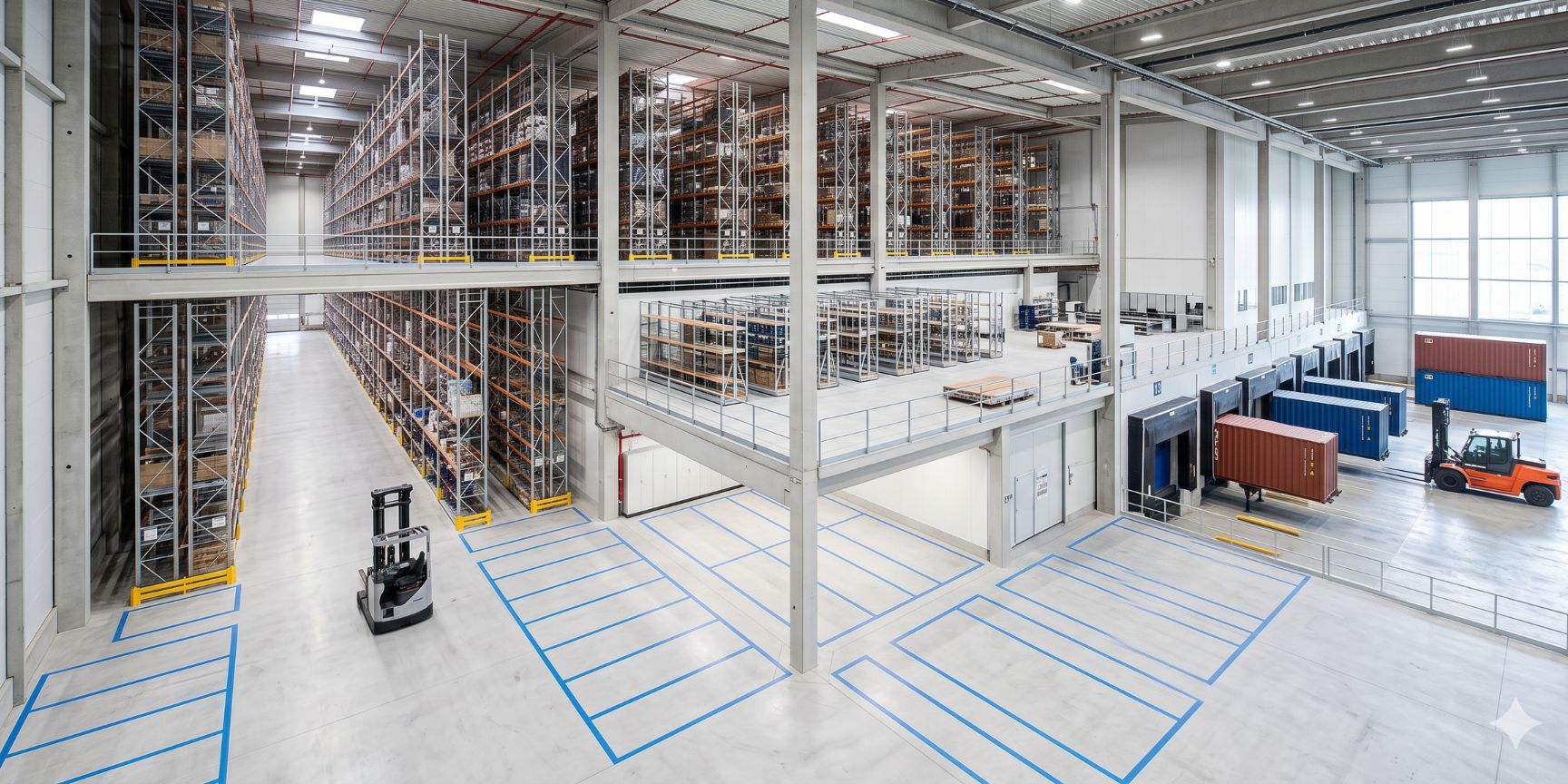
From the point of view of real estate development, the buffer capacity must already be taken into account in the planning phase. A modern logistics property "breathes" not only through shelves, but also through its architecture:
- Mezzanine areas: Additional levels can serve as short-term buffer areas.
- Hall height: Higher halls allow densification through narrow aisles (VNA - Very Narrow Aisle), which creates more reserve with the same footprint.
- Outdoor areas: Designated staging zones for containers or swap bodies act as an external buffer capacity.
Investors today increasingly value real estate according to its suitability for third-party use. A hall with a high reserve capacity and flexible zones is attractive for a wider range of tenants.
Facts, Figures, Data: Calculating the Reserve
In order to control the reserve capacity professionally, logistics managers use specific key figures.
If the degree of utilization is permanently above 90%, the reserve capacity is critically low. Experts also calculate the "peak-to-average" ratio. If the peak volume is 30% above average, the reserve capacity must be sized accordingly to avoid expensive outdoor rentals.
FAQ: Frequently asked questions about Reserve Capacity
Question: Doesn't a high buffer capacity cost money unnecessarily?
Answer: In the short term, yes, because there are fixed costs for unused space. In the long term, however, it is cheaper than the costs of process delays, express follow-up deliveries or the loss of customers due to inability to deliver.
Question: How can I increase the reserve capacity without building a new building?
Answer: Through process optimization such as slotting (optimal placement of fast-moving items) or the use of warehouse management systems (WMS), which dynamically optimize the use of space and minimize dead spaces.
Question: Does the reserve capacity also apply to automated warehouses?
Answer: Yes, even more strictly. Automatic warehouses (such as AKL or AutoStore) often have physical limits. If a system is 100% full, the algorithm loses the scope for optimization runs in the background.
Strategic Planning: Controlling the "Breath" of the Warehouse
Controlling the reserve is a balancing act. Too much reserve leads to high opportunity costs (dead capital), too little reserve leads to operational inefficiency.
Practical tip: Use an ABC analysis combined with the buffer capacity. Keep the reserve high, especially in the areas for A-items (fast-movers), as every blocked meter massively slows down the throughput.
Conclusion: The Reserve Capacity as a Resilience Factor
In times of just-in-time production and global disruptions, the reserve capacity in warehouse logistics has advanced from a "nice-to-have" to a critical success factor. It is the cushion that protects companies when the supply chain coughs. For operators of logistics properties and contract logistics companies, smart capacity planning does not mean maximum utilization of every square centimeter, but the strategic provision of space for growth and the unpredictable.
If you know your buffer capacity and manage it proactively, you secure a competitive advantage that goes far beyond pure warehousing. It is the freedom to be able to say "yes" to new orders while the competition is already struggling with a lack of space.

Your Ideal Logistics Warehouse
Browse listings for warehouse space, logistics real estate, industrial land, and contract logistics solutions.
Browse Exposés
Maximize Exposure for Your Warehouse Space
Showcase your logistics properties and attract qualified inquiries.
Discover Products