




Narrow-aisle racking in warehouse logistics
Table of Contents
- The Narrow-aisle Racking: Maximum Compaction in Modern Warehouse logistics
- Design and Functionality
- The Logistics Property as a Precision Tool
- Guidance Systems: Inductive vs. Mechanical
- Narrow-aisle Racks in Contract Logistics
- Fire Protection and Safety: Special Requirements
- Facts, Figures, Data: A Comparison
- Expert FAQ: Questions and Answers from Practice
- Conclusion for Practice
The Narrow-aisle Racking: Maximum Compaction in Modern Warehouse logistics
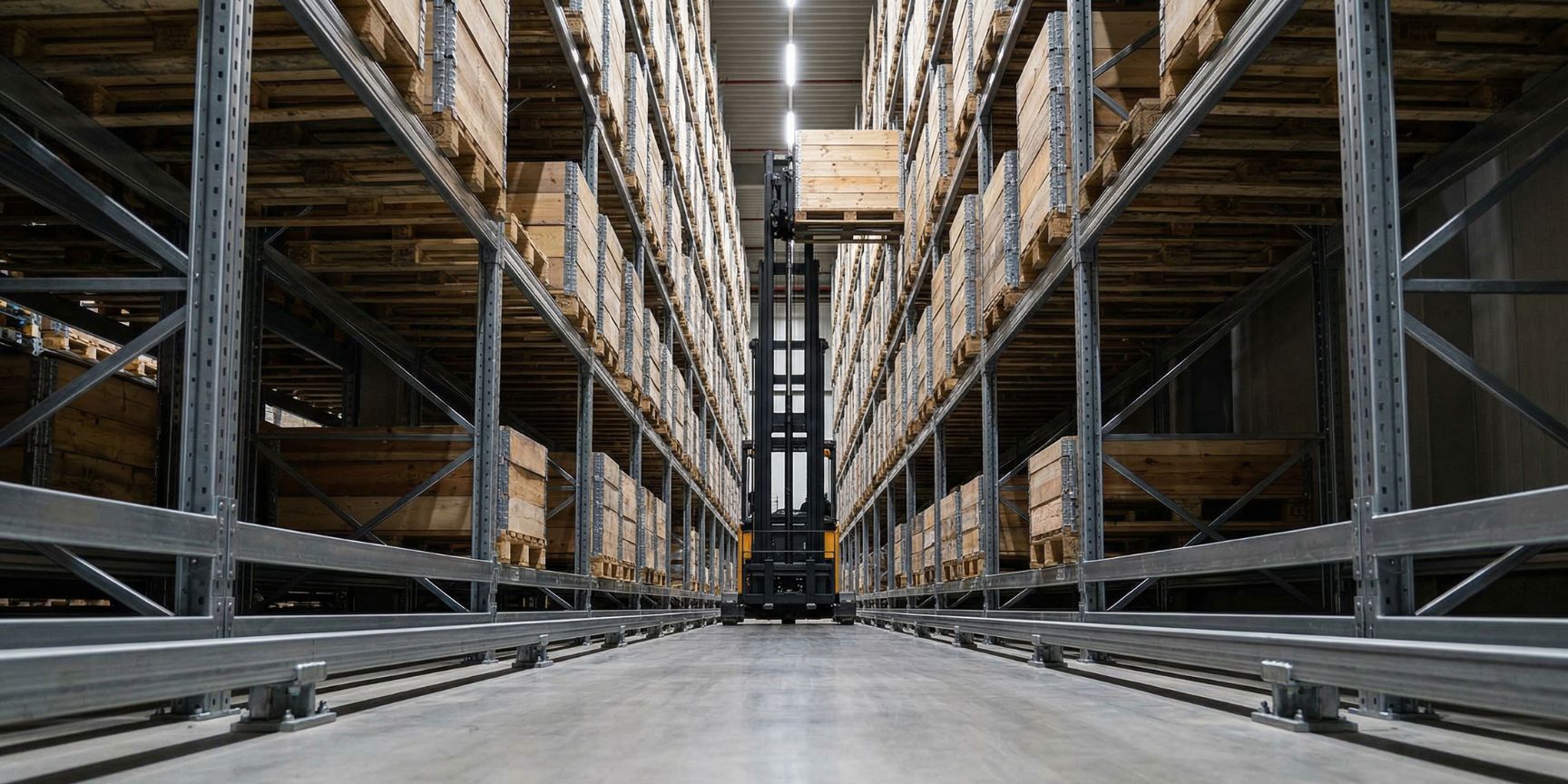
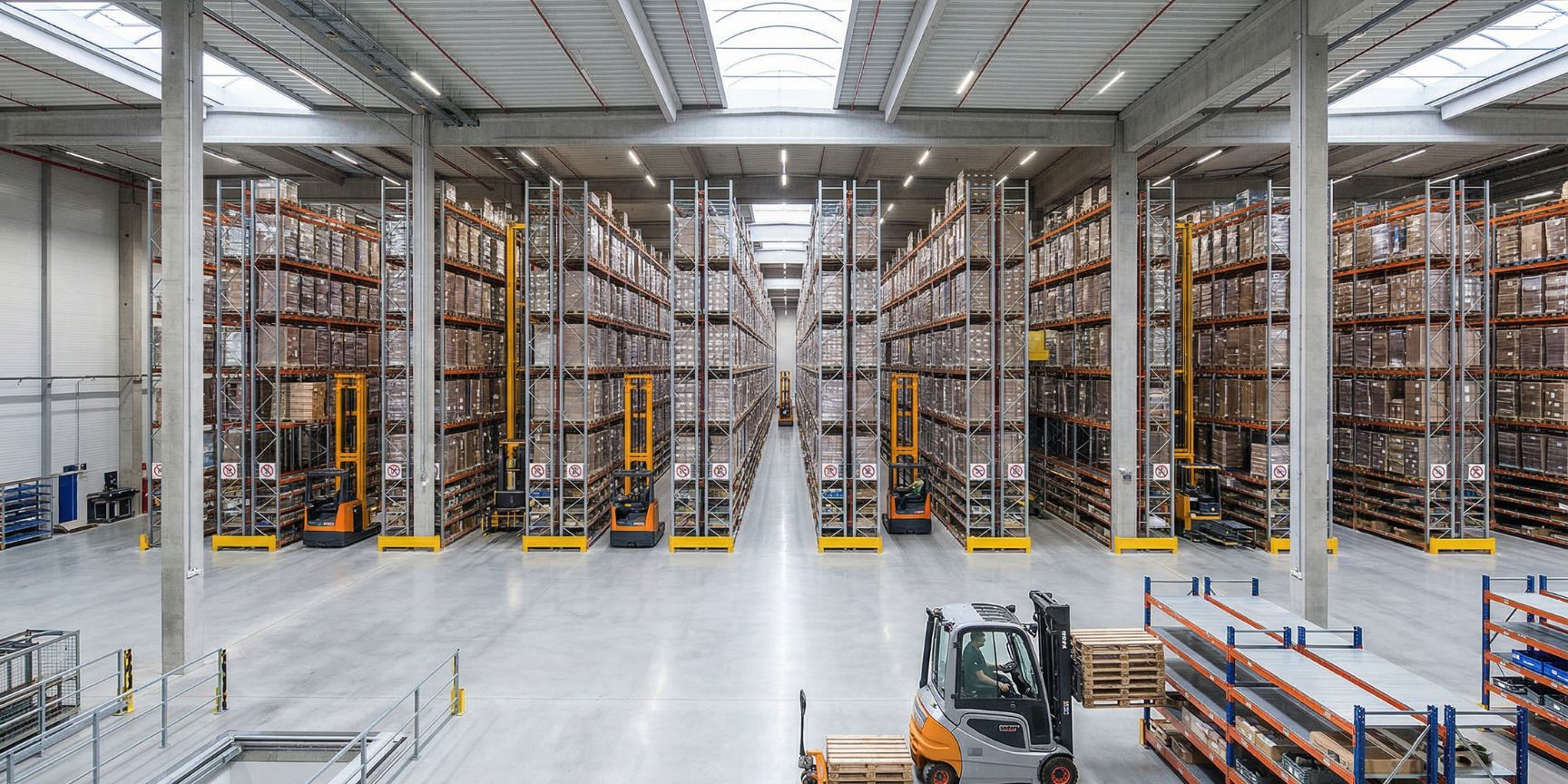
In the world of logistics real estate, space is the most precious commodity. While classic wide-aisle warehouses (aisle widths of approx. 3.30 m to 3.80 m) take up a lot of manoeuvring space for forklift trucks, the narrow-aisle rack (also known as VNA – Very Narrow Aisle) reduces the aisle width to a minimum of often only 1.40 m to 1.80 m. This allows the storage capacity to be increased by up to 40% on the same space.
Design and Functionality
At its core, a narrow-aisle racking system is a pallet racking system that is optimised for operation by specialised narrow-aisle forklifts (man-up or man-down devices). Since the forklifts cannot turn in the aisle, they have swivel push forks or telescopic forks that store and retrieve loads laterally.
The racking systems often reach heights of 12 to 18 meters. Due to these enormous leverage forces and the low tolerances in the aisle, the static calculation of a narrow-aisle rack is far more complex than with standard systems.
The Logistics Property as a Precision Tool
For developers and owners of logistics properties, a narrow-aisle warehouse is a technical challenge. Here, the hall itself becomes part of the machine:
- Soil conditions (DIN 18202 & VDMA 15185): This is the most critical point. Since narrow-aisle forklifts have hardly any suspension and work at great heights, any minimal unevenness in the ground leads to dangerous swaying of the mast. The floor must meet extreme flatness tolerances in accordance with VDMA guideline 15185 .
- Floor load capacity: The concentration of loads on narrow aisles and high shelves results in punctual loads of often over 10 to 15 tons per shelf support.
- Hall height: In order to exploit the cost advantages, VNA systems need a clear lower edge (UK) of at least 12 meters, ideally 15 meters+.
Guidance Systems: Inductive vs. Mechanical
Since the clearance between the forklift and the rack is often only a few centimetres, a narrow-aisle forklift cannot be steered freely. There are two primary guidance systems:
- Mechanical rail guidance: Angle rails are mounted on the floor, along which the forklift shimmys along with lateral guide rollers.
- Advantage: Cost-effective and robust.
- Disadvantage: Makes cleaning under the shelf more difficult and represents a tripping hazard.
- Inductive guide (wire control): A frequency wire laid in the ground provides the track. Sensors on the forklift hold the vehicle exactly in the middle.
- Advantage: Barrier-free floor, less wear and tear on the rollers.
- Disadvantage: Higher installation costs and dependence on electronics.
Narrow-aisle Racks in Contract Logistics
For contract logistics companies, the narrow-aisle warehouse is a double-edged sword. On the one hand, it provides the necessary storage density to offer competitive pallet prices. On the other hand, it is less flexible than a wide-aisle warehouse.
- Scalability: A change in the assortment structure (e.g. from Euro pallets to special dimensions) is difficult in narrow aisles, as the aisle widths are precisely matched to the loading equipment and the vehicle.
- Throughput: In a narrow aisle, only one vehicle can work in each aisle. This limits the pick rate during massive order peaks.
Fire Protection and Safety: Special Requirements
The combination of high storage density and narrow aisles requires specific fire protection concepts:
- In-rack sprinkling: Above a certain height, ceiling sprinkling is no longer sufficient. Sprinkler heads must be integrated directly into the shelf levels.
- Personal protection system (PPE): Since forklift drivers have hardly any escape options in the aisles, modern narrow-aisle devices are equipped with laser scanners that immediately initiate forced braking when people are detected in the aisle.
Facts, Figures, Data: A Comparison
| Feature | Wide aisle warehouse | Narrow-aisle warehouse (NAW) |
| Aisle width | 3.30 – 3.80 m | 1.40 – 1.80 m |
| Land use | approx. 40 - 45 % | approx. 60 - 75 % |
| Capital expenditure (CAPEX) | Low | High (because of forklift & floor) |
| Direct access | 100 % | 100 % |
| Throughput capacity | High (multiple trucks/aisle) | Medium (1 truck/aisle) |
Expert FAQ: Questions and Answers from Practice
Question: Can I simply convert an existing standard hall into a narrow-aisle warehouse?
Answer: Theoretically, yes, but in practice it often fails on the ground. If the floor slab does not have the necessary evenness (VDMA 15185), it must either be elaborately sanded or provided with a new leveling layer. In addition, the load capacity of the floor slab must be tested for the high point loads.
Question: Is automation worthwhile in narrow aisles?
Answer: Absolutely. Narrow-aisle warehouses are predestined for automation by automated guided vehicles (AGVs) or storage and retrieval machines, as the routes are firmly defined and the environment is highly standardized.
Question: What role does lighting play?
Answer: At a height of 15 meters, a lack of light is a safety risk. Narrow-beam LED lights are usually used here, which throw the light specifically onto the hall floor without dazzling the drivers with reflections on the rack sides.
Conclusion for Practice
The narrow-aisle rack is the ideal solution for logistics locations with high land prices and a high proportion of fast-moving pallet goods that require permanent access. If the high demands on the hall floor and fire protection technology are already taken into account in the planning phase of a logistics property, this system offers unbeatable space productivity.